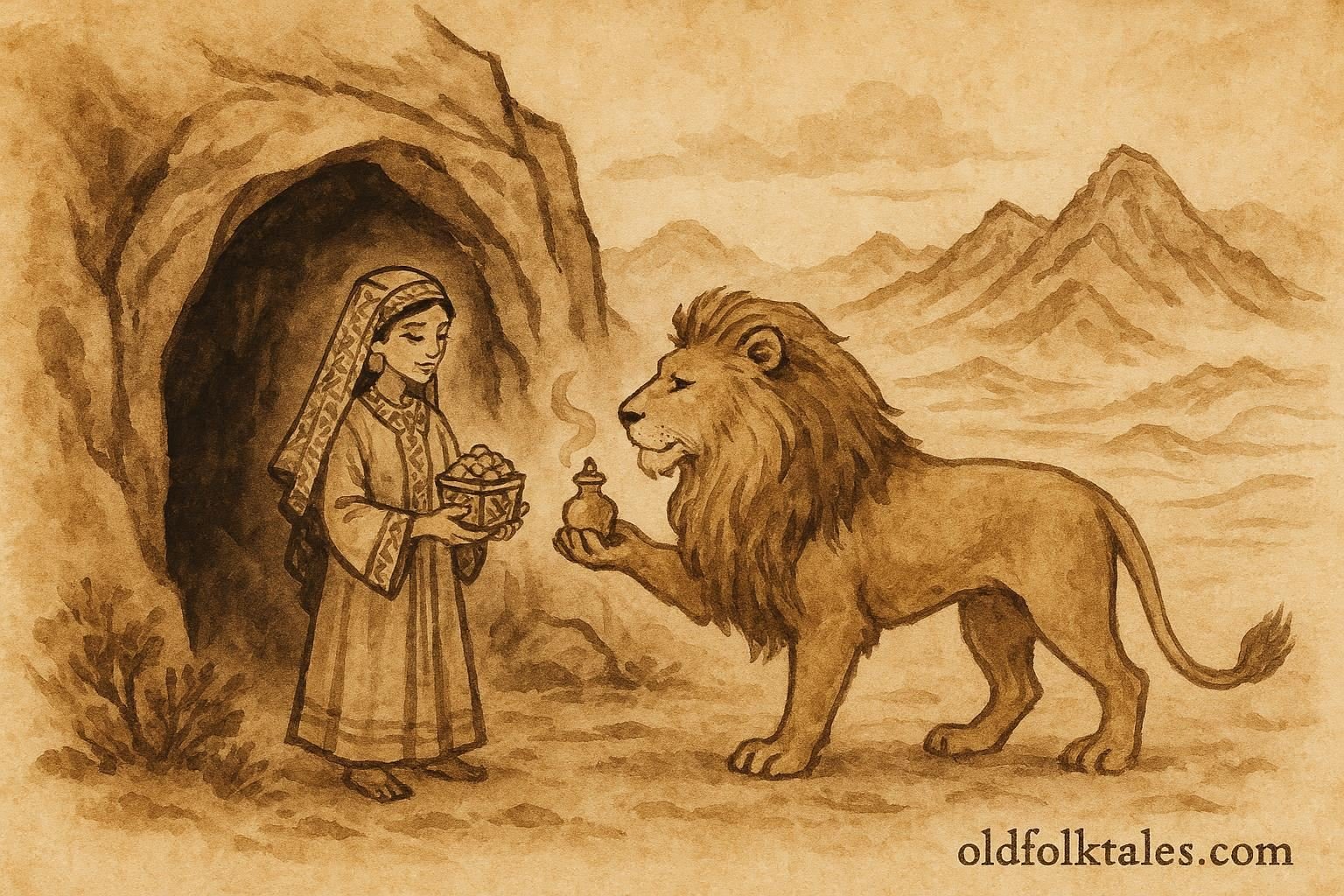
Nestled deep within the rugged, mist-touched mountains of the Asir region, there once lived a young woman named Dalal, renowned across neighboring villages for her beauty. Her eyes were dark and bright like polished obsidian, her hair long and flowing like a raven’s plume, and her presence carried an elegance that made many pause in admiration. Yet her beauty, often praised, had grown into vanity. Suitor after suitor came seeking her hand, farmers, merchants, hunters, even sons of respected elders, but Dalal found flaws in each. She mocked their appearances, laughed at their gifts, and dismissed their sincerity as if it were beneath her. Soon, people whispered that her pride rose higher than the mountain peaks themselves.
One afternoon, as the sun dipped low and cast warm amber light across the village, a strange hush fell upon the air. A lion, majestic, golden, and seemingly tame, approached Dalal’s home. His mane shimmered in the sunlight like threads of fire, and his steps were steady, deliberate, and without menace. To the astonishment of villagers who watched from afar, the lion carried precious gifts: gold, rare myrrh, and woven fabrics scented with the winds of far-off deserts.
He laid the treasures before Dalal’s door.
Instead of fear, she felt a thrill of fascination. Such a creature, powerful and beautiful, seemed more worthy than any man who had come before. Her pride whispered: Only someone truly extraordinary deserves me. And so, with barely a moment’s hesitation, Dalal agreed to marry him.
The villagers protested in disbelief, begging her to reconsider, but Dalal waved them away, eager to step into what she imagined was a life of grandeur. The lion led her across rocky trails and into the mountains, to a secluded cave hidden behind a curtain of vines. Surprisingly warm and illuminated by flickering torches, the cave felt less like a lair and more like a secret dwelling.
That night, under the glow of dancing firelight, the lion stepped back and shook his body. Slowly, his golden skin peeled away, slipping to the ground like a discarded cloak. Before Dalal stood a powerful jinn prince, his form tall and radiant, with eyes that glowed like embers. His voice echoed with both strength and sorrow as he revealed the truth: he had been cursed to live in the form of a lion, bound to wear the skin until the day the curse ran its course.
He placed a gentle hand on her shoulder.
“You must never burn the lionskin,” he warned. “It is the key to my being. Without it, the covenant that binds me to this world will shatter.”
Dalal, still entranced by his beauty and power, agreed.
Years passed, and the couple lived in harmony. The jinn prince treated Dalal with tenderness and wisdom, teaching her humility, patience, and the quiet magic of the mountains. She learned to gather herbs, to read the rhythm of shifting winds, and to listen to the whisper of spirits moving across the valleys. Her vanity softened into gratitude, and for the first time, she understood the value of a heart that was true.
But the lionskin remained. Coiled in a corner of their cave, it served as a reminder of a bond she didn’t fully understand. To Dalal, it seemed like a prison that kept her husband tied to a form he no longer needed. Over time, a new thought took root, perhaps burning it would free him completely. Perhaps it would grant them a life without shadows of old curses.
One afternoon, while the prince was away, Dalal approached the lionskin. She hesitated, recalling his warning, but her desire to “help”, and her lingering belief that she knew best, overwhelmed her judgment. She carried the skin outside the cave, built a fire of dry cedar branches, and placed the lionskin atop the flames.
It shriveled instantly, releasing a harsh, metallic scent that stung the air. The fire roared unnaturally high, as though consuming more than flesh or fur. Dalal stepped back, startled.
A moment later, a terrible cry echoed through the mountains.
The jinn prince burst into the clearing, agony twisting his features. His voice was thunder as he cried, “You have broken the covenant!”
Before Dalal’s eyes, his luminous form cracked with light. Wings of shimmering feathers burst from his back, and his body shifted into that of a hawk, swift and fierce. With a single, sorrowful look, equal parts love and despair, he rose into the sky and disappeared beyond the clouds.
Dalal fell to her knees, the ashes of the lionskin swirling around her. She called his name until her voice broke, but the mountains answered only with silence.
From that day on, the people of the Asir region passed down the tale of the girl who married a lion, a story of beauty, pride, enchantment, and the irreversible cost of breaking sacred trust.
Moral of the Story
The tale teaches that arrogance blinds judgment, and that impulsive decisions, even those meant to help, can destroy the bonds we hold most dear. Wisdom grows from humility, and sacred promises must never be taken lightly.
Knowledge Check
1. What is the main lesson in “The Girl Who Married a Lion”?
It warns against arrogance and impulsive actions that break sacred trust.
2. Why did Dalal marry the lion in the Asir folktale?
She married him out of vanity and fascination with his majestic appearance and lavish gifts.
3. What was the true identity of the lion husband?
He was a jinn prince cursed to live inside a lionskin.
4. Why was burning the lionskin forbidden in the story?
Because the skin maintained the magical covenant binding the jinn to his human form.
5. What transformation occurs at the end of the folktale?
The jinn prince turns into a hawk after the covenant is broken.
6. What cultural region does “The Girl Who Married a Lion” come from?
It originates from the Asir region of southwestern Arabia.
Source
Adapted from the Asir regional folktale “The Girl Who Married a Lion,” collected by the Saudi Oral History Project (Recordings from Khamis Mushait) and analyzed on Mythology.com.