In a quiet Uzbek village surrounded by sun-baked fields and apricot orchards, there lived a humble farmer. His life was simple, tilling dry earth, tending his few goats, and sharing what little he had with neighbours. Though poor in coin, he was rich in heart and never refused a creature in need.
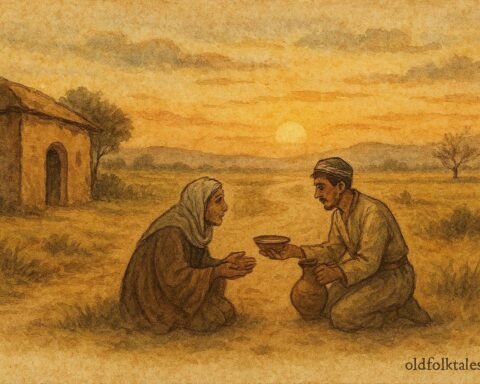
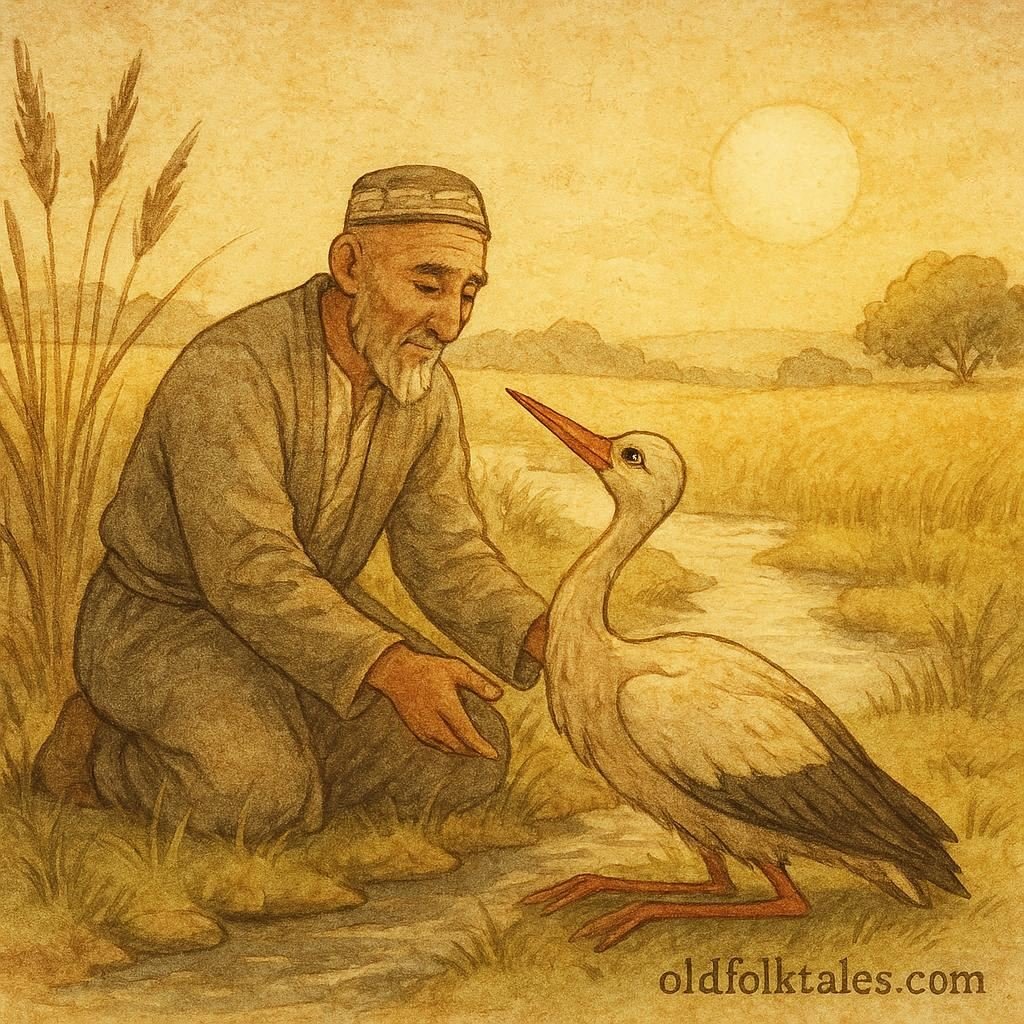
One morning, as he walked to his field beside a small stream, he saw a stork lying motionless among the reeds. Its wing was twisted, and its feathers were muddied with dust. The farmer lifted the bird gently, cleaned its wound, and carried it home. Day after day, he fed it grains and water, bound its wing with soft cloth, and sheltered it near the hearth until it healed.
Discover more East Asian Folktales from the lands of dragons, cherry blossoms, and mountain spirits.
When spring returned and the stork could again lift its wings, the farmer released it into the bright sky. The bird circled above his hut three times, as if offering thanks, before flying away toward the southern horizon. The farmer smiled, content that he had simply done what was right.
Weeks later, as he worked in his field, a shadow crossed the sun. Looking up, the farmer saw the same stork gliding down with a bundle held in its beak. It landed softly before him and dropped three small, shining seeds at his feet. Then, with a cry that sounded almost like human speech, it soared away once more.
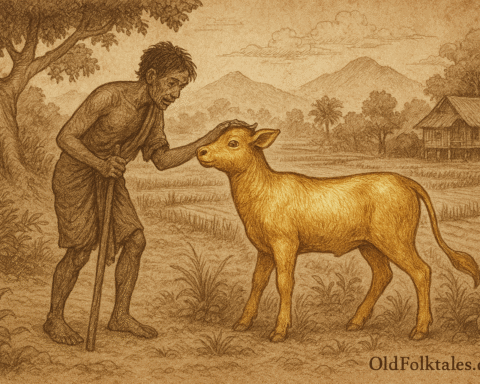
The farmer, puzzled but trusting, planted the seeds near his hut. He watered them each morning, and within days, green vines crept across the ground, bearing blossoms of white and gold. When the fruits ripened, they gleamed faintly under the sun, watermelons streaked with golden lines.
Curious, the farmer cut one open, and to his astonishment, the melon was filled not with pulp but with glittering coins of pure gold. His eyes widened in disbelief. The other two melons held the same.
With this miraculous gift, he repaired his roof, shared grain and clothing with the poor, and offered food to travelers passing through the village. Yet he did not grow proud. He continued to plough his fields with the same care as before, greeting each dawn with gratitude.
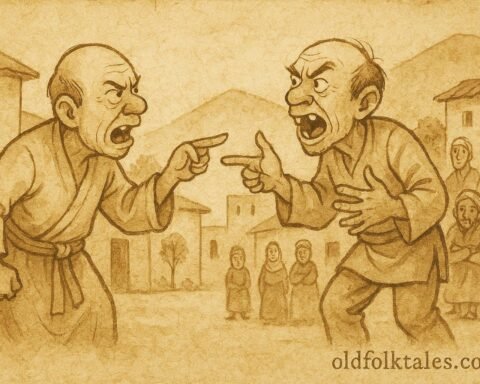
But not everyone shared his humility. His next-door neighbour, a wealthy but covetous man, grew restless watching the farmer’s good fortune. He demanded to know how such wealth had come from mere melons. The kind farmer, suspecting no malice, told him the truth, how he had found and cared for a wounded stork, and how it had later returned with seeds of gold.
The greedy neighbour scoffed but quickly hatched a plan. The next day, he went out searching near the same stream. There, he caught a stork in a net, not injured, but struggling to break free. Instead of showing mercy, the man cruelly clipped the bird’s wing, locking it inside a cage. He shouted, “Now, bird, bring me golden seeds as you did for that fool of a farmer, or you shall never see the sky again!”
Days passed. The poor creature grew weak, its feathers dull with fear. When at last it could bear no more, the stork flapped painfully and escaped through a hole in the roof, flying off into the distance. The man cursed after it, throwing stones.
Yet a week later, he found three strange seeds lying near his door, dull and dark like burnt ash. Believing them to be the same kind of magic seeds, he planted them greedily. The vines grew quickly, and within days, heavy watermelons swelled on the ground. Laughing with triumph, he rushed to open one.
But instead of gold, a coil of snakes burst forth, hissing and striking at him. The second melon cracked open with sharp stones that shattered his jars, and the third released a stench so foul that his crops withered. In terror, the man fled his farm, never to return.
From that day, the villagers remembered the lesson. The kind farmer’s gold served not only to ease his life but also to feed the poor. The greedy man’s punishment reminded everyone that cruelty poisons even the richest soil.
Moral Lesson
This story teaches that compassion and sincerity invite blessings, while greed and cruelty bring destruction. The farmer’s kindness to a helpless creature restored harmony with nature, while his neighbour’s selfishness destroyed it. True wealth lies not in gold, but in a good heart.
Knowledge Check
1. Who are the main characters in “The Gold Watermelon”?
The humble farmer who helps the stork and his greedy neighbour who imitates him.
2. What act of kindness begins the story’s events?
The farmer rescues and nurses an injured stork back to health.
3. What magical gift does the stork bring the farmer?
Three golden seeds that grow into melons filled with gold.
4. What happens when the greedy neighbour tries to copy the farmer?
His mistreated stork brings cursed seeds that produce snakes and stones instead of gold.
5. What moral lesson does the tale teach?
Kindness and sincerity bring blessings; greed and cruelty bring misfortune.
6. From which region and culture does this folktale originate?
It comes from rural Uzbek oral tradition, especially from the Bukhara and Samarkand regions of Uzbekistan.
Source: From Kazakh and Uzbek Folk Tales (University of Washington Folklore Collection).
Region of Origin: Uzbekistan, Bukhara and Samarkand regions.