
The sun hung low over the rice paddies, casting long shadows across the dusty path that led to the village well. It was here, in this humble corner of the Indonesian countryside, that a poor villager named Pak Joko made his daily journey to fetch water for his family. His clothes were patched and worn, his sandals held together with twine, and his stomach often growled with hunger. Yet Pak Joko never complained he accepted his lot in life with quiet resignation.
On this particular evening, as the golden light of dusk painted the sky in shades of amber and rose, something caught his eye near the base of the ancient well. Half-buried in the damp earth, glinting with an otherworldly brilliance, lay a golden bracelet. Pak Joko’s heart leaped in his chest. He glanced around nervously, but the area was deserted. Everyone had already collected their water for the day.
Click to read all East Asian Folktales — including beloved stories from China, Japan, Korea, and Mongolia.
With trembling hands, he reached down and pulled the bracelet from the soil. It was exquisite intricately carved with symbols he didn’t recognize, surprisingly heavy, and radiating a warmth that seemed almost alive. In his entire life of poverty, Pak Joko had never held anything so valuable. His mind raced with possibilities. This bracelet could feed his family for months, perhaps even years. He could repair his house, buy new clothes for his children, and finally hold his head high among his neighbors.
Without a moment’s hesitation, he slipped the golden bracelet into his pocket and hurried home, the water bucket sloshing forgotten in his other hand.
That night, Pak Joko hid the bracelet beneath a loose floorboard in his modest home. He told no one not even his wife about his discovery. As he lay in bed, unable to sleep, the bracelet seemed to pulse with a strange energy beneath the wooden planks, but he dismissed his unease as mere excitement.
The troubles began the very next morning.
Pak Joko’s youngest son developed a fever that left him writhing and crying out in his sleep. By midday, their only goat the animal that provided milk for the family collapsed and died for no apparent reason. That evening, the roof of their house began to leak despite there being no rain, and strange scratching sounds echoed through the walls after dark.
Within three days, word had spread throughout the village about Pak Joko’s sudden string of misfortunes. Neighbors whispered behind cupped hands, and soon the whispers grew into accusations. Old Bu Siti, the village elder, claimed she had seen someone lurking near her home the night her silver ceremonial bowl went missing. Eyes turned toward Pak Joko’s family with suspicion and contempt.
“Perhaps he has angered the spirits,” some said.
“Or perhaps he is a thief who has brought a curse upon himself,” others muttered darkly.
Pak Joko’s wife noticed the change in her husband. He was jumpy, irritable, and refused to meet anyone’s gaze. Dark circles formed under his eyes from sleepless nights. The children grew thin and pale, and an oppressive atmosphere settled over their home like a heavy blanket.
Finally, on the seventh night, Pak Joko could bear it no longer. He lay awake in the darkness, listening to his sick son’s labored breathing, when he heard it a woman’s voice, soft yet commanding, seeming to emanate from the earth itself.
“Return what is mine,” the voice whispered, echoing through the floorboards. “Return what was never yours to take.”
Terror seized Pak Joko’s heart. With shaking hands, he retrieved the golden bracelet from its hiding place. Even in the darkness, it seemed to glow with an eerie light. He knew then, with absolute certainty, what he must do.
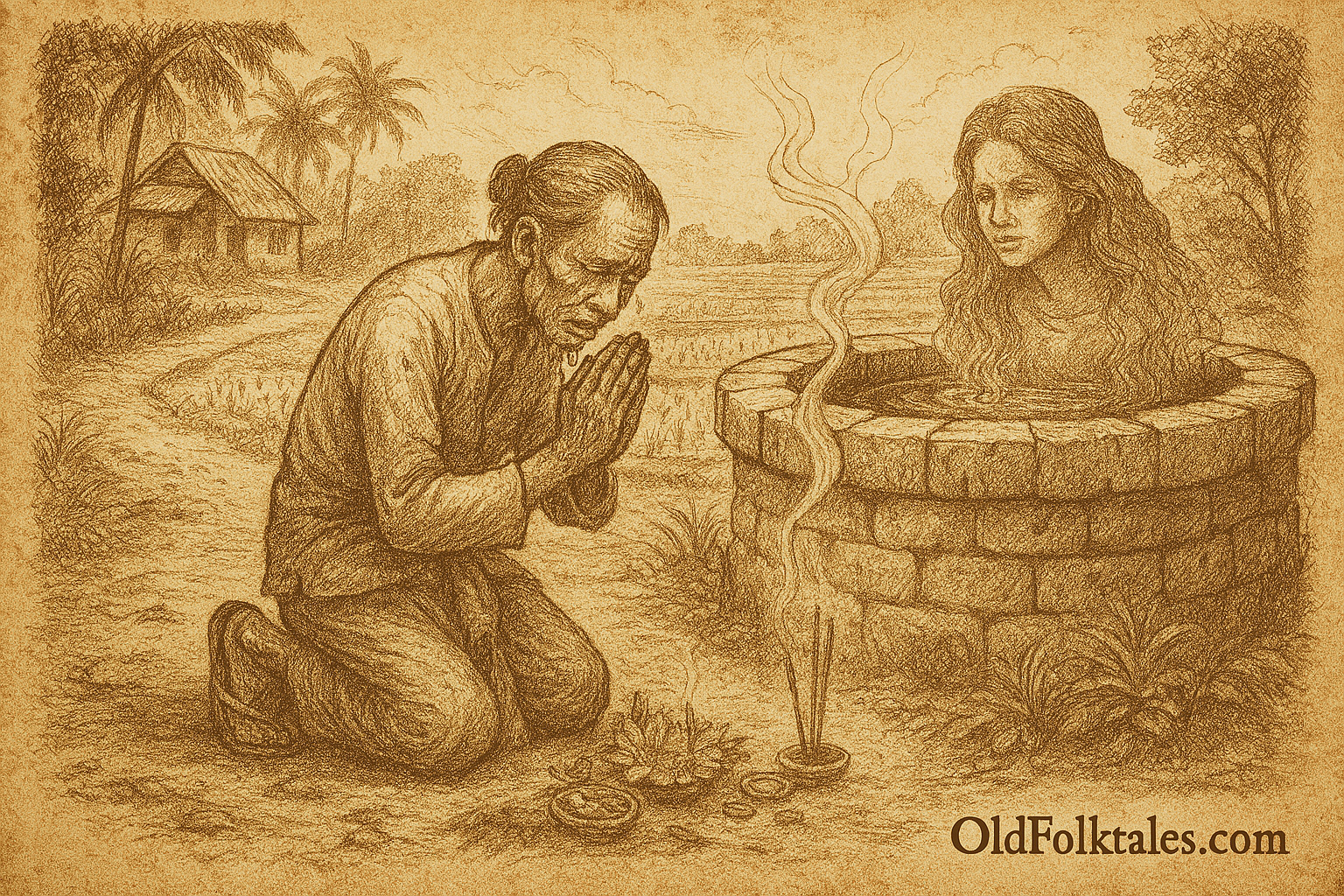
Before dawn broke, Pak Joko made his way to the ancient well. He carried the bracelet wrapped in clean white cloth, along with offerings he had hastily prepared flowers from his meager garden, incense he had borrowed from a neighbor, and a handful of rice from their dwindling stores.
As he approached the well, the air grew thick and heavy. Pak Joko fell to his knees at the water’s edge, tears streaming down his weathered face.
“Forgive me, spirit guardian,” he cried out, his voice breaking with emotion. “I did not know. I did not understand. Please, accept the return of your sacred possession and spare my family from further suffering.”
He performed the proper rituals as best as he could remember from the ceremonies he had witnessed in his youth burning the incense, scattering the flower petals, and bowing deeply three times. Then, with reverent care, he unwrapped the golden bracelet and lowered it back into the well.
The moment the bracelet touched the water’s surface, the oppressive atmosphere lifted. A gentle breeze stirred the leaves of the surrounding trees, and somewhere in the distance, a bird began to sing. The water in the well began to glow with a soft, golden light, and for just a moment, Pak Joko thought he saw the face of a beautiful woman looking up at him from the depths her expression stern yet forgiving.
When Pak Joko returned home, he found his son’s fever had broken. The strange sounds in the walls had ceased, and a sense of peace had returned to their humble dwelling. Though they remained poor, the family’s health was restored, and their neighbors’ suspicions gradually faded.
Pak Joko never spoke of the golden bracelet again, but he visited the well each week to leave small offerings of flowers and thanks. He had learned a profound lesson about the difference between poverty of pocket and poverty of spirit, and he vowed never again to let greed cloud his judgment or lead him to disrespect the sacred.
Click to read all Southeast Asian Folktales — featuring legends from Thailand, Indonesia, Vietnam, and the Philippines.
The Moral Lesson
The tale of Bilai Amas teaches us that true wealth lies not in material possessions obtained through questionable means, but in living with integrity and respect for the sacred. Greed can blind us to the consequences of our actions, leading to suffering far greater than the poverty we seek to escape. When we take what doesn’t belong to us especially objects of spiritual significance, we disturb the balance between the physical and spiritual worlds, inviting misfortune upon ourselves and those we love. The story reminds us to honor sacred places and objects, to resist the temptation of easy gain, and to understand that some treasures are meant to remain untouched, serving purposes far greater than our immediate desires.
Knowledge Check
Q1: Who is Pak Joko in the Indonesian golden bracelet story? A: Pak Joko is a poor villager who discovers the golden bracelet near an ancient well. He represents the common person who faces the moral test of choosing between material gain and spiritual respect. His character arc shows transformation from greed-driven desperation to humble understanding of sacred boundaries.
Q2: What does the golden bracelet symbolize in this Indonesian folk tale? A: The golden bracelet symbolizes sacred objects that belong to the spiritual realm and should not be taken by humans. It represents the boundary between the material and spiritual worlds, and serves as a test of human character, revealing how greed can overcome good judgment and lead to suffering.
Q3: Why did misfortune befall Pak Joko’s family after taking the bracelet? A: The misfortunes (including his son’s fever, the goat’s death, and strange occurrences in the house) were spiritual consequences of disturbing a sacred object belonging to the well’s guardian spirit. These events served as warnings that Pak Joko had violated spiritual laws by taking something that was never meant for human possession.
Q4: Who is the spirit guardian of the well in the Bilai Amas story? A: The spirit guardian is a supernatural being who protects the ancient well and owns the golden bracelet. She manifests through a voice calling for the bracelet’s return and briefly appears as a beautiful woman in the well’s water, representing the spiritual forces that govern sacred places in Indonesian folklore.
Q5: What is the cultural significance of wells in Indonesian folk tales? A: In Indonesian folklore, wells are often considered sacred liminal spaces where the physical and spiritual worlds intersect. They are believed to be protected by guardian spirits and require respectful treatment. Taking objects from or near sacred wells is seen as a violation of spiritual boundaries that can bring misfortune.
Q6: What rituals does Pak Joko perform to return the golden bracelet? A: Pak Joko performs traditional Indonesian purification rituals including wrapping the bracelet in clean white cloth, bringing offerings of flowers and incense, scattering rice, burning incense, and bowing three times (all gestures of respect and repentance meant to appease the spirit guardian and restore spiritual balance).
Cultural Origin: Indonesian archipelago, particularly Java and Sunda regions.








