
Long ago, in a quiet village nestled among the lush rice paddies and volcanic mountains of Java, there lived a humble couple whose hearts ached with longing. They had everything they needed, a small but comfortable home, fertile land, and good health, yet their greatest wish remained unfulfilled. They longed desperately for a child to fill their home with laughter and love.
Years passed, and their hope began to fade like morning mist under the tropical sun. They prayed at temples, made offerings, and consulted village elders, but still, no child came. Their neighbors’ children grew tall and strong, while their own home remained silent and empty.
Click to read all Southeast Asian Folktales — featuring legends from Thailand, Indonesia, Vietnam, and the Philippines.
One day, as the wife worked alone in her garden, tending to the vegetables and herbs that grew in neat rows, a massive shadow fell across the ground. She looked up in terror to see an enormous giant towering above her fence. His body was as tall as the coconut palms, his face weathered and ancient, and his eyes gleamed with an unsettling intelligence.
“Do not be afraid,” the giant rumbled, his voice like distant thunder. “I know of your sorrow. I can give you what you desire most, a child.”
The woman’s heart leaped with hope, even as fear gripped her. “How?” she whispered.
The giant reached into a pouch at his side and produced a single golden cucumber seed. It shimmered with an otherworldly light, warm and pulsing as if alive. “Plant this seed in your garden. Care for it well. When the cucumber ripens, cut it open, and you will find your daughter. But remember, there is a price. When the child reaches her seventeenth year, she will belong to me.”
Desperation clouded the woman’s judgment. Without fully considering the terrible bargain, she agreed. The giant disappeared as suddenly as he had arrived, leaving only enormous footprints in the soft earth and the magical seed gleaming in her palm.
She and her husband planted the seed that very afternoon, watering it with trembling hands. To their amazement, a vine sprouted overnight, growing with supernatural speed. Within days, a magnificent cucumber hung from the vine, larger than any they had ever seen, glowing with a soft golden light that illuminated their garden even at night.
When the cucumber was fully ripe, they carefully cut it open. Inside, nestled among the seeds like a precious jewel, lay a beautiful baby girl. Her skin was smooth and golden-hued, her eyes bright and alert. Tears of joy streamed down their faces as they lifted her from the fruit. They named her Timun Mas, Golden Cucumber, in honor of her miraculous birth.
The years that followed were the happiest of their lives. Timun Mas grew into a clever, kind-hearted girl with a spirit as bright as her name. She helped her mother in the kitchen, grinding spices and rolling out rice flour for cakes. She assisted her father in the fields, learning to plant rice seedlings in straight rows. Her laughter rang through their home like music, and for a time, they almost forgot the terrible promise they had made.
But as Timun Mas approached her seventeenth birthday, dread settled over her parents like a heavy fog. They could no longer hide the truth from their beloved daughter. One evening, as the sun set behind the mountains, painting the sky in shades of orange and crimson, they told her everything about their desperate wish, the giant’s offer, and the price they had agreed to pay.
Timun Mas listened quietly, her face pale but determined. “Do not worry,” she said, embracing her weeping parents. “I will not let the giant take me. There must be a way.”
Her parents sought help from a wise hermit who lived deep in the forest, a holy man known for his knowledge of magic and spirits. After hearing their story, the hermit nodded solemnly and gave them four small pouches containing magical items: cucumber seeds, sharp needles, salt, and fermented shrimp paste terasi, a pungent ingredient common to every Javanese kitchen.
“When the giant comes,” the hermit instructed, “Timun Mas must run. When he draws close, she must throw these items behind her, one at a time. Each will create an obstacle to slow him down.”
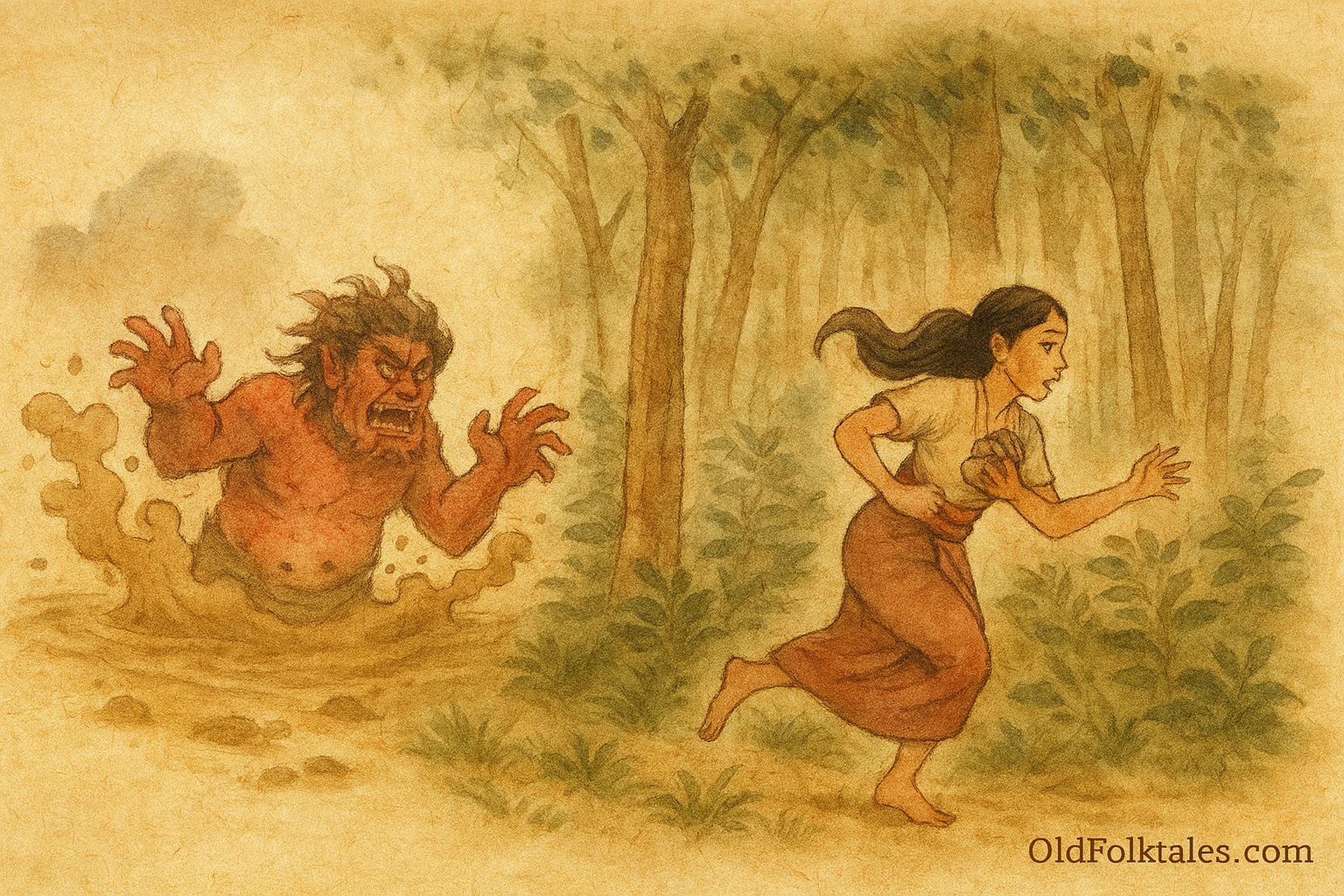
On the morning of her seventeenth birthday, the ground began to shake. The giant had returned to claim his prize, his footsteps causing the earth to tremble and birds to flee from the trees in panic. Timun Mas kissed her parents goodbye, tucked the four pouches into her sarong, and ran into the forest as fast as her legs could carry her.
The giant roared with rage when he discovered she had fled. He crashed through the trees, easily following her trail. When Timun Mas heard him gaining on her, she threw the first pouch, the cucumber seeds behind her.
Instantly, a vast field of cucumber vines erupted from the ground, their thorny stems tangling into an impenetrable wall. The giant struggled through, tearing at the vines, but this gave Timun Mas precious time to increase her lead.
Soon she heard him crashing through the undergrowth again. She threw the needles. They transformed into a forest of sharp bamboo spears, pointing in every direction. The giant roared in pain as the spears pierced his feet and legs, but still he pressed forward, his determination fueled by fury.
Next, Timun Mas scattered the salt. A vast ocean materialized, its waters deep and churning with waves. The giant waded through, the salt water stinging his wounds, his angry bellows echoing across the water. But he was strong and relentless, and eventually he reached the far shore.
By now, Timun Mas was exhausted, her lungs burning and her legs trembling. She could hear the giant’s heavy breathing behind her, feel the vibration of his footsteps. With her last strength, she threw the final pouch—the shrimp paste.
The fermented terasi exploded into a boiling mud lake, thick and bubbling, releasing sulfurous fumes that filled the air. The giant stepped into the scalding mud and immediately began to sink. He thrashed and struggled, but the more he fought, the deeper he sank. With a final, terrible cry, the giant disappeared beneath the surface, consumed by the magical mud.
Silence fell over the forest. Timun Mas stood gasping for breath, hardly daring to believe she was safe. When she was certain the giant was truly gone, she made her way back home, where her parents waited in anguished hope.
When they saw her emerging from the forest, alive and free, they ran to embrace her with tears of joy and relief. The terrible debt was paid, not with Timun Mas’s life, but with her courage and cleverness. The family lived together in peace and happiness for the rest of their days, forever grateful for the second chance they had been given.
Journey through enchanted forests and islands in our Southeast Asian Folktales collection.
The Moral of the Story
The tale of Timun Mas teaches us that bravery and resourcefulness can overcome even the most fearsome obstacles. When faced with impossible odds, quick thinking and determination can save us. The story also reminds us that shortcuts and desperate bargains often carry hidden costs, and that true strength comes from family love and support. Timun Mas’s parents may have made a foolish promise, but their love for their daughter gave her the courage to fight for her freedom.
Knowledge Check
Q1: How was Timun Mas born in this Indonesian folktale?
A1: Timun Mas was born from a magical golden cucumber given to a childless couple by a giant. When the cucumber ripened and was cut open, they found a baby girl inside, whom they named Timun Mas, meaning “Golden Cucumber.”
Q2: What price did the couple promise to pay the giant in the Javanese folktale?
A2: The couple promised that when their daughter reached her seventeenth birthday, she would belong to the giant. This was the price for receiving the magical cucumber that produced their child.
Q3: What four magical items did Timun Mas use to escape the giant?
A3: Timun Mas used four magical items: cucumber seeds (which created a thorny vine forest), needles (which became sharp bamboo spears), salt (which transformed into an ocean), and shrimp paste or terasi (which became a boiling mud lake).
Q4: What do the magical obstacles in the Timun Mas story symbolize?
A4: The magical obstacles symbolize resourcefulness and the power of using simple, everyday items (common to Javanese culture) in clever ways. They represent how intelligence and preparation can overcome brute strength and help the weak defeat the powerful.
Q5: What is the cultural origin of the Timun Mas folktale?
A5: Timun Mas is a traditional folktale from Java, Indonesia. It is one of the most popular Indonesian legends and reflects Javanese cultural elements, including the use of traditional ingredients like terasi (fermented shrimp paste).
Q6: What lesson does the Timun Mas legend teach about family and bravery?
A6: The legend teaches that family love provides strength in difficult times, and that bravery combined with cleverness can overcome seemingly impossible challenges. It also warns against making desperate bargains without considering the consequences.
Source: Indonesian folktale from Java, Indonesia








