
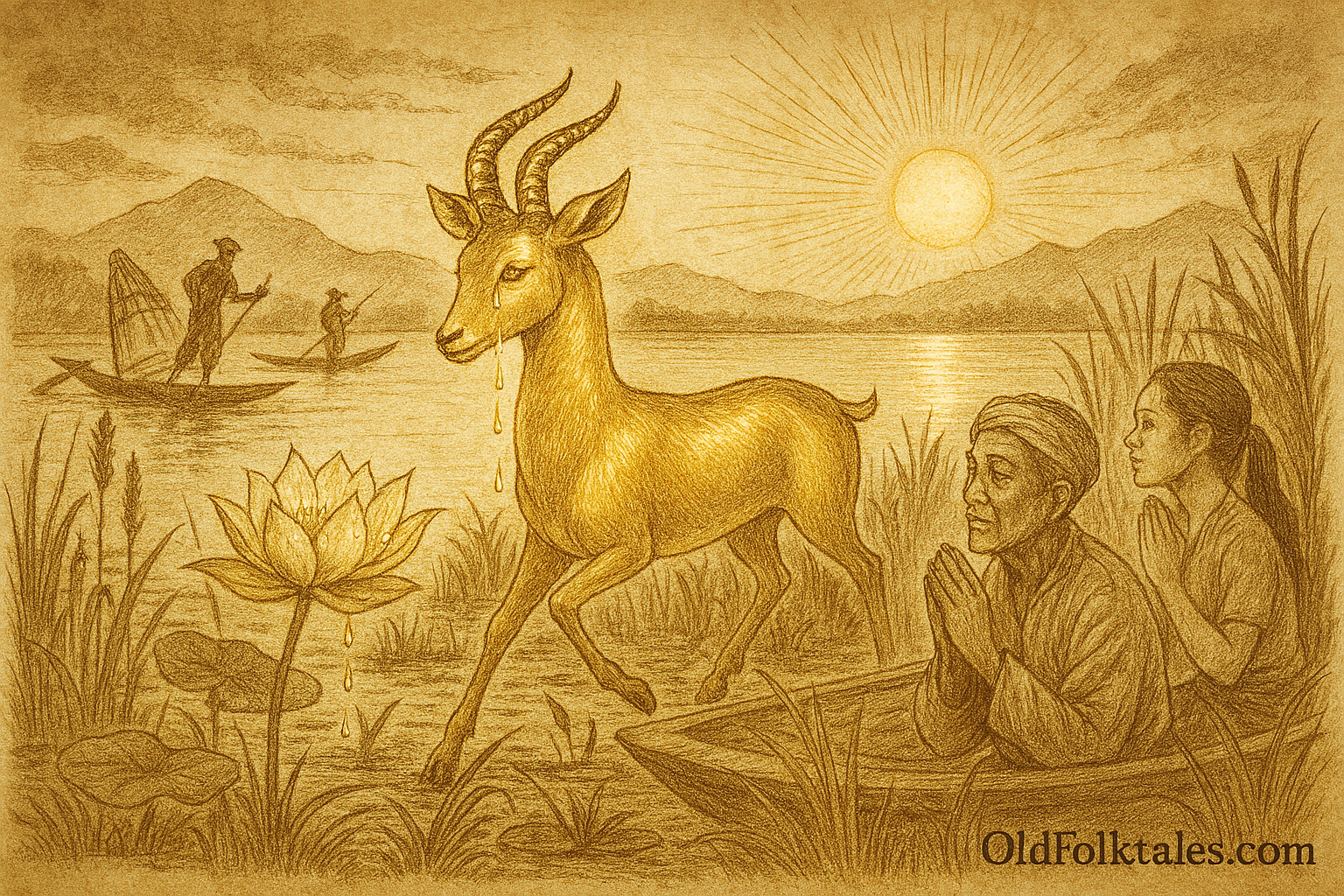
In the Shan State of Myanmar, high in the mountains where morning mist clings to hillsides and the air carries the scent of wild orchids, lies Inle Lake, a place unlike any other in the world. The lake stretches across the valley floor like a sheet of liquid silver, its surface disturbed only by the distinctive rowing of Intha fishermen who propel their boats with single legs wrapped around long oars, leaving their hands free to work their conical nets. Around the lake’s edges, where open water gives way to vast expanses of floating gardens and tangled marshlands, reeds grow so thick that the boundary between land and water becomes impossible to define.
It is in these transitional places, where the elements merge and blur, that the most mysterious things are said to dwell. And among all the legends whispered by the Intha people as they work their nets and tend their gardens, none is more persistent or more revered than the tale of the Golden Gazelle of Inle.
Click to read all East Asian Folktales — including beloved stories from China, Japan, Korea, and Mongolia.
The creature is described consistently by those rare few who claim to have seen it: a gazelle unlike any known species, its coat not brown or gray but gleaming gold, as if each hair had been spun from precious metal and blessed by the sun. Its horns, say the witnesses, curve backward in elegant spirals that catch the light and seem to glow from within. Its eyes are deep and knowing, holding an intelligence that goes beyond animal awareness into something approaching wisdom. And when it moves through the marshes, its delicate hooves somehow find purchase on surfaces that would not support even a water bird, allowing it to walk across floating vegetation and shallow water as if on solid ground.
The Golden Gazelle appears only rarely, and never in the same place twice. It shows itself at dawn or dusk, in those liminal hours when day transitions to night or night to day, when the light plays tricks and reality seems more fluid. Most often, it is seen in the remote marshes where few people venture, where reeds grow tall and waterways wind through vegetation so dense that even experienced fishermen can lose their way.
Those fortunate enough to witness the Golden Gazelle report that the encounter brings unexpected fortune. Not immediately, and not in obvious ways, but within days or weeks of the sighting, life seems to shift in positive directions. A fisherman whose nets have been empty suddenly finds them full. A farmer whose crops have struggled inexplicably thrives. A family facing financial hardship receives an unexpected opportunity or discovers a solution to their problems. The blessings are subtle but real, and they come, the elders say, because the witness showed proper respect.
For there is one crucial rule that governs encounters with the Golden Gazelle: you must not chase it. You must not try to capture it, to touch it, to possess it in any way. The gazelle is a gift meant only to be witnessed, a blessing meant only to be received with gratitude from a distance. Those who understand this receive fortune. Those who forget it face consequences far more severe than missed opportunity.
The most cautionary tale told about the Golden Gazelle concerns a man named Ko Htun, a villager who lived three generations ago but whose story remains vivid in local memory. Ko Htun was not a bad man, but he was ambitious and pragmatic, the kind of person who saw value in everything and opportunity in most situations. He made his living trading goods between the lake villages, always seeking the best price, the most advantageous deal.
One morning, as Ko Htun was paddling his boat through a remote section of marsh to reach a distant village, he saw something that made him freeze in mid-stroke. There, not twenty meters away, standing impossibly on a mat of floating vegetation, was the Golden Gazelle. The rising sun struck its coat and set it ablaze with light. The creature’s head was turned toward him, and its eyes met his with a gaze that seemed to look straight through to his soul.
For a moment, Ko Htun felt what he should have felt: awe, reverence, gratitude for being granted this rare vision. But then another thought intruded, a thought born of his commercial nature and his constant calculation of advantage. A creature like this, he reasoned, would be worth a fortune. If he could somehow capture it, even just secure a few hairs from its golden coat to prove its existence, he could sell the story and the evidence to collectors, to temples, to anyone fascinated by the mystical. He would be famous. He would be wealthy.
The moment these thoughts formed in his mind, the gazelle’s expression changed. What had been merely watchful became something else: warning, sadness, disappointment. But Ko Htun, his judgment clouded by greed, did not heed the unspoken message.
He dropped his oar and lunged forward in his boat, reaching toward the creature. The gazelle did not flee in panic but simply turned and walked deeper into the marsh, moving with unhurried grace across surfaces that should not have held its weight. Ko Htun, now fully committed to his foolish pursuit, jumped from his boat onto the floating vegetation and ran after it.
The marsh, which had seemed to support the gazelle so easily, began to give way beneath Ko Htun’s weight. His feet sank into the tangled reeds and soft mud beneath. But driven by determination and greed, he pushed forward, following the golden gleam that seemed always just ahead of him, always just out of reach.
Other fishermen working in the area heard Ko Htun’s shouts as he called out to the gazelle, as he splashed and struggled through the marsh. They tried to follow, to help him or to warn him back, but the maze of waterways and reeds seemed to shift and change, making it impossible to determine exactly where the sounds were coming from. Ko Htun’s voice grew more distant, more confused, more desperate, and then, abruptly, it stopped.
When the fishermen finally found Ko Htun’s boat, it was empty, drifting among the reeds with his oar still lying in the bottom. They searched for days, combing through every waterway and checking every patch of marsh where he might have become lost or injured. But Ko Htun was never found. It was as if the marsh had simply swallowed him, or as if he had stepped through some invisible boundary into a place from which there is no return.
The disappearance shocked the lake communities and reinforced what the elders had always taught: the Golden Gazelle is not meant to be pursued, captured, or possessed. It is a sacred mystery, a blessing that comes only to those who can accept it on its own terms, who can witness beauty without needing to own it, who can receive fortune without demanding to control its source.
Since Ko Htun’s disappearance, there have been other sightings of the Golden Gazelle, but those who see it now understand what is required of them. When the creature appears, they stop whatever they are doing. They press their palms together in a gesture of respect. They watch in silence as the gazelle moves through the marsh, and they feel grateful simply for the privilege of witnessing something so rare and beautiful. And then, when the gazelle disappears back into the reeds or fades with the changing light, they continue with their day, carrying the encounter in their hearts like a secret treasure.
The blessings still come to these respectful witnesses. U Tin Maung, an elderly fisherman, saw the gazelle five years ago while checking his nets at dawn. He did not move, did not speak, simply watched until it vanished. Within a month, his daughter, who had been struggling to find work, received an offer to teach at the local school, a position that transformed the family’s circumstances. U Tin Maung never claimed credit for the blessing or boasted about his sighting. He simply understood the connection and felt grateful.
A young woman named Ma Shwe saw the gazelle while gathering lotus stems for her mother’s weaving. She was so startled she dropped her basket, but she did not chase the creature or try to get closer. She simply stood still, barely breathing, until it moved away. Two weeks later, her younger brother, who had been chronically ill with a sickness no doctor could diagnose, suddenly recovered, his health returning as mysteriously as it had departed.
The stories accumulate over time, each one reinforcing the pattern: see the Golden Gazelle with respect, and blessings follow. Pursue it with greed or the desire to possess, and you may vanish like Ko Htun, lost in the liminal spaces where the marsh swallows those who cannot accept that some wonders must remain free.
The Intha people have incorporated this understanding into their broader philosophy of life. They teach their children that not everything of value is meant to be owned, that some forms of wealth come from appreciation rather than acquisition, that true fortune lies in knowing when to reach out and when to simply witness and honor. The Golden Gazelle has become a symbol of these principles, a reminder that the greatest blessings often come to those who can let beauty remain mysterious, who can experience wonder without needing to control its source.
Today, visitors to Inle Lake sometimes ask their guides about the Golden Gazelle, having heard rumors of the legend. The guides smile and nod, confirming that yes, the stories are told, yes, some people claim to have seen it. But they also explain, with a seriousness that makes clear this is not merely entertainment, that if you are fortunate enough to witness the Golden Gazelle, you must remember: watch with gratitude, honor with stillness, and never, ever pursue what is meant to remain free.
The marsh at the edges of Inle Lake continues to blur the boundary between water and land, between the visible world and the realm of mystery. And somewhere in those transitional spaces, the Golden Gazelle still walks, still appears to those it chooses, still offers its blessings to those wise enough to accept them with reverence rather than greed. Ko Htun’s fate stands as a permanent warning, but the fortune of those who watched with proper respect stands as an equally permanent promise: some wonders are meant only to be witnessed, and that witnessing is gift enough.
Click to read all Southeast Asian Folktales — featuring legends from Thailand, Indonesia, Vietnam, and the Philippines.
The Moral Lesson
This legend teaches that some blessings come only to those who can appreciate without possessing. The Golden Gazelle rewards witnesses who honor mystery and respect boundaries, but it punishes those who try to capture or control what should remain free. True fortune lies not in owning rare things but in knowing when to simply witness and honor them. Ko Htun’s disappearance reminds us that greed transforms blessing into curse, while respectful observation opens doors to unexpected good fortune.
Knowledge Check
Q1: What is Inle Lake and why is it significant to the legend? A: Inle Lake is a large body of water in Myanmar’s Shan State, known for its Intha fishermen who row with their legs and for its extensive marshlands where water and land blur together. These liminal spaces between elements are where the Golden Gazelle appears, making the lake’s unique geography essential to the legend’s setting and meaning.
Q2: How is the Golden Gazelle of Inle described by witnesses? A: The Golden Gazelle has a coat that gleams like spun gold, spiraling horns that glow from within, and eyes holding wisdom beyond animal intelligence. It walks across floating vegetation and shallow water as if on solid ground, defying natural laws. It appears only at dawn or dusk in remote marshes, never in the same place twice.
Q3: What blessings come to those who see the Golden Gazelle respectfully? A: Witnesses who show proper respect by not chasing or trying to capture the gazelle receive unexpected fortune within days or weeks. Blessings are subtle but real: empty fishing nets suddenly fill, struggling crops thrive, financial hardships resolve through unexpected opportunities. The fortune comes because the witness honored the encounter with reverence rather than greed.
Q4: What happened to Ko Htun and why? A: Ko Htun was a trader who saw the Golden Gazelle but, driven by greed and the desire to profit from capturing it, pursued the creature into the marsh. Despite the gazelle’s warning look, he chased it through the reeds until he became lost and disappeared completely. His fate serves as a cautionary tale about trying to possess what should remain free.
Q5: What is the crucial rule for encountering the Golden Gazelle? A: The rule is that you must never chase, capture, touch, or try to possess the Golden Gazelle in any way. It is meant only to be witnessed from a distance with gratitude and respect. Those who understand this receive blessings; those who try to pursue or capture it face severe consequences, potentially disappearing like Ko Htun.
Q6: What broader life philosophy does the Golden Gazelle legend represent in Intha culture? A: The legend teaches that not everything valuable is meant to be owned, that some wealth comes from appreciation rather than acquisition, and that true fortune lies in knowing when to witness rather than control. It represents the principle that the greatest blessings come to those who can let beauty remain mysterious and free, a philosophy the Intha people incorporate into their broader approach to life.
Source: Adapted from Myanmar Cultural Documentation, Inle Lake Oral History Records.
Cultural Origin: Intha people, Inle Lake, Shan State, Myanmar










