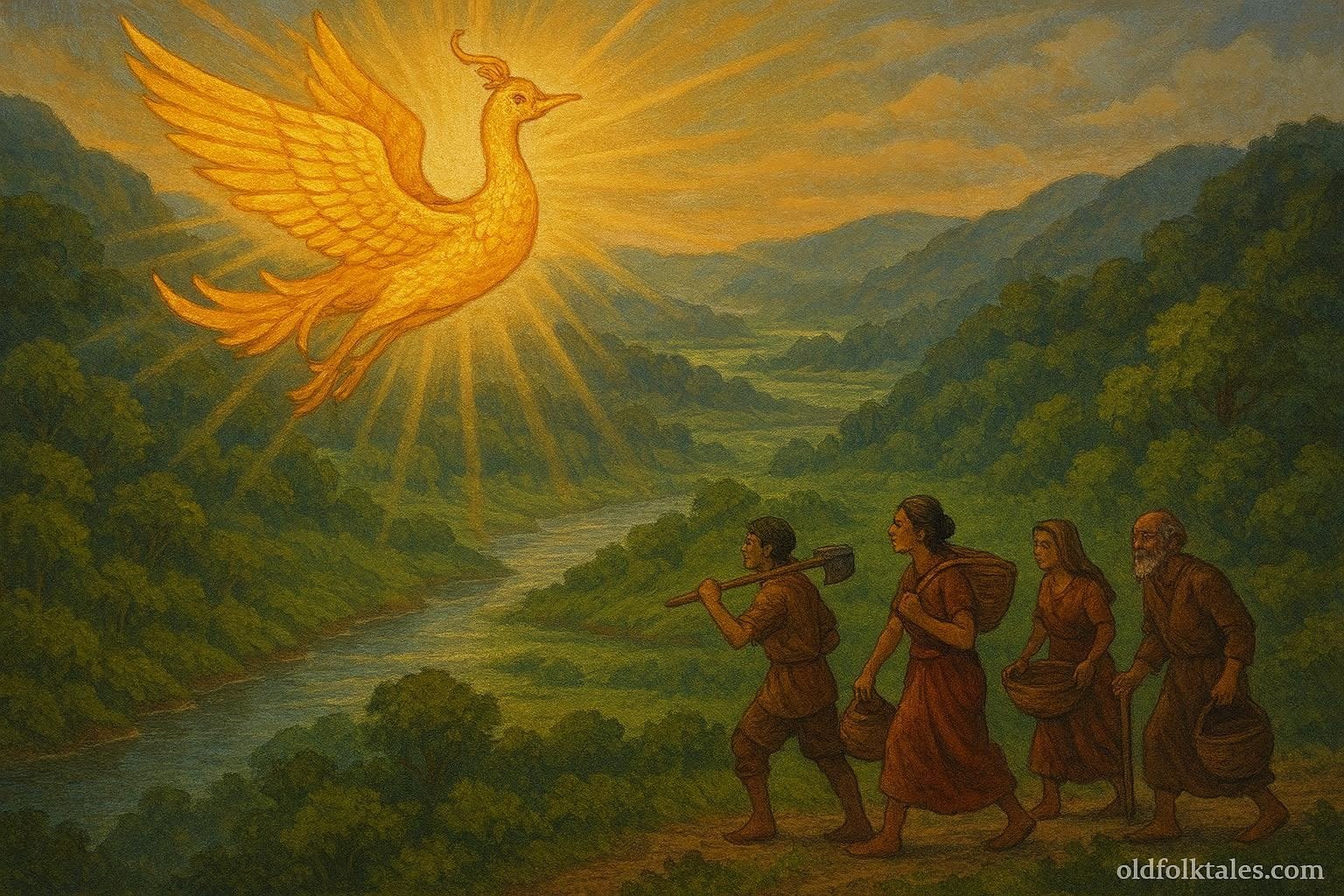
In the heart of a dense forest where the rivers flowed swiftly and the hills were covered in mist, a radiant golden bird appeared one morning. Its feathers shimmered with sunlight and reflected the colors of dawn. The early settlers of the region were tending to their meager crops and guiding their herds when they noticed the extraordinary creature. They had long struggled to find a safe and fertile place to settle. Villages they had attempted to build previously were destroyed by floods, wild beasts, and harsh winds. Their spirits were weary, but the sight of the golden bird filled them with hope.
The settlers watched as the bird glided gracefully over the forest canopy, dipping and rising as if tracing an invisible path. They sensed that the bird was not an ordinary creature but a messenger of the unseen world. Its song carried across the hills, a melody so pure and compelling that it seemed to speak directly to the hearts of those who listened. The villagers decided to follow the bird, believing that it would lead them to a place where their lives could flourish.
The journey was not easy. They traveled through thick forests where sunlight barely touched the ground and over hills where rocks threatened to injure their feet. They crossed streams and marshes where the mud clung to their ankles. Yet the golden bird flew steadily ahead, always appearing just far enough to guide them without frightening them. The villagers felt a mixture of awe and reverence. They whispered prayers and promised offerings, acknowledging that their success depended on both their efforts and the guidance of the divine bird.
Explore timeless legends from China, Japan, and Korea in our East Asian Folktales collection.
After several days of careful following, the golden bird led them to a hidden valley that opened into a wide plain. The soil was rich and dark, perfect for planting crops. Fresh springs bubbled from the ground, and small streams meandered gently through the land. Wild fruits grew abundantly, and the air was fragrant with the scent of flowers. The villagers knew that they had found the land that had been promised to them through the guidance of the golden bird. They set to work immediately, building homes, planting fields, and creating a community based on mutual support.
As the settlers labored, the golden bird continued to appear at dawn and dusk, its wings catching the light and casting a golden glow over the plain. It seemed to observe the people, rewarding their cooperation and diligence with its continued presence. Over time, the villagers erected a shrine in the center of the settlement to honor the golden bird. They left offerings of fruits, flowers, and small handmade trinkets. Parents told the children stories of how the bird had led their ancestors to safety and prosperity. These stories were repeated at festivals, in homes, and around fires at night. The bird became not only a symbol of divine guidance but also a teacher of values.
Through the seasons, the village prospered. Crops flourished, and the herds grew strong. The villagers learned to care for the land as carefully as they followed the bird. When droughts or storms threatened, they remembered the lessons of the golden bird. They did not panic but worked together, sharing resources, reinforcing their homes, and conducting rituals of gratitude to the spirit that had guided them. They realized that the bird’s guidance extended beyond leading them to the valley. It taught them how to live in harmony with nature, with each other, and with the unseen forces that governed the world.
The golden bird also became a symbol of moral integrity. Those who attempted to hoard resources or exploit others found that the bird no longer appeared for them. Only those who acted with humility, honesty, and respect were blessed with its presence. The villagers began to see the bird not only as a guide to fertile land but as a moral compass. They understood that prosperity without virtue would bring misfortune, and they worked diligently to maintain justice, fairness, and harmony in their daily lives.
Generations passed, and the story of the golden bird remained at the heart of the village’s culture. Travelers from neighboring regions heard of the bird and visited the valley, hoping to witness the creature themselves. They brought offerings, performed dances, and learned from the villagers how to live in harmony with the land. The golden bird, ever vigilant and radiant, continued to fly above the plains, guiding all who were pure of heart and willing to act with wisdom and respect. Its flight became a symbol of hope, courage, and the rewards of listening to the signs of the natural and spiritual world.
Even in times of conflict, when outsiders threatened the village, the settlers remembered the golden bird. They did not fight recklessly but strategized, relying on cooperation, intelligence, and careful observation of the environment. They attributed their victories and safety to the lessons imparted by the bird and their continued dedication to living harmoniously with nature. The golden bird’s influence shaped not only the physical settlement but also the cultural and ethical identity of the people.
The golden bird’s legacy extended beyond its physical appearances. Songs were composed in its honor, depicting its radiant wings and melodious voice. Artwork depicted the bird soaring over the valley, inspiring awe and gratitude. The shrine remained the focal point of the community, a reminder that prosperity and safety are gifts that require respect, attention, and moral responsibility. The villagers understood that the golden bird’s guidance was a lifelong lesson.
Even centuries later, stories of the golden bird were told to children to teach them the values of courage, perseverance, compassion, and respect for the natural and spiritual world. The bird’s story reminded every generation that guidance comes to those who are attentive, patient, and willing to follow the path of virtue. Its image became a symbol of hope, a guardian of wisdom, and a reminder that the unseen forces in the world reward those who act with integrity and humility.
Moral Lesson:
Faith in guidance, attentiveness to the natural and spiritual world, cooperation, and moral integrity lead to prosperity and communal harmony.
Knowledge Check:
- What guided the early settlers to the fertile valley?
Answer: The golden Hintha bird. - How did the villagers honor the golden bird?
Answer: They built a shrine, left offerings, and told its story to future generations. - What values did the golden bird teach?
Answer: Cooperation, humility, respect for nature, and moral integrity. - How did the villagers respond to challenges while remembering the bird?
Answer’s: They worked together, shared resources, and conducted rituals of gratitude. - Why did the golden bird only appear to certain people?
Answer: It appeared to those who acted with honesty, respect, and moral integrity. - What was the lasting legacy of the golden bird?
Answer: It became a symbol of guidance, hope, wisdom, and virtuous living.
Source:
Adapted from Myanmar Ministry of Culture Traditional Narratives Archive, 2010.
Cultural Origin:
Mon and Lower Myanmar foundation folklore.