In the heart of ancient Sri Lanka, where green fields rippled like waves beneath the sun, there lived a humble peasant. Each morning, he rose before dawn, working the soil with patience and reverence. His fields were small, his hut simple, yet he carried a calm joy born of honest labour and gratitude.
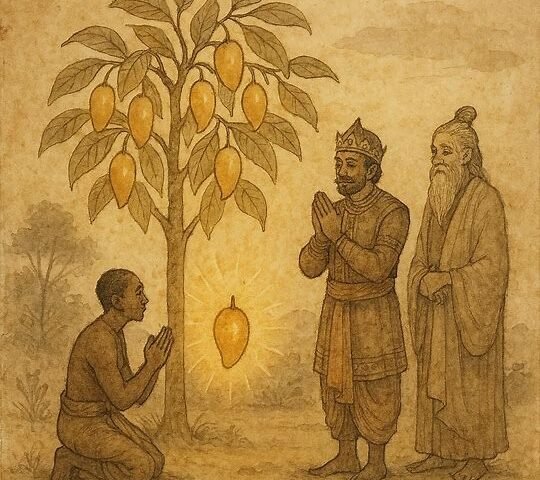
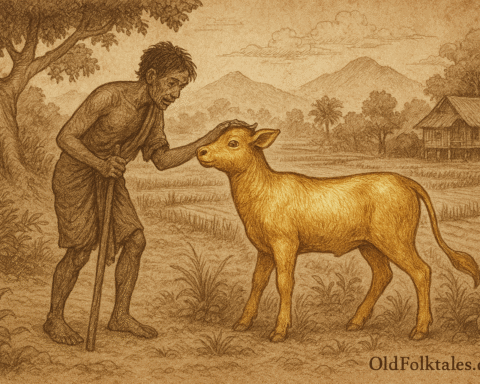
One summer day, while wandering along the edge of his land, the peasant noticed something extraordinary. Among the tall grasses stood a lone mango tree, its branches heavy with fruit that shimmered like molten gold. The mangoes glowed as though sunlight itself had been captured in their skins, casting a soft radiance upon the earth below.
Explore desert legends and palace tales in our Western Asian Folktales archive.
The peasant, awestruck, pressed his palms together in reverence. “Surely this is no ordinary tree,” he murmured. “It must be a gift from the heavens.”
Wanting to share the marvel, he gently plucked one golden mango and carried it with both hands to the royal palace. The guards at first laughed at the sight of a dusty farmer cradling a fruit, but when they saw its glow, they bowed and ushered him inside.
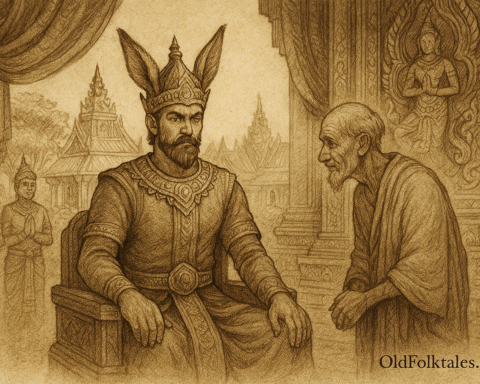
The king, known for his wisdom but also his pride, received the mango on a silver tray. Its beauty silenced the court. The fruit’s golden sheen reflected on the marble floors and jeweled walls, bathing the room in soft light.
“What wonder is this?” the king asked.
“A gift from the earth, Your Majesty,” replied the peasant humbly. “It grows in the wild near my fields. I thought it worthy of your eyes.”
The king turned the mango in his hand, admiring its perfection. “Such beauty must belong to the palace,” he declared. “Bring me the tree itself. It shall grow in my royal garden, where all may behold its splendour.”
At his command, servants rode out with shovels and carts. They found the glowing tree and, despite the peasant’s quiet hesitation, uprooted it from its home and carried it to the palace grounds.
For a few days, the tree stood tall, its leaves rustling gently in the warm wind. But soon, its radiance faded. The golden fruits dulled, the leaves turned pale, and within a fortnight, the once-glorious tree began to wither.
Alarmed, the king summoned his healers, priests, and gardeners. They watered the soil with perfumed water, sprinkled sacred ash around the roots, and chanted verses to bless it, but the tree continued to die.
Desperate, the king sent messengers across the land in search of wisdom. At last, word reached an old hermit who lived beside a quiet river at the edge of the forest. The hermit, known for his insight into nature and the soul, agreed to come before the throne.
The palace was filled with murmurs as the hermit entered, barefoot, wrapped in a simple robe, carrying only a staff. Bowing slightly, he looked upon the king with calm eyes.
“Great King,” said the hermit softly, “I have heard of your golden mango tree. Tell me, where did it once grow?”
“In a field near a poor man’s hut,” replied the king. “I had it brought here to bless my garden, yet it dies despite all care.”
The hermit smiled sadly. “That tree grew in soil made rich not by wealth, but by purity of heart. You took it from the hands of one who lived in harmony with the earth, and so its spirit faded. No root can thrive where pride overshadows humility.”
The king fell silent, humbled by the hermit’s words. “Then what must I do?” he asked.
“Return it to its home,” said the hermit. “There, in the soil of kindness and gratitude, it will live again.”
Moved by remorse, the king ordered his men to carry the withered tree back to the peasant’s field. The journey was long, and the branches drooped like weary arms, but the moment the roots touched their native earth once more, a breeze stirred through its leaves.
Days later, new shoots appeared, green and tender. Within weeks, the golden glow returned, brighter than before. The tree flourished, bearing fruit that shone like small suns.
The king visited the field again, this time not in splendour but in humility. Standing beside the peasant, he said, “The hermit was right. This tree does not belong to kings, but to goodness itself. Let it remain here, and let its fruit be shared with those who need it most.”
From that day forward, the golden mangoes were given to the poor and the hungry. The peasant tended the tree with care, and its light became a blessing upon the land.
Moral Lesson
True prosperity grows only in the soil of humility. When pride uproots goodness, life withers, but kindness and repentance can make it bloom again.
Knowledge Check
1. Who are the main characters in “The Golden Mango”?
The main characters are a humble peasant, a proud king, and a wise hermit who guides the story’s moral resolution.
2. What is special about the mango tree in this folktale?
The tree bears glowing golden fruit, symbolising purity, virtue, and the blessings that arise from goodness.
3. Why does the mango tree wither after being moved to the palace?
It withers because the king uprooted it from its pure, humble soil—showing that greed and pride destroy natural harmony.
4. What lesson does the hermit teach the king?
He teaches that true life and prosperity thrive only where humility and goodness dwell.
5. What does the golden mango symbolise in Sri Lankan culture?
It represents spiritual richness, the rewards of virtue, and the harmony between human character and nature.
6. How does the story reflect Buddhist moral traditions?
The tale mirrors Buddhist teachings that greed leads to suffering, while humility and compassion restore balance and peace.
Source:
Adapted from the Sinhalese folktale “The Golden Mango Tree” in Folk Tales of the Sinhalese, collected by H. Parker (1910), London: Luzac & Co.
Cultural Origin: Sri Lanka (Sinhalese folklore)