Long ago in the village of Hahoe, surrounded by gentle hills and winding rivers, there lived a young scholar named Minjo. He was known for his intelligence and his deep sense of compassion. Though his family was not wealthy, Minjo studied diligently and treated everyone in the village with respect and fairness. He helped neighbors with their crops, assisted the elderly, and offered shelter to travelers who passed through the village.
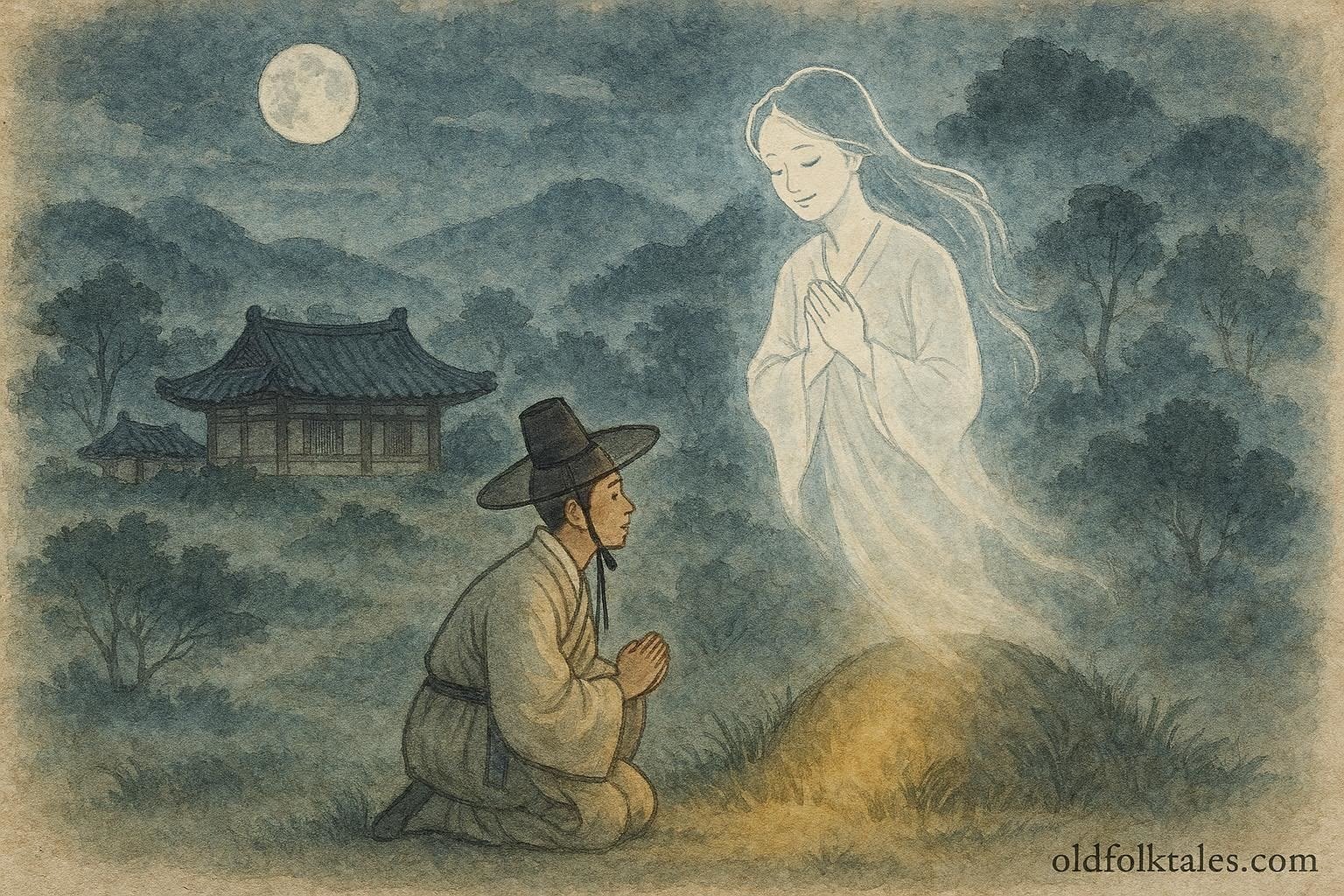
One quiet evening, as Minjo was returning from the market, he noticed a soft figure standing near the edge of the village. It was a young woman, her form translucent in the moonlight, dressed in white robes that swayed like mist over the grass. Her eyes, filled with sadness, met Minjo’s, and she spoke in a voice that trembled like a distant wind. She explained that she was a wandering spirit, unable to rest because her final wish had been left unfulfilled. Her name was Haeun, and in life, she had died young and alone. Her family had long since forgotten her, and her grave lay neglected on a hilltop outside the village. She asked Minjo to help her find peace by tending to her resting place and performing the proper rites.
Minjo was frightened at first, yet he felt a profound sense of responsibility. He knew that spirits in Korean belief were not to be ignored or insulted, and he respected the sorrow that lingered in Haeun’s eyes. He agreed to help her, taking the necessary tools to repair her grave, sweep the area clean, and place offerings of rice and incense. He invited other villagers to join him in honoring the spirit, explaining that doing so would bring both peace to Haeun and blessings to the community.
Explore ancient tales from Thailand, Cambodia, and the Philippines in Southeast Asian Folktales.
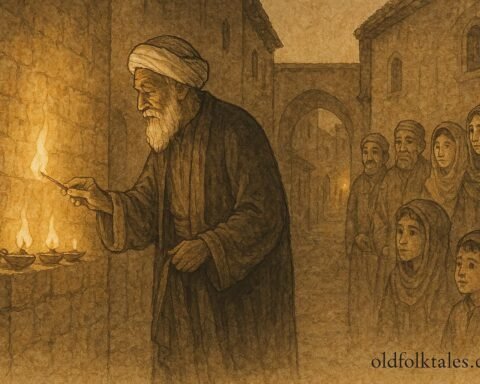
Over the following weeks, Minjo returned daily to care for the grave. He polished the tombstones, planted flowers along the hillside, and offered water to the stone markers. At night, he lit lanterns and recited prayers, guiding Haeun’s spirit toward a place of rest. Slowly, he began to sense her presence more kindly. The air around the grave seemed calmer, the winds gentler, and sometimes he would hear the soft echo of her voice, singing songs from her life before she had passed.
One night, while Minjo was meditating near the grave, Haeun appeared again, more solid and radiant than before. She smiled and bowed deeply. “Thank you, kind scholar,” she said. “Because of your respect and diligence, I may now rest. I shall not forget your kindness. My spirit will watch over you and your family, bringing protection and prosperity for generations.”
From that night onward, Minjo noticed subtle blessings in his life. Crops flourished beyond expectation, neighbors treated him with kindness, and illnesses seemed to avoid his household. At first, he thought these were coincidences, but over time it became clear that the grateful ghost of Hahoe had truly intervened. Whenever danger or misfortune threatened the village, Minjo would find small signs of guidance, a misplaced tool found just in time, a river not flooding, or a sudden wind that redirected falling branches away from homes.
Years passed, and Minjo grew into an elder respected for his wisdom and benevolence. Stories of Haeun’s gratitude were told to children, reminding them that respect for the dead and acts of compassion brought harmony into the living world. The villagers learned that spirits could reward the sincere and protect those whose hearts were pure. Even after Minjo’s own passing, his family continued to honor Haeun’s grave and care for wandering spirits, believing that the bond formed by kindness extended beyond a single lifetime.
Thus the tale of the Grateful Ghost of Hahoe became a cherished story, teaching generations the value of respect, benevolence, and the enduring connection between the living and the departed. It was said that on quiet evenings when the moon reflected upon the river, Haeun’s presence could still be felt, her voice mingling with the wind to remind the villagers that kindness never goes unnoticed, and that true gratitude can transcend the boundary between life and death.
Moral Lesson
Acts of kindness and respect for others, including spirits, create lasting harmony. Benevolence toward those who cannot repay us teaches humility, earns gratitude, and protects families and communities for generations. When we honor the needs and memories of others, we cultivate bonds that endure beyond life and guide future generations toward compassion and moral integrity.
Knowledge Check
- Why was Haeun’s spirit wandering?
Answer: Her final wish had been left unfulfilled and her grave neglected. - How did Minjo help Haeun find peace?
Answer: He tended to her grave, performed proper rites, and cared for her resting place. - What blessings did Minjo notice after helping Haeun?
Answer: Prosperous crops, good health, and protection from misfortune. - Why did Minjo continue honoring the spirit even after she rested?
Answer: To maintain the bond of gratitude and show ongoing respect. - What lesson did the villagers learn from the story?
Answer: Respect for the dead and benevolence bring harmony and protection. - How does the story illustrate the connection between the living and spirits?
Answer: It shows that acts of compassion can create spiritual bonds that influence life positively.
Source
Adapted from Andong Mask Museum Folklore Records, 2018.
Cultural Origin
Hahoe village ancestral lore.