In the ancient kingdoms of Burma, when pagodas gleamed with gold leaf under the tropical sun and the great Irrawaddy River carried trade from the mountains to the sea, there ruled a king whose name has been lost to time but whose story serves as an eternal warning. His palace was magnificent, its teak pillars carved with intricate designs, its roofs layered and gilded until they seemed to capture and hold the very light of heaven. Within those ornate walls lived a man consumed by a hunger that no amount of wealth could satisfy.
The king had inherited a prosperous realm from his father, who had ruled with wisdom and fairness, maintaining the ancient balance between the throne’s needs and the people’s welfare. The old king had understood that a ruler’s wealth came from his subjects’ prosperity, that taxing too heavily was like a farmer eating his seed grain, it might fill the belly today but guarantee starvation tomorrow.
Click to read all East Asian Folktales — including beloved stories from China, Japan, Korea, and Mongolia.
But the son did not possess his father’s wisdom. From the moment he ascended the throne, he saw his kingdom not as a trust to be administered but as a treasure to be extracted. Gold became his obsession, his measuring stick for all value, his substitute for every other form of satisfaction or meaning.
He began modestly enough, raising taxes by small increments that seemed reasonable when announced individually. But like water dripping on stone, these increases accumulated until the burden grew crushing. Farmers who once kept half their harvest now surrendered three-quarters to the royal tax collectors. Merchants who had prospered through fair trade found their profits consumed by endless fees and levies. Even the poorest families, living hand-to-mouth on subsistence fishing or daily labor, were required to pay tribute that left them choosing between food and payment.
The king’s advisors tried to counsel restraint. “Your Majesty,” the eldest minister would say carefully, kneeling before the throne with the deference required by protocol but urgency in his voice, “the people suffer greatly under these taxes. Rice is scarce in the villages. Children go hungry. If we do not ease their burden, we risk unrest.”
But the king would wave away these concerns with a jewel-laden hand. “The people always complain,” he would reply dismissively. “They are lazy and unwilling to work hard enough. I need these revenues to maintain the palace, to build greater monuments, to ensure our kingdom’s glory. Their temporary discomfort is a small price to pay for our eternal magnificence.”
The truth was that the king needed no such revenues. His treasury already overflowed with gold, silver, rubies from the northern hills, jade from the borderlands, pearls from the coastal waters. He had inherited wealth that would have sustained several lifetimes of reasonable royal expenditure. But his hunger for more was insatiable, a void that grew larger with each addition to his hoard.
He spent hours each day in his treasure vault, a vast underground chamber accessed by hidden stairs from his private quarters. There he would run his fingers through piles of gold coins, hold glittering gems up to lamplight, count and recount his accumulated wealth with the attention a loving father might give to his children. The cold metal and hard stones gave him more satisfaction than any human interaction, more pleasure than any accomplishment, more security than any relationship.
While the king gloated over his treasures, his kingdom withered. Villages that had once thrived with markets and laughter grew quiet, their people too exhausted from labor and too hungry from deprivation to maintain their former vibrant culture. Children who should have been learning trades or attending temple schools instead worked alongside their parents from dawn to dusk, trying to produce enough to both survive and satisfy the tax collectors’ demands.
The elderly, who in better times would have been cared for and respected in their final years, instead begged in temple courtyards or died quietly in their homes, alone and forgotten. Young couples delayed marriage and childbearing, uncertain whether they could feed themselves, much less offspring. The population began to decline as the most desperate families fled to neighboring kingdoms where rulers governed with more humanity.
Yet the king noticed none of this suffering. Protected by palace walls and surrounded by courtiers too fearful or corrupt to speak truth, he lived in a bubble of gleaming denial. When reports of hardship did reach his ears, he dismissed them as exaggerations from lazy complainers who simply refused to work harder.
His isolation from reality was so complete that he felt genuinely puzzled by his own unhappiness. Despite possessing more wealth than any ten kings might need, despite having every material desire instantly satisfied, despite spending hours fondling his treasures, he found no peace. Instead, he experienced a gnawing anxiety that his wealth might be stolen, an obsessive need to acquire more, and a hollow loneliness that no amount of gold could fill.
He slept poorly, waking multiple times each night to ensure his treasures remained secure. He trusted no one, convinced that everyone from his ministers to his servants plotted to steal from him. He found no joy in food, music, or companionship, as all these seemed inferior to the gleam of gold.
Then came the night that changed everything.
The king retired to his bedchamber after his usual evening visit to the vault, his mind churning with plans to impose yet another tax this time on fishing nets, which would extract revenue from even the poorest coastal villagers. He fell into restless sleep, tossing and turning under silk sheets that brought no comfort.
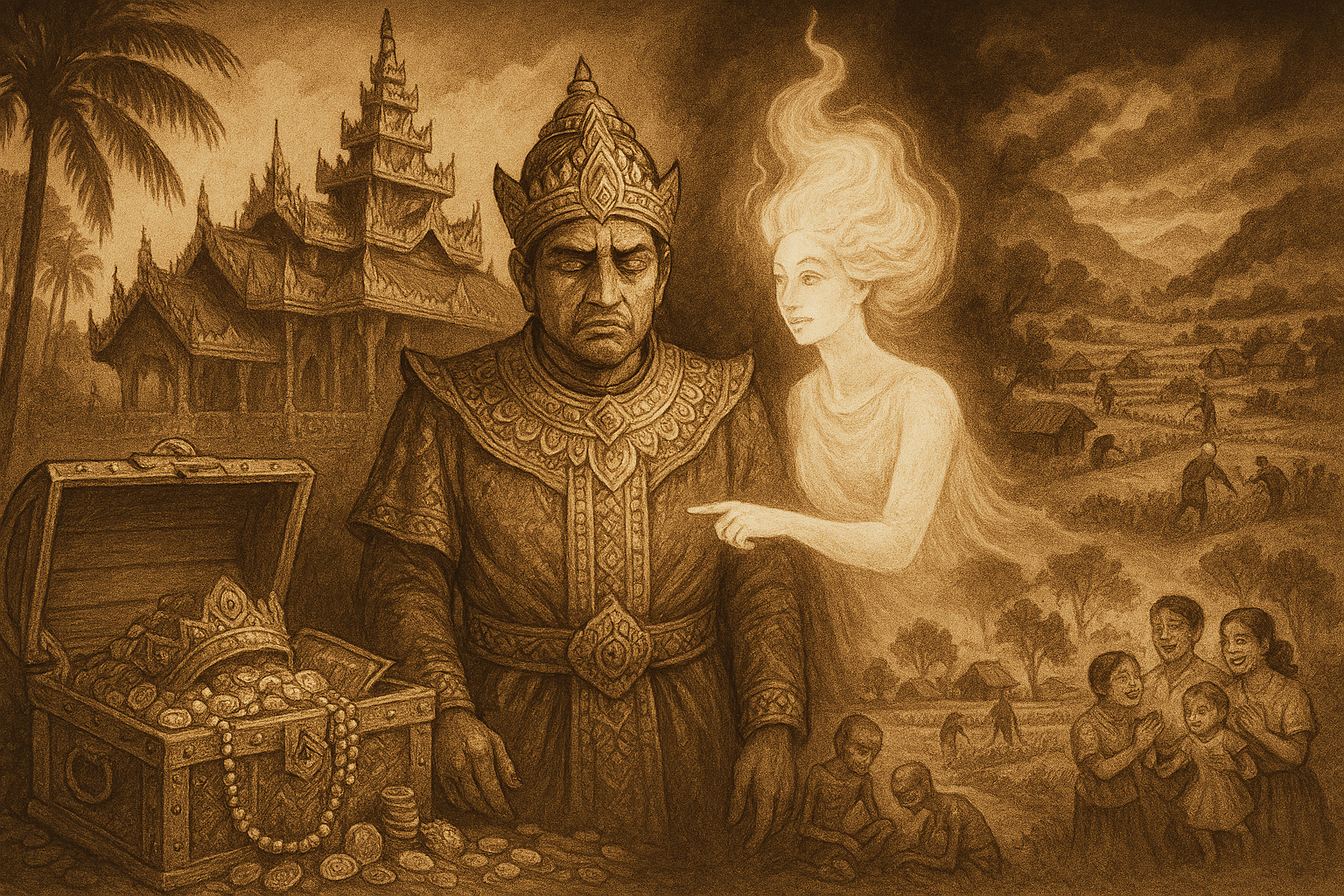
In the deepest part of the night, when the boundary between the waking world and the realm of spirits grows thin, a presence entered his chamber. The king’s eyes opened to find a figure standing beside his bed, illuminated by a pale light that seemed to emanate from within rather than from any external source.
The figure appeared ancient beyond measure, neither clearly male nor female, dressed in simple robes that seemed woven from moonlight and shadow. Its face was both terrible and beautiful, expressing an wisdom and compassion so profound that the king found himself unable to speak or move, paralyzed not by fear but by awe.
“I am the Guardian of Balance,” the spirit said, its voice like wind through ancient trees, “sent by forces beyond your understanding to show you truth you refuse to see. You have corrupted the sacred trust of kingship. Tonight, you will see what your greed has created.”
Before the king could protest or question, the spirit touched his forehead with one translucent finger, and the palace chamber dissolved around them.
Suddenly the king stood invisible in his own throne room, watching himself from a distance. He saw his own face twisted with avarice as he ordered yet higher taxes. He heard his own voice, cold and dismissive, rejecting his ministers’ pleas for mercy toward his suffering subjects. He observed his own hands, decorated with rings and bracelets worth more than entire villages, waving away concerns about starving children.
The scene shifted, and now he stood in a village he recognized as lying within his kingdom but had never personally visited. He watched a farmer a man perhaps fifty years old but looking seventy from hardship working his small plot of land with equipment so worn it barely functioned. The man’s wife sat outside their deteriorating house, attempting to make a meal from a handful of rice that would have fed one person adequately but must somehow sustain their family of five.
Their children, thin and hollow-eyed, played a listless game in the dust, too weak from poor nutrition to run or laugh with the energy children should possess. The king watched as the oldest child, a girl of perhaps ten years, quietly gave her portion of the meager dinner to her younger siblings, pretending she had already eaten though her protruding ribs told a different story.
“This family pays seventy-five percent of their harvest in taxes to you,” the spirit’s voice said beside him. “The father works from before sunrise until after sunset. The mother walks three miles each way to a stream because your tax on well maintenance means the village well has fallen into disrepair. The children receive no education and no medical care. The girl who sacrificed her meal will likely not survive the next illness that comes to the village. And for what? So you can add more gold to vaults already overflowing?”
The king tried to speak, to justify or explain, but the spirit silenced him with a gesture and shifted the scene again.
Now he stood in the royal vault, his treasure chamber, but seeing it as if for the first time. The piles of gold that had given him such satisfaction now appeared differently not as symbols of success but as stolen life. Each coin represented a meal taken from a hungry mouth, a night’s warmth denied to someone sleeping in cold, a child’s chance at education sacrificed to royal avarice.
The gems he had admired for their beauty now seemed to pulse with accusation. The rubies reminded him of the blood his people metaphorically shed through their labor. The jade made him think of the green rice paddies that no longer produced abundantly because farmers lacked resources to maintain irrigation. The pearls brought to mind the tears of mothers watching their children suffer.
“Look deeper,” the spirit commanded. “See what this wealth truly represents.”
The king’s vision changed again, and now he saw his treasure as it truly was not as gold and jewels but as concentrated misery, crystallized suffering, solidified injustice. Each item in his hoard bore the spiritual weight of the pain it had caused. The coins felt heavy with the exhaustion of those who had worked to produce them. The gems carried the grief of families broken by poverty. The very air in the vault seemed thick with silent screams of suffering.
But the spirit was not finished. “Now see the alternative,” it said, and the vision shifted once more.
The king saw himself or rather, a different version of himself sitting on the throne with a different expression on his face. This king’s eyes held compassion rather than greed. This king listened carefully to his ministers’ counsel rather than dismissing it. This king announced not higher taxes but their reduction, declaring that the royal treasury would invest in irrigation projects, schools, medical care, and infrastructure that would help his people prosper.
The scene expanded to show the kingdom’s transformation under this alternative leadership. Villages thrived with markets full of goods and laughter. Children attended temple schools, their faces bright with health and curiosity. Elderly citizens received respect and care in their final years. Young couples married and raised families without fear of starvation. The population grew as word spread of a kingdom where the ruler served his people rather than exploiting them.
“This king has less gold in his vault,” the spirit explained, “but more wealth where it matters in the loyalty of his subjects, in the prosperity of his realm, in the reputation of his kingdom. He sleeps peacefully at night because his conscience is clear. He feels genuine joy because he witnesses the happiness his wise governance creates. He will be remembered with love rather than loathed in secret by those he rules.”
The spirit showed him one final vision two funeral processions, side by side for comparison. One was for a greedy king, attended by the required ceremonial participants but devoid of genuine grief. The people watched his passing with relief, even joy, celebrating the end of his oppressive reign. His legacy was curses rather than blessings, his name becoming synonymous with tyranny and exploitation.
The other funeral was for a generous king, mourned sincerely by thousands who lined the streets with tears streaming down their faces. They remembered his kindness, his wisdom, his care for their welfare. Parents named their children after him. Poets composed verses honoring his memory. His legacy was love, his name becoming synonymous with justice and compassion.
“Which king will you be?” the spirit asked. “The choice is yours, but the time for choosing ends tonight. Tomorrow you will wake, and your path will be set. Redemption requires more than recognition it demands action. Will you hoard wealth while your people starve, or will you remember that a kingdom’s true treasure is its people’s wellbeing?”
The king tried to speak, but emotion choked his words. For the first time since ascending the throne, perhaps for the first time in his adult life, he felt genuine remorse. He saw clearly how his obsession with gold had blinded him to human suffering, how his greed had corrupted his sacred duty as a ruler, how his isolation in luxury had separated him from the reality of his subjects’ lives.
“I understand,” he finally managed to whisper. “I have been a fool. I have betrayed my people and dishonored my father’s legacy. If I wake tomorrow, I will change. I will be the king I should have been from the beginning.”
The spirit nodded slowly. “Remember this night,” it said. “Remember what you have seen. Remember what you have felt. And remember that wealth without compassion is poverty of the worst kind poverty of the soul.”
The king woke with dawn light streaming through his chamber windows, his face wet with tears, his heart transformed. For a long moment, he lay still, uncertain whether the night’s experience had been real or merely an unusually vivid dream. But the emotions remained too powerful, the memories too clear, the understanding too profound to dismiss as simple imagination.
He rose and immediately summoned his council, surprising them with the urgency of the early morning meeting. When they assembled, bowing nervously and wondering what new extraction scheme the king had devised, he shocked them with his announcement:
“I have been a terrible king,” he declared, his voice carrying an authority born not from position but from genuine conviction. “I have exploited my people, hoarded wealth while they suffered, and corrupted the sacred trust my father left me. From this day forward, everything changes.”
The ministers exchanged uncertain glances, unsure whether to believe this sudden transformation or suspect some trick.
“Effective immediately,” the king continued, “I am reducing all taxes by half. The excessive levies on fishing, on wells, on tools, on basic necessities all abolished. The treasury will fund irrigation projects in every village, establish schools for children, provide medical care for the sick and elderly. Our wealth belongs not to the throne but to the kingdom. We will use it as it should have been used all along to serve our people rather than oppress them.”
One brave minister dared to speak: “Your Majesty, such generosity will empty the treasury within a few years.”
The king smiled, a genuine expression of joy that had been absent from his face for so long that his courtiers barely recognized it. “Then we will have done well,” he replied. “A full treasury and empty stomachs is failure. Empty vaults and full bellies is success. I would rather be a poor king of a prosperous people than a rich king of a suffering nation.”
True to his word, the king transformed his governance completely. He opened his treasure vaults and directed the wealth toward projects that benefited everyone. He visited villages personally, listening to his subjects’ concerns with humility and genuine interest. He learned their names, held their children, shared their simple meals, and understood their lives in ways he had never attempted before.
The changes did not occur overnight years of damage required years of healing. But gradually, unmistakably, the kingdom recovered. Fields once again produced abundant harvests. Markets bustled with trade. Children’s laughter replaced the silence of despair. The elderly received dignity in their final years. Young families grew without fear.
And the king discovered something that would have seemed impossible during his days of obsessive gold-hoarding: he found genuine happiness. The smile on a farmer’s face when new irrigation reached his fields brought more satisfaction than any amount of treasure. The laughter of children in newly established schools filled him with more joy than counting coins ever had. The respect and genuine affection of his people provided more security than any vault.
He slept peacefully now, his conscience clear, his dreams untroubled. He trusted his ministers and subjects because he had earned their trust in return. He discovered that generosity created not scarcity but abundance, that giving away wealth made him feel richer than hoarding it ever had.
When he finally passed away many years later, mourned sincerely by the kingdom he had learned to serve rather than exploit, his greatest treasure was not the modest amount remaining in the royal vault but the legacy of love and gratitude his transformation had created. His story was told throughout Burma and beyond, a testament to the possibility of redemption and the truth that real wealth lies not in gold but in goodness.
Click to read all Southeast Asian Folktales — featuring legends from Thailand, Indonesia, Vietnam, and the Philippines.
The Moral Lesson
This Burmese folktale teaches that greed corrupts leadership and separates rulers from the very people they are meant to serve, while generosity strengthens society and creates genuine prosperity. The king’s obsession with accumulating wealth blinded him to his sacred duty and his subjects’ suffering, demonstrating that material abundance without compassion creates spiritual poverty. His transformation shows that true power comes from service rather than exploitation, that a kingdom’s real treasure is its people’s wellbeing, and that redemption is possible for those willing to recognize their failures and choose a different path.
Knowledge Check
Q1: What caused the king to become obsessed with wealth?
A: Unlike his wise father who ruled with balance, the son saw the kingdom as a treasure to extract rather than a trust to administer. His obsession grew from treating gold as a measure of all value and substitute for meaning, leading him to prioritize accumulation over his duty to his people and his own genuine happiness.
Q2: How did the king’s greed affect his kingdom?
A: The crushing taxes impoverished his subjects, causing widespread hunger, suffering, and population decline. Villages withered, children worked instead of learning, elderly citizens died alone, young couples delayed families, and the most desperate fled to neighboring kingdoms. The realm deteriorated while the king remained isolated in his palace, unaware of the suffering he caused.
Q3: What was the Guardian of Balance and why did it visit the king?
A: The Guardian of Balance was a mysterious spirit sent to show the king truths he refused to see. It appeared when the king’s corruption of his sacred trust as ruler reached a critical point, using visions to reveal the suffering his greed caused and the alternative path of generous leadership still available to him.
Q4: What visions did the spirit show the king?
A: The spirit showed the king his own cruel behavior, a starving family suffering under his taxes, his treasure vault as concentrated misery rather than wealth, an alternative version of himself ruling with compassion, the contrasting results of greedy versus generous leadership, and two funeral processions representing his possible legacies one hated, one loved.
Q5: How did the king change after the spirit’s visit?
A: The king immediately reduced taxes by half, abolished excessive levies, directed treasury wealth toward irrigation projects, schools, and medical care, and personally visited villages to understand his subjects’ lives. He transformed from an isolated hoarder into a compassionate servant-leader who found genuine happiness in his people’s prosperity.
Q6: What cultural and spiritual values does this Burmese tale emphasize?
A: The story reflects Buddhist concepts of detachment from material wealth, the suffering caused by greed (one of the Three Poisons), the importance of compassion and right action, the karmic consequences of exploitation versus generosity, and the understanding that true prosperity comes from serving others rather than accumulating possessions. It emphasizes that leadership is a sacred trust requiring wisdom and humanity.
Source: Adapted from Folklore and Fairy Tales from Burma, a collection preserving traditional Burmese moral tales that reflect Buddhist ethical teachings and cultural values of Myanmar.
Cultural Origin: Burmese folklore, Myanmar (Burma), Southeast Asia