
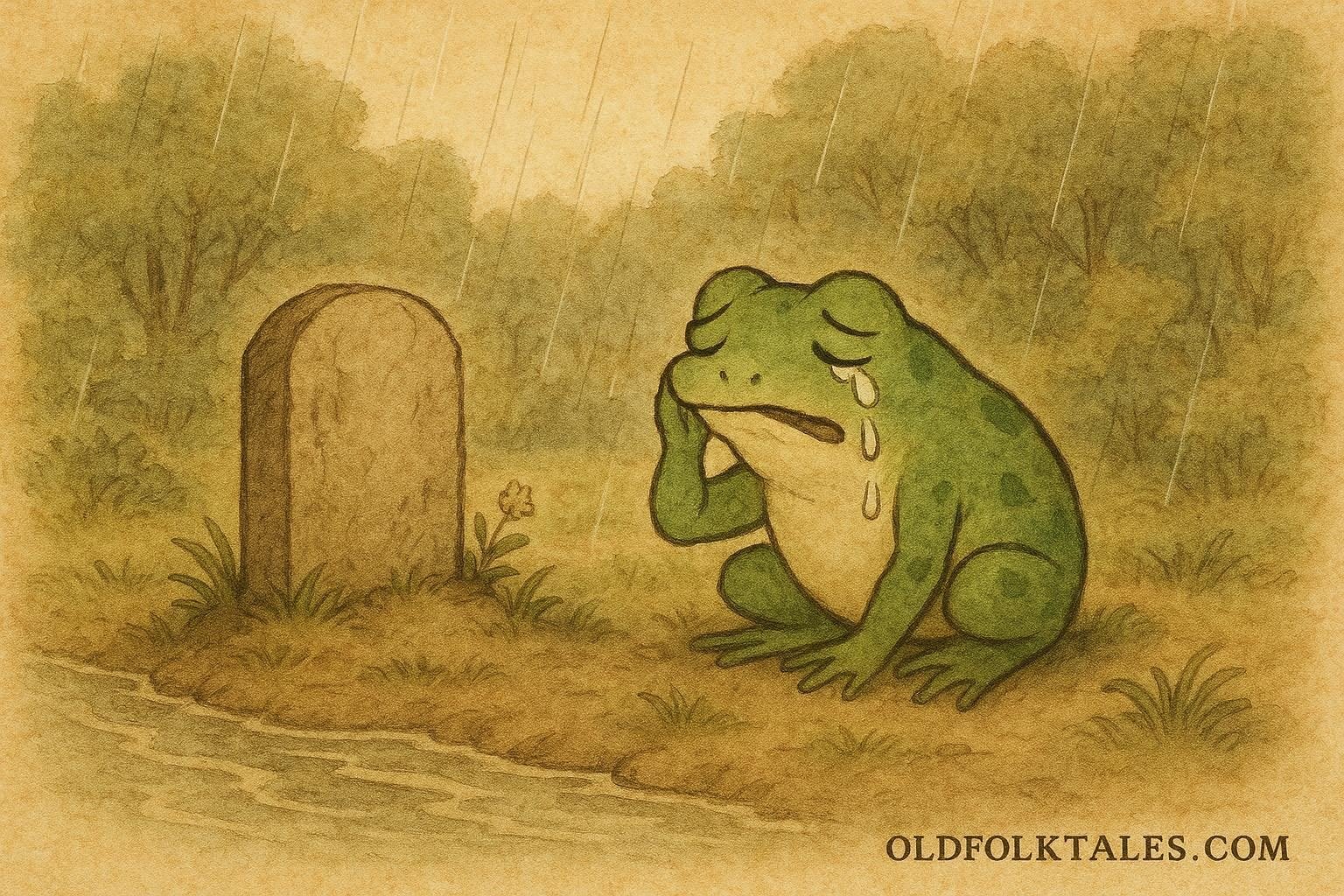
In a quiet village surrounded by willow trees and winding streams, there lived a young green frog whose mischief was known to everyone. While the other animals followed the rhythms of nature with contentment, this little frog chose to rebel against anything and everything. If his friends hopped left, he hopped right. If the breeze suggested he rest in the shade, he leapt into the sunshine instead. His name was Cheonggaeguri, but most simply called him the green frog who never listened.
His mother, a patient and loving frog, spent her days trying to guide him. She taught him where to find food, how to stay safe, and how to respect the world around him. Yet Cheonggaeguri always did the opposite of whatever she said. If she told him to stay close to the pond, he wandered deep into the fields. If she asked him to clean their home, he only made a bigger mess. If she begged him to sing quietly at night, he croaked loudly until the stars quivered.
Despite his stubborn behavior, the mother frog never stopped caring for him. She scolded him, yes, but her scolding was always warm and full of worry rather than anger. She hoped that one day he would understand her guidance. Sometimes she would sit beside him by the riverbank and speak softly about the importance of listening, respect, and growing into a responsible frog. But even on those calm evenings, he would roll onto his back and pretend the clouds were speaking instead.
Explore ancient tales from Thailand, Cambodia, and the Philippines in Southeast Asian Folktales.
The villagers often shook their heads when they saw him. Some laughed, some frowned, and some whispered that the green frog would never change. His mother worried more deeply as the years passed. She felt her strength weakening. Each morning she woke with a heavier heart, praying that her son would show even the smallest sign of understanding.
One day, after Cheonggaeguri had once again run off instead of helping her gather food, the mother frog sat alone by the riverbank. The water moved quietly, reflecting her tired face. She realized she might not have much time left. Her greatest fear was not that she would die, but that her son would remain lost in his defiance forever. She wondered what would become of him without her.
When Cheonggaeguri returned and saw her sitting so still, he felt a strange uneasiness. For the first time, he noticed how frail she looked. Her breathing was shallow, and her eyes could not hide their sadness. He hopped closer and asked what was wrong. She smiled gently and patted his head.
She told him that she was ill and did not know how much longer she could stay with him. Cheonggaeguri’s heart tightened. He had never considered the possibility of losing her. The thought made him tremble. The mother frog looked into her son’s eyes with a deep, quiet love. She told him her final request.
She said that when she passed away, she wished to be buried high on the mountain where the soil was dry and safe. She told him that the riverbank was too wet and that bodies buried there might be washed away by the flowing water. But in her worry, she remembered his lifelong disobedience. Fear struck her heart. If she told him to bury her on the mountain, would he stubbornly place her by the river instead? Would her resting place be disturbed forever?
With trembling hesitation, she reversed her instructions. She asked him to bury her by the riverbank. She hoped that this time, perhaps for the first time, he would do the opposite and choose the mountain instead. When she finished speaking, she looked at him with both hope and sorrow.
That night, while the wind whispered through the reeds, the mother frog passed away peacefully. Cheonggaeguri sat beside her, devastated. He cried until the morning sun rose over the hills. The world felt empty. He realized too late how deeply she had loved him, how much she had tried to teach him, and how carelessly he had treated her guidance.
For the first time in his life, Cheonggaeguri decided he would obey her. He believed that fulfilling her final request was the only way to honor her. Remembering her words, he carried her gently to the riverbank. He dug a small grave with his trembling hands and laid her to rest with all the care he had never shown before. As he placed the last handful of earth over her, he whispered that he was sorry for every moment he had caused her pain.
Soon after, rain clouds gathered above the village. Heavy drops began to fall, and the river rose with alarming speed. Wind swept through the trees as thunder rolled across the sky. Cheonggaeguri realized too late why his mother had always warned him about the river. The water swelled dangerously, threatening to wash away the grave he had made with such devotion.
Terrified and regretful, he clung to the mound of earth, crying out to his mother as the rain poured around him. His voice echoed across the valley with a grief so raw that even the thunder seemed to pause. From that day on, whenever rain darkened the sky, the green frog returned to the riverbank to weep. His cries carried through the air, a mournful reminder of the obedience he found only too late.
Generations passed, and villagers came to believe that the cries of frogs by the rivers were the echoes of Cheonggaeguri’s sorrow. They said that frogs wail before storms because they fear the rising waters will disturb the place where a loving mother rests.
Thus the tale of the green frog became a lesson shared with children for centuries, reminding them that regret is a heavy burden, and that listening to those who care for us is a gift, not a chore. And even today, when the rain begins to fall and the rivers swell, the sound of the frogs carries the memory of a son’s tears.
Discover more East Asian Folktales from the lands of dragons, cherry blossoms, and mountain spirits.
Moral Lesson
Obedience and gratitude should be shown while our loved ones are still with us, for regret often comes too late.
Knowledge Check
- Why was the green frog known throughout the village?
Answer: Because he always did the opposite of what he was told. - What caused the mother frog the greatest worry?
Answer: That her son would remain disobedient even after her death. - Why did the mother frog tell him to bury her by the river?
Answer: She hoped he would do the opposite and choose the safe mountain. - Why did Cheonggaeguri obey her instructions after she died?
Answer: He finally understood her love and wanted to honor her. - What happened after he buried her by the river?
Answer: A storm came and threatened to wash her grave away. - Why do people say frogs cry by rivers before rain?
Answer: They believe the frogs echo Cheonggaeguri’s sorrow and fear for his mother’s resting place.
Source
Adapted from Korea Literature Translation Institute Children’s Classics Archive, 2016.
Cultural Origin
Korean children’s morality folklore.








