In the verdant forests of ancient Cambodia, where towering trees created canopies so dense that sunlight filtered through in golden streams, there lived a small hare beside a crystal-clear pond. This pond was no ordinary watering hole its surface was so still and pure that it reflected the sky like polished silver, and the moon, when she rose at night, would gaze upon her own face in the water with evident pleasure. For the hare, this pond was everything: home, sanctuary, and the center of its small but peaceful world.
The hare had made its burrow in the soft earth near the water’s edge, beneath the gnarled roots of an ancient fig tree whose branches spread like protective arms over the pond. Every morning, the hare would emerge to drink from the cool waters and nibble on the tender shoots that grew along the bank. Every evening, as the sun painted the sky in shades of amber and crimson, the hare would return to watch the moon rise and cast her luminous reflection upon the pond’s glassy surface. Life was simple, orderly, and safe.
Click to read all East Asian Folktales — including beloved stories from China, Japan, Korea, and Mongolia.
But one day, the tranquility was shattered by a sound that made the very earth tremble. It began as a distant rumbling, like approaching thunder, and grew steadily louder until the ground itself seemed to quake. The hare emerged from its burrow, whiskers twitching with alarm, just in time to see an enormous elephant bull crashing through the forest undergrowth.
This was no ordinary elephant. He was massive beyond measure, with tusks that curved like ivory scimitars and a body that seemed as solid and immovable as a mountain. His trunk swung from side to side as he walked, powerful enough to uproot trees and crush boulders. His footsteps left deep impressions in the earth, and when he trumpeted, birds scattered from the trees in frightened clouds.
The elephant had caught the scent of water, and nothing would deter him from his goal. He lumbered directly toward the pond, his huge feet thundering against the ground with each step. The hare watched in growing horror as the giant beast approached the precious water source. When the elephant finally reached the pond’s edge, he plunged his trunk deep into the clear water and began to drink with great, sucking gulps that created whirlpools on the surface.
The elephant drank and drank, his massive body blocking the sunlight and casting a dark shadow across the water. With each draw of his trunk, the water level dropped visibly. Mud churned up from the bottom, clouding the once-crystalline pond. The elephant’s enormous feet sank into the soft earth around the water’s edge, leaving deep craters that would fill with muddy water. After drinking his fill, the elephant waded directly into the pond to cool himself, and the water sloshed over the banks, flooding the hare’s carefully maintained burrow.
The small hare stood watching, its heart pounding with fear and despair. If this elephant continued to visit the pond, the hare’s entire world would be destroyed. The burrow would be trampled, the water would become permanently muddied and depleted, and the peaceful sanctuary would transform into a devastated wasteland. The hare was tiny barely reaching the elephant’s ankle and possessed no physical strength to challenge such a massive creature. Fighting was impossible. Fleeing would mean abandoning the only home it had ever known.
But what the hare lacked in size and strength, it possessed abundantly in intelligence. As the elephant prepared to leave, clearly intending to return the next day, the hare’s mind raced, considering and discarding various plans. Then, looking up at the sky where the afternoon sun was beginning its descent, an idea formed clever, audacious, and just possibly effective.
That evening, as twilight painted the forest in shades of purple and blue, the elephant returned to the pond. The hare was waiting, sitting at the water’s edge with an air of grave solemnity that seemed unusual for such a small creature. When the elephant approached, the hare did not flee but instead called out in a voice that carried surprising authority.
“Great elephant,” the hare said, “I must speak with you on a matter of utmost importance.”
The elephant, amused by the tiny creature’s boldness, paused and lowered his massive head. “What could a small hare possibly have to say to me?”
The hare’s voice became even more serious, almost trembling with what seemed like fear though whether the fear was of the elephant or of something else remained unclear. “I am the messenger of the moon god,” the hare declared. “The divine moon, who watches over all the waters of the earth, has sent me to deliver a warning.”
The elephant’s small eyes widened slightly. In those times, all creatures held the celestial beings in reverence, and the moon was considered a powerful deity whose favor or anger could determine the fate of mortals. “A warning?” the elephant asked, his voice losing some of its casual confidence.
“Yes,” the hare continued, its voice grave and ceremonious. “The moon god has seen how you disturbed the sacred waters of this pond. You have muddied the reflection in which the divine moon gazes upon her own face. You have drunk without asking permission from the deity who rules over all waters. The moon god is deeply angry with you.”
The elephant shifted nervously, his huge feet shuffling in the mud. “But I meant no disrespect,” he protested. “I was merely thirsty.”
“Ignorance does not excuse offense against the divine,” the hare replied, sounding very much like a priest delivering judgment. “However, the moon god is merciful. If you wish to avoid divine punishment, you must come with me tonight. The moon will appear in person to show you the depth of the anger you have provoked. Perhaps, if you show proper contrition, you may yet escape terrible consequences.”
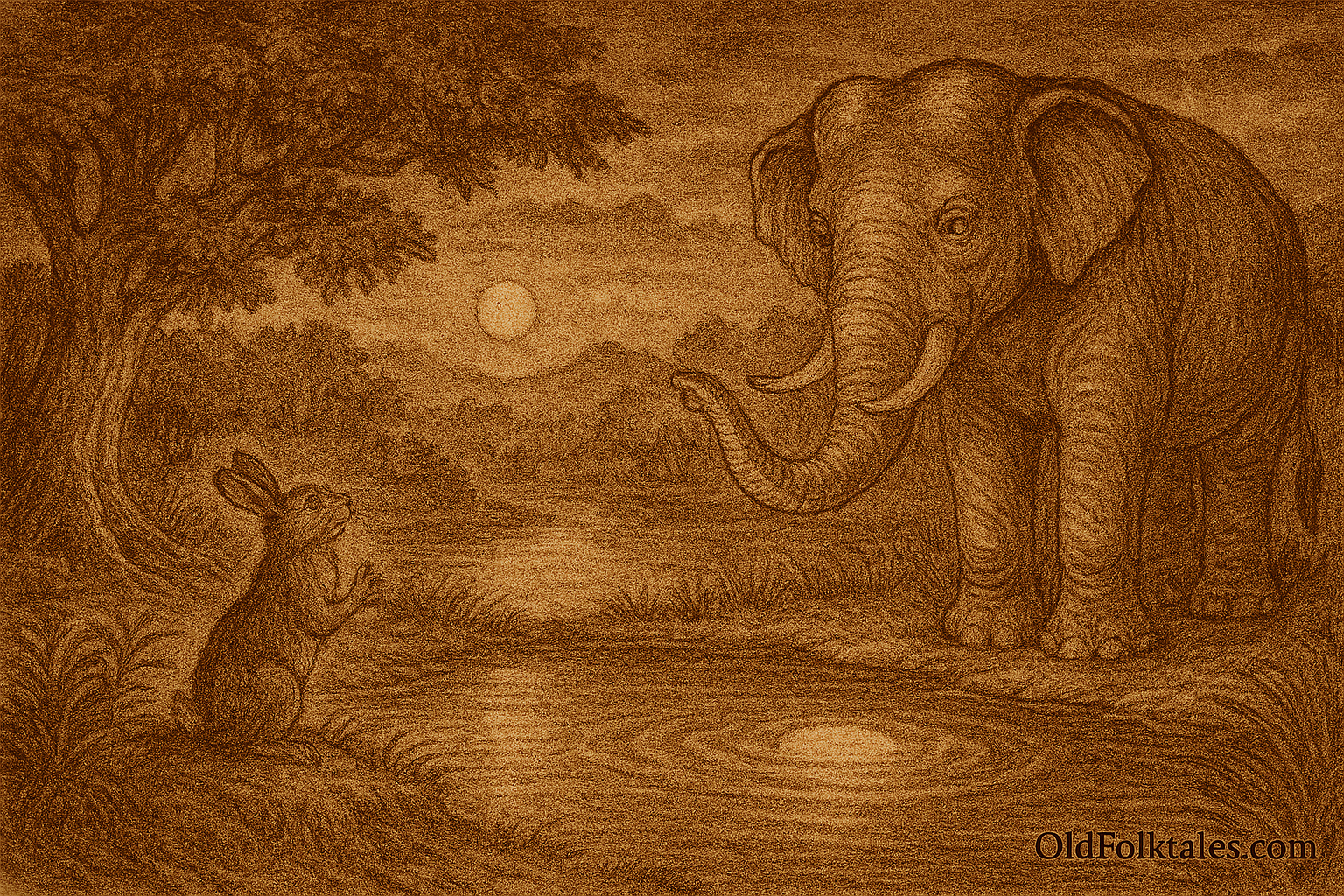
The elephant, now thoroughly frightened, agreed immediately. As darkness fell and the full moon rose like a silver disc above the forest, the hare led the elephant to a different part of the pond a section where the water was especially still and deep, surrounded by overhanging trees that blocked the wind. The moon’s reflection appeared on the water’s surface, perfectly round and luminous, seeming to float just beneath the surface like a captured pearl of light.
“There,” the hare whispered, pointing with one small paw toward the reflection. “Do you see? The moon god has descended into the water to confront you. Look how the divine face glows with anger!”
The elephant stared at the reflection, his heart pounding with fear. The moon did indeed seem to be glaring up at him from the depths of the pond, her light both beautiful and terrible. Then the hare, in a stroke of pure genius, urged the elephant to approach the water and acknowledge the deity’s presence.
As the elephant nervously stepped closer and extended his trunk toward the water, the reflection shattered into a thousand rippling fragments of light. To the elephant, it appeared as though the moon god had exploded with rage at his approach, her face breaking apart in fury.
“You see!” the hare cried out. “The moon god is so angry that even your shadow disturbs the divine presence! You must leave this place immediately and never return, or the moon’s wrath will surely destroy you!”
The elephant, now completely terrified, trumpeted in fear and turned to flee. His massive body crashed back through the forest, away from the pond, away from the angry moon god, and away from the tiny hare who had saved its home through cleverness rather than force. The elephant ran until he was far from that place, and he never returned to disturb the pond again.
The hare watched the elephant disappear into the forest, then turned to look at the pond. Already, the water was clearing, the moon’s reflection reappearing whole and serene on the smooth surface. The small creature had faced impossible odds and emerged victorious, not through strength or violence, but through wisdom, quick thinking, and understanding of the world beyond mere physical power.
Click to read all Southeast Asian Folktales — featuring legends from Thailand, Indonesia, Vietnam, and the Philippines.
The Moral Lesson
This Buddhist tale teaches that wisdom and intelligence are far more powerful than brute strength or physical size. The hare, though small and vulnerable, was able to protect its home by understanding the elephant’s beliefs and using clever strategy rather than attempting impossible physical confrontation. The story embodies the Buddhist principle that enlightened thinking and ethical cleverness can overcome any obstacle, and that even the mightiest can be guided by the wisdom of the smallest. It reminds us that true power lies not in muscles or size, but in the ability to think clearly, act wisely, and understand the hearts and minds of others.
Knowledge Check
Q1: What was the hare’s main concern when the elephant came to the pond?
A1: The hare feared that its entire home and way of life would be destroyed if the massive elephant continued visiting the pond. The elephant’s drinking depleted the water, his bathing muddied the clear pond, and his enormous feet trampled the earth around the water’s edge, flooding and threatening to destroy the hare’s burrow beneath the fig tree.
Q2: Why couldn’t the hare use physical strength to solve its problem with the elephant?
A2: The hare was extremely small compared to the elephant barely reaching the giant creature’s ankle and possessed no physical power to challenge such a massive beast. Direct confrontation or fighting was impossible, making the hare’s intelligence and cleverness its only viable tools for protecting its home.
Q3: What clever strategy did the hare use to frighten away the elephant?
A3: The hare claimed to be a messenger of the moon god and told the elephant that the deity was angry about the disturbance of the sacred waters. The hare then led the elephant to see the moon’s reflection in the pond, presenting it as the moon god appearing in person. When the elephant’s approach shattered the reflection into ripples, it appeared as divine rage, terrifying the elephant into fleeing permanently.
Q4: What does the moon’s reflection symbolize in this Cambodian Buddhist tale?
A4: The moon’s reflection symbolizes how perception can be more powerful than reality, and how understanding another’s beliefs and worldview can be used to achieve peaceful solutions. It also represents the divine presence in nature that all creatures in the Buddhist tradition respect, making it the perfect tool for the hare’s non-violent strategy.
Q5: What Buddhist moral principles are illustrated in The Hare and the Elephant?
A5: The story illustrates several Buddhist principles: that wisdom and intelligence triumph over brute force, that ethical cleverness is preferable to violence, that even the smallest being can possess great wisdom, and that understanding and working within the beliefs and fears of others can achieve peaceful resolutions. It shows that enlightened thinking, not physical power, determines true strength.
Q6: How does this Jātaka tale reflect Cambodian cultural values?
A6: This tale reflects Cambodian Buddhist values that emphasize wisdom over violence, respect for divine forces in nature, and the importance of intelligence in navigating life’s challenges. As part of the Gatiloke tradition of Buddhist teaching stories, it uses animals to embody ethical lessons accessible to all people, showing that dharma (righteous living) relies on clever, compassionate thinking rather than force or aggression.
Cultural Origin: Cambodian Buddhist tradition (Jātaka-derived teaching tales), Cambodia, Southeast Asia