Long ago, deep in the green valleys and misty forests of Tibet, there lived a great lion, fierce, proud, and feared by all creatures. He was the strongest and most terrible beast in the land. Every day, he prowled through the forest, roaring with hunger and devouring any animal that crossed his path. None dared to challenge him. The smaller creatures, the deer, monkeys, and rabbits trembled at the sound of his mighty voice.
At last, the animals of the forest gathered beneath an ancient Bodhi tree to seek a way to survive. The old monkey spoke first. “If we go on like this,” he said, “none of us will live to see another moon.” The deer nodded sadly. “We cannot fight him; his claws are like knives, and his teeth are sharper than the rocks of the high cliffs.” After much debate, they agreed to send one animal each day to the lion as food, so that he would not hunt them all. Though it was a painful decision, it gave them a small hope of peace.
Days passed, and each morning, one poor creature went to meet the lion’s hunger. The forest grew quiet, filled only with sighs and fear. When it came time for the hare to go, he did not tremble. He was small and gentle, but his mind was quick as lightning. “If I go today,” he thought, “perhaps I can end this misery for all.”
Journey through enchanted forests and islands in our Southeast Asian Folktales collection.
He took his time, moving slowly through the forest, nibbling grass and thinking of a plan. By the time he reached the lion’s den, the sun was already high in the sky. The lion, furious with hunger, roared so loudly that the mountains echoed. “Why are you so late, little creature?” he thundered. “Do you not know I have been waiting for my meal?”
The hare bowed low, pretending to tremble. “Great King,” he said in a soft voice, “forgive my delay. I was on my way here early this morning, bringing another hare with me as an offering. But on the path, another lion appeared! He claimed to be the true ruler of this forest and said that you were nothing but a thief. He seized my companion and dared me to come tell you that if you are truly king, you should face him.”
The lion’s golden eyes blazed with fury. “Another lion?” he roared. “Where is he? Show me at once, and I will tear him to pieces!”
The clever hare bowed again. “He lives by the great well beyond the hill. He said he lives there because it is a magic well that reflects his kingdom.”
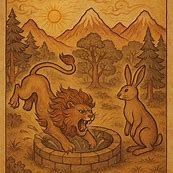
Without another word, the lion charged across the forest, his paws shaking the ground like thunder. The hare followed slowly, hiding a smile behind his whiskers. When they reached the well, the lion peered into its deep, still water. There, staring back at him, was his own reflection of a proud lion with blazing eyes and bared teeth. The foolish beast thought it was his rival.
The hare whispered, “There, mighty King, the imposter who insulted you.”
The lion roared into the well, and the echo came back just as loud. “How dare he roar at me!” he growled. Without hesitation, the lion leapt into the well to attack his reflection. The moment he plunged in, the water closed over his head, and he sank into the darkness below. The forest was still.
The hare looked down into the silent water and whispered, “The forest is free.”
He hurried back to the animals and told them what had happened. Joy spread through the forest like morning light. The monkeys leapt from branch to branch, the deer danced, and the birds sang again. “From this day forth,” said the old monkey, “we shall remember that wisdom is greater than strength.” And so the clever hare became a hero not for his size or strength, but for his courage and his mind.
Generations of Tibetan storytellers have told this tale to children around the fire, teaching that true power lies not in muscles or claws, but in cleverness guided by compassion. The story also carries a Buddhist lesson — that pride and anger destroy themselves, while patience and intelligence bring peace. The lion’s downfall was not the hare’s cruelty, but his own arrogance reflected in the still water.
To this day, the tale of The Hare and the Lion reminds listeners across the Himalayas that no matter how small or weak one may appear, a wise heart can overcome the mightiest of foes.
Moral Lesson
Wisdom and calm thinking can triumph over brute force and anger. Arrogance blinds the strong, but patience and intelligence lead to safety and justice.
Knowledge Check
-
Why were the animals afraid of the lion?
Because he was cruel and killed many creatures every day. -
What plan did the animals make to protect themselves?
They agreed that one animal would go each day to serve as food for the lion, so the rest could live. -
Why did the hare delay his visit to the lion?
He delayed on purpose to make the lion angry and to give time for his clever plan to work. -
How did the hare trick the lion?
He told the lion that another lion lived in a well and claimed to be the true ruler, making the proud lion rush to attack his reflection. -
What happened to the lion in the end?
He jumped into the well to fight his reflection and drowned. -
What lesson or moral does this story teach?
That wisdom and intelligence can defeat pride and brute strength; anger and arrogance lead to one’s downfall.
Source:
Adapted from the Tibetan folktale “The Hare and the Lion” in Folk Tales from Tibet, collected and translated by W. F. O’Connor (1906), London: Hurst and Blackett.Cultural Origin: Tibet (Buddhist Jātaka and oral folktale tradition)