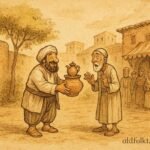
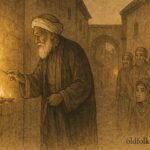
Once, in a distant Syrian kingdom, there lived a prince and his wife, a woman of grace yet often misunderstood. Though bound by marriage and years of companionship, the two rarely saw eye to eye. Every disagreement between them ended with the prince uttering the same bitter words:
“It’s not your fault, it’s your father’s fault, for he did not teach you good manners.”
Time passed, their hair turned grey, but the quarrels never ceased. Their three sons grew into men, each moving to a different town to build a life of his own. Yet the tension between their parents remained as constant as the desert wind.
One day, the prince’s temper boiled over. His wife’s words, though simple, pierced his pride. Once again, he shouted, “It’s not your fault, it’s your father’s fault because he didn’t raise you well!” But this time, his anger drove him to a decision he had long withheld: he would divorce her and send her back to her father in shame.
Still, a small voice of reason whispered in his mind. What would people say? What would my sons think of me? He could not risk being seen as unjust. And so, he conceived a plan, a riddle that would decide her fate and his conscience.
Calling his wife before him, the prince declared solemnly:
“Take this riddle to your father, the man who failed to teach you wisdom. If he answers it correctly, you shall be forgiven. But if he fails, both your heads will be cut off.”
The woman trembled as her husband pronounced the challenge:
“Tell me, what is the lightest thing of all, and what is the heaviest thing of all?”
Without delay, she journeyed to her father’s home. Her heart was heavy, but she clung to the hope that her father’s wisdom would save them both. When she arrived, she knelt and told him everything, her husband’s anger, the riddle, and the cruel punishment that awaited if he failed to solve it.
The old man, calm and confident, replied:
“That is simple, my child. The lightest thing of all is cotton, and the heaviest thing of all is lead.”
Relieved, the woman spent the night under her father’s roof, then set off early the next morning to return home.
On her way, she stopped in the town of her eldest son. Overjoyed to see her, he welcomed her warmly. After exchanging greetings, she told him about the riddle and her father’s answer. The eldest son nodded approvingly. “Yes, Mother, that seems right enough,” he said.
Encouraged, she continued her journey and stopped in the village of her second son, who also agreed that his grandfather’s answer made sense.
But when she reached her youngest son’s home, the story took a different turn. After listening carefully, he frowned and said gently, “Mother, your father’s answer is wrong. If you tell that to Father, both of you will perish.”
The mother’s heart skipped a beat. “Then, my son, what should I say?”
The young man paused, thinking deeply, then said:
“Tell him this, the lightest of all are the bountiful, and the heaviest of all are the destitute. But promise me, Mother, do not tell Father that I gave you the answer.”
The woman thanked her son, embraced him, and continued home, clutching his words as though they were jewels.
When she stood once more before her husband, she bowed and answered the riddle:
“The lightest of all are the bountiful, and the heaviest of all are the destitute.”
The prince’s eyes gleamed with satisfaction. “That is a wise answer,” he said slowly. “But I doubt your father gave it to you. Did you visit our youngest son?”
The woman quickly denied it. “No, my lord, I went straight to my father and returned.”
The prince, however, was not so easily fooled. Whispering to one of his servants, he instructed him to run outside and return pretending to bring terrible news. Moments later, the servant burst into the room crying:
“My lord, a dotted snake has bitten the little prince!”
The woman gasped, her composure breaking. “Oh, my God! How could that be? I just saw him, and he was fine!”
At that, the prince smiled knowingly. Her reaction had betrayed the truth. He sent for the youngest son at once.
When the young man arrived, the prince confronted him. “Tell me, did you give your mother the answer to my riddle?”
The son bowed his head. “Yes, Father, I did.”
The prince leaned back, stroking his beard. “Very well,” he said. “I shall give you another riddle. If you answer correctly, you, your mother, and your grandfather shall live. But if you fail, all three of you shall die.”
The hall fell silent. The prince’s eyes bore into his son’s as he asked:
“If you were the judge of the royal treasury, and a bountiful man came before you with a destitute man, how would you judge between them?”
Without hesitation, the son replied, “I would take from the bountiful and give to the destitute.”
The prince continued, “And if two destitute men came before you?”
The young man thought briefly, then said, “I would take money from the treasury and give to both of them.”
The prince’s eyes narrowed. “And if two bountiful men came before you?”
The young man smiled. “Then, Father, I do not think two bountiful men would need the treasury.”
For a moment, the prince was silent. Then, with admiration, he rose from his seat and embraced his son.
“My son,” he said, “you are wiser than your mother and your grandfather. From this day, you shall rule in my place.”
And so, the prince relinquished his throne to his youngest son, forgiving his wife and her father. Peace finally returned to the palace, and the land was ruled with fairness and wisdom ever after.
Moral Lesson
True wisdom does not come from age or rank but from understanding the value of kindness and balance. Generosity lightens the heart, while greed and want weigh the soul down.
Knowledge Check
1. Who gave the correct answer to the prince’s riddle?
The youngest son gave the correct answer: “The lightest are the bountiful, and the heaviest are the destitute.”
2. What was the wrong answer given by the wife’s father?
He said the lightest thing was cotton and the heaviest was lead.
3. What quality does the story value most?
The story praises wisdom, fairness, and generosity.
4. How did the prince discover that his wife’s answer came from their son?
He tricked her by having a servant pretend that their youngest son had been bitten by a snake, and her reaction gave her away.
5. What did the prince do after hearing his youngest son’s wise answers?
He forgave his wife and father-in-law and made his youngest son the new prince.
6. What culture does this folktale come from?
It originates from Syrian folklore, part of the Middle Eastern storytelling tradition.
Source: Adapted from the Syrian folktale “The Heaviest and the Lightest of All” in Syrian Folktales Anthology, collected by Cultural Heritage without Borders (CHwB, 2015).
Cultural Origin: Syria (Middle Eastern folklore)