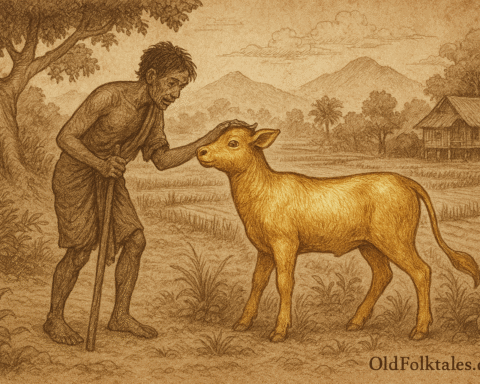
In a small Thai village nestled between green rice paddies and winding rivers, there lived a humble farmer named Somchai. Each morning, he rose before sunrise, offering a quiet prayer of gratitude before tending his fields. Though his clothes were worn and his home was simple, his heart was pure, and his hands were never idle.
One hot afternoon, while plowing his field, Somchai’s hoe struck something hard beneath the soil. Curious, he dug it up and discovered a leather purse heavy with gold coins. The sunlight caught the glint of gold, and his heart pounded. He looked around there was no one in sight. For a moment, the farmer stood still, listening to the whisper of the wind through the palms.
He could have hidden the purse and told no one. But Somchai believed that honesty was a gift greater than gold. He carefully tied the purse in his cloth bag and walked to the village chief’s house.
Discover more East Asian Folktales from the lands of dragons, cherry blossoms, and mountain spirits.
“Chief,” he said, bowing respectfully, “I found this in my field today. Surely, someone must have lost it. Please keep it safe until the owner comes.”
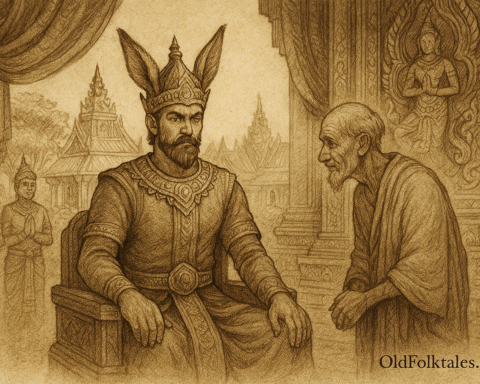
The chief, an old man wise in the ways of the world, nodded approvingly. “Somchai, you have done what few would do. The spirits of the land will bless you for this.”
The next morning, word spread quickly through the market that a lost purse filled with gold had been found. Before long, a wealthy merchant named Channarong appeared at the chief’s house, claiming ownership.
“That purse is mine!” he declared loudly. “I lost it while traveling to the next town. It contained one hundred gold coins.”
The chief looked at the purse. “We shall count the coins to be certain,” he said calmly.
When they opened it, they found exactly eighty coins inside.
“This cannot be my purse!” cried the merchant. “Mine held a hundred coins!”
The farmer looked surprised. “I did not take or add anything,” he said softly. “It was just as I found it.”
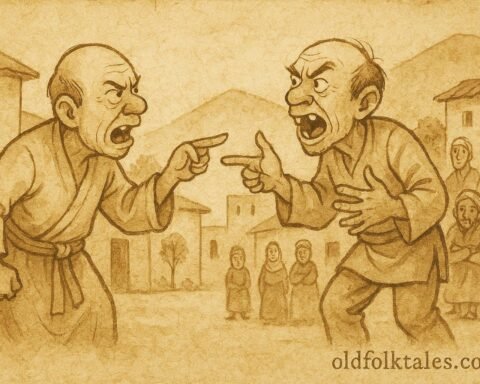
The merchant glared at him, his voice rising. “Lies! You are a thief pretending to be honest!”
The chief raised his hand for silence. “Enough,” he said sternly. “Let us think carefully.”
After a moment of thought, the chief turned to the merchant. “You say your purse had one hundred coins, and this purse has only eighty. Then surely this cannot be yours.”
The merchant blinked in confusion. “What do you mean?”
“This purse,” the chief continued, “belongs to the one who lost eighty coins, not a hundred. If yours had one hundred, this is not yours. You may continue searching for your missing gold elsewhere.”
The crowd burst into laughter as the merchant’s face turned red with shame. He realized his greed had betrayed him. Unable to argue, he left the village in disgrace.
The chief then turned to Somchai. “Since no true owner has come forward, and the purse does not match the merchant’s claim, this gold now belongs to you. You found it with honesty and returned it with integrity.”
Somchai bowed deeply. “Thank you, Chief. I will use it wisely to help my neighbors and improve our fields.”
And true to his word, he shared his good fortune with the villagers, repairing the temple roof and building a small bridge over the stream that often flooded their path.
From that day on, children in the village grew up hearing the tale of Somchai the honest farmer, a story told beneath starlit skies and in temple courtyards to remind all that truth, though simple, shines brighter than gold.
Moral Lesson
The story of The Honest Farmer and the Greedy Merchant teaches that honesty and integrity always prevail over greed and deceit. True wealth lies not in riches but in a pure heart and a clear conscience.
Knowledge Check
-
What did the farmer find while plowing his field?
-
A purse filled with gold coins.
-
-
What did he do after finding the purse?
-
He took it to the village chief to find its rightful owner.
-
-
How did the merchant try to deceive the chief?
-
He falsely claimed that the purse had contained more coins than it did.
-
-
What was the chief’s clever judgment?
-
Since the purse found had fewer coins than the merchant claimed, it could not be his.
-
-
What did the chief decide to do with the purse?
-
He awarded it to the honest farmer.
-
-
What is the main moral of the story?
-
Honesty brings reward and peace, while greed leads to shame.
-
Source
Adapted from the Thai folktale “The Honest Farmer and the Greedy Merchant” in Folk Tales from Thailand, collected by Phya Anuman Rajadhon (1954), Bangkok: Thai National Museum Archives.
Cultural Origin: Thailand (Traditional Thai village folklore and moral tales)