
In a village nestled between emerald rice paddies and the deep, ancient forest of Indonesia, there lived a hunter whose skill was unmatched. His name was Jaya, and his arrows flew straighter than any other man’s in the kampung. He could track a deer through the thickest undergrowth, sense a wild boar’s movements before it stirred, and bring down game that others could only dream of catching.
But Jaya’s talent had bred something dangerous within him a swelling pride that pushed aside the wisdom of his ancestors. The village elders had taught him the pantang, the sacred prohibitions that governed the relationship between hunter and forest. These were not mere suggestions but ancient covenants: never mock the animals you hunt, always use every part of what you kill, offer gratitude to the forest spirits, and treat the wilderness with the reverence it deserves.
Click to read all East Asian Folktales — including beloved stories from China, Japan, Korea, and Mongolia.
Jaya had begun to forget these teachings.
On his hunts, he would laugh cruelly when a wounded deer stumbled, mimicking its frightened cries for his own amusement. He took more meat than his family needed, leaving carcasses to rot in the undergrowth, their flesh turning to waste beneath the indifferent sun. When other hunters reminded him of the old ways, he would wave them off with a dismissive hand.
“The forest provides endlessly,” he would say, his voice thick with arrogance. “Why should I concern myself with spirits and superstitions? My skill is what matters, not these old wives’ tales.”
The older hunters would shake their heads, their faces grave with concern. They knew what Jaya did not that the forest was alive in ways the young man refused to see, and that it was listening.
One evening, as the sun melted into the horizon like palm oil spreading across water, Jaya entered the forest alone. The trees stood tall and silent, their canopy filtering the dying light into scattered coins of gold and shadow. He walked deeper than usual, following tracks that seemed almost too easy to read, too clear to be natural.
The forest around him began to change. The familiar paths twisted into configurations he didn’t recognize. Trees he could have sworn he’d passed seemed to multiply, their trunks forming walls that hemmed him in. The bird calls that usually guided him home fell silent, replaced by sounds that made his skin prickle whispers that seemed to come from the leaves themselves, laughter that echoed from no visible source.
He tried to retrace his steps, but the forest had become a maze. Every direction looked the same, every landmark had vanished. The spirits of the forest the hantu and dewata that his grandmother had warned him about had taken hold of him, leading him deeper into their realm as punishment for his disrespect.
Night fell like a heavy blanket, and Jaya found himself truly lost for the first time in his life. The darkness was absolute, pressing against him from all sides. Strange lights flickered between the trees will-o’-wisps that danced just out of reach, luring him further astray whenever he tried to follow them. Shadows moved with purpose, circling him, and he heard voices speaking in languages he almost but didn’t quite understand.
Days blurred together. Jaya wandered, growing weaker with each passing hour. His throat burned with thirst, his stomach cramped with hunger. The confident hunter had been reduced to a frightened, stumbling man, no better than the wounded animals he had once mocked. He tried to catch game, but his arrows flew wide, as if the forest itself deflected them. He tried to find water, but every stream he approached would vanish before he could drink.
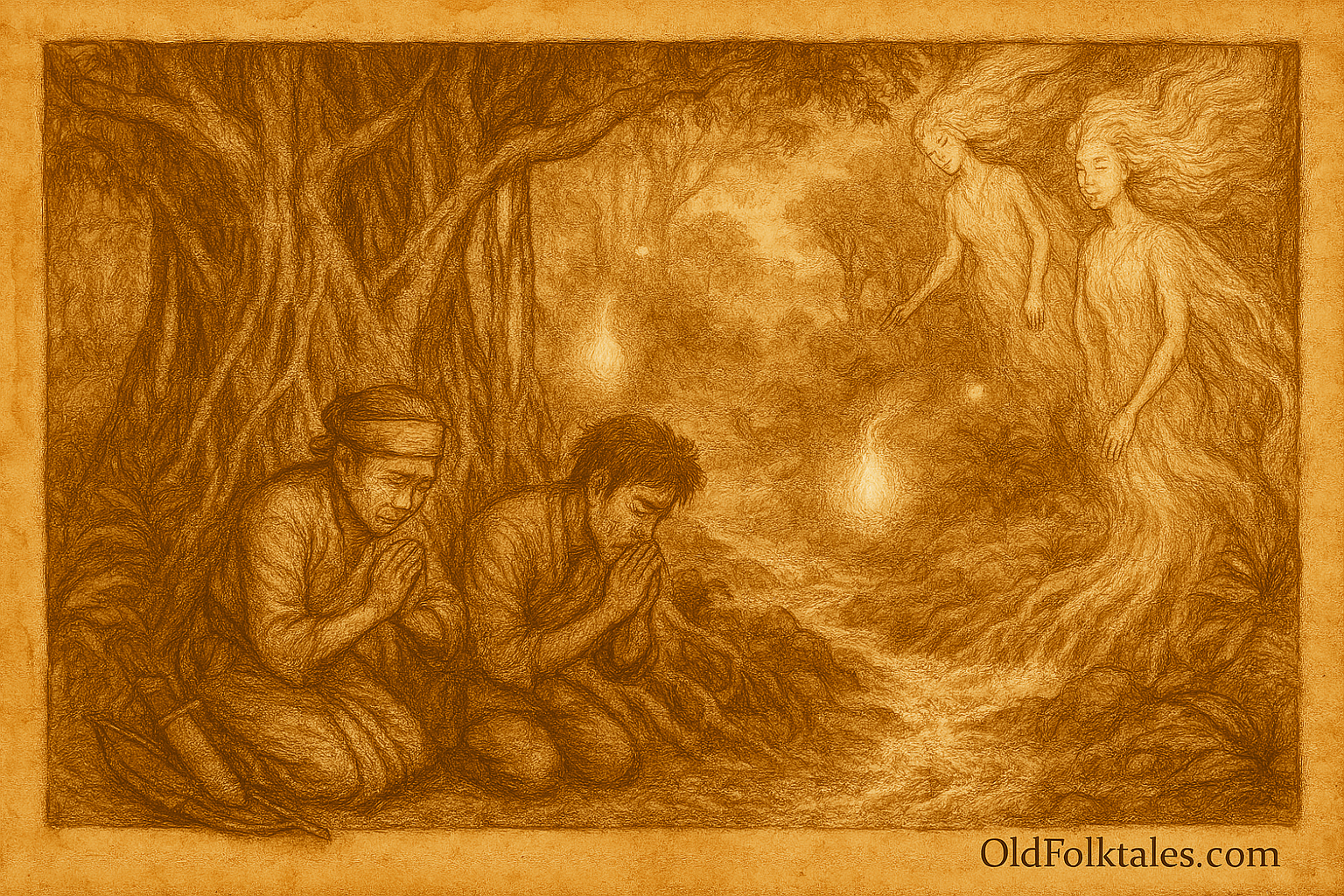
On what might have been the third or fourth night he had lost count Jaya collapsed beneath a massive banyan tree. Its aerial roots hung down like the bars of a cage, and in his delirium, he felt the weight of his transgressions crushing down upon him. He remembered the deer he had mocked, the meat he had wasted, the spirits he had scorned.
With the last of his strength, Jaya pressed his forehead to the earth and spoke not with arrogance, but with genuine remorse.
“Forgive me,” he whispered to the forest, to the spirits, to every creature he had wronged. “I have been a fool. I have taken without gratitude, killed without respect, and mocked what I should have honored. If you grant me life, I swear by my ancestors that I will uphold the pantang. I will hunt only what I need, waste nothing, and teach others to respect the sacred balance.”
The forest seemed to hold its breath. Then, slowly, the oppressive darkness began to lift. The first light of dawn filtered through the canopy, and with it came the sound he had been longing for the distant crow of a rooster from his village. The trees parted, revealing a path he recognized, and Jaya understood that the spirits had heard him.
He stumbled home to find his family gathered in mourning, certain he had perished. When he appeared at the village edge, gaunt and humbled, there were tears of relief and wonder. But Jaya never boasted of his survival. Instead, he told his story as a warning, and from that day forward, he became the most faithful observer of the pantang, teaching the young hunters the sacred laws with the fervor of one who had learned their importance the hardest way possible.
Click to read all Southeast Asian Folktales — featuring legends from Thailand, Indonesia, Vietnam, and the Philippines.
The Moral Lesson
This folktale teaches that arrogance and disrespect toward nature carry consequences. The traditional pantang exists not as mere superstition but as accumulated wisdom meant to maintain harmony between humans and the natural world. True strength lies not in dominating nature but in understanding our place within it, showing gratitude for what we receive, and exercising restraint even when we possess skill and power. Pride that dismisses ancient wisdom leads to downfall, while humility and respect create sustainable relationships with the world around us.
Knowledge Check
Q1: Who is Jaya and what makes him special in his village?
A: Jaya is a highly skilled hunter in an Indonesian village whose accuracy and tracking abilities are unmatched by any other hunter in the community. However, his exceptional talent leads to dangerous pride.
Q2: What are the pantang and why are they important?
A: The pantang are sacred prohibitions or traditional rules that govern the relationship between hunters and the forest. They include never mocking animals, using every part of what you kill, offering gratitude to forest spirits, and treating the wilderness with reverence. They maintain balance and harmony with nature.
Q3: What specific rules does Jaya break that anger the forest spirits?
A: Jaya mocks wounded animals by imitating their cries, wastes meat by leaving carcasses to rot, takes more than he needs, and dismisses the wisdom of the forest spirits as mere superstition, showing no gratitude for what the forest provides.
Q4: How do the forest spirits punish Jaya for his disrespect?
A: The forest spirits lead Jaya astray, causing him to become hopelessly lost. They make familiar paths unrecognizable, create illusions with will-o’-wisps, prevent him from catching game or finding water, and trap him in the forest for days until he genuinely repents.
Q5: What must Jaya do to escape the forest and return home?
A: Jaya must genuinely repent for his actions by pressing his forehead to the earth and sincerely apologizing to the forest, the spirits, and the creatures he wronged. He promises to uphold the pantang, hunt responsibly, waste nothing, and teach others to respect the sacred balance.
Q6: What cultural message does this Indonesian folktale convey about nature?
A: The folktale conveys that nature is not merely a resource to exploit but a living entity deserving respect and reverence. It emphasizes the Indonesian cultural belief in maintaining harmony between humans and the natural world through traditional wisdom, restraint, and gratitude rather than domination.
Source: Adapted from traditional Indonesian oral folklore of the Malay archipelago, collected in Indonesian Folktales by Murti Bunanta.
Cultural Origin: Malay-Indonesian tradition, Southeast Asia (Indonesia)








