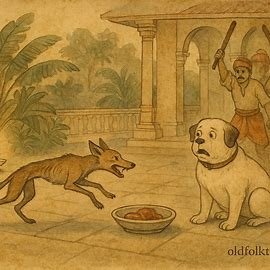
In a quiet village that nestled near the royal palace of an ancient Sri Lankan kingdom, there lived a sleek dog who belonged to the king himself. Every day, this royal dog feasted on the richest morsels, tender meats from the palace kitchen, bones soaked in gravy, and bits of food too fine for even the nobles’ tables. His fur gleamed, and his belly was always full.
Not far away, among the shadows of the outer walls, prowled a lean and hungry jackal. His ribs showed through his skin, and his sharp eyes glowed with envy each time he watched the palace dog stroll through the courtyard, wagging his tail and basking in the attention of servants. The jackal lived on scraps, whatever he could steal from the rubbish heaps or scavenge in the forest.
Journey through enchanted forests and islands in our Southeast Asian Folktales collection.
One day, driven by jealousy and desperation, the jackal gathered his courage and approached the dog as he lay resting near the palace gate.
“Brother,” said the jackal, bowing slightly, “you live such a happy life! Look at your shining fur and plump body. Tell me, how is it that you are so fortunate? Would you not let me share your food and company?”
The dog, being good-natured and friendly, looked at the jackal with mild surprise. “Why not?” he replied with a wag of his tail. “Come with me to the palace. You shall eat as I eat and live as I live.”
The jackal’s heart leapt with joy. “Truly? You would do that for me?”
“Of course,” said the dog. “Come tonight when the servants bring our meal.”
That evening, as the lamps of the palace flickered and the scent of cooked meat filled the air, the jackal crept through the gate behind the dog. He marveled at the splendour of the courtyard, the glittering torches, the soft carpets, and the trays of food laid out for the royal animals.
When the servants placed a large dish of meat before the dog, the jackal could no longer control himself. Hunger had made him wild. With a snarl of greed, he lunged forward, tearing at the meat and growling as he ate.
The palace guards, startled by the sudden commotion, turned and saw the jackal, a wild creature covered in dust and hunger. “A thief! A beast from the jungle!” they shouted. Without hesitation, they struck at him with their sticks.
The jackal yelped in terror and pain. His meal forgotten, he bolted from the courtyard, dodging blows and leaping over the wall into the darkness. He ran through the night until he reached the safety of the forest, trembling and bleeding. There, beneath the cold light of the moon, he licked his wounds and wept.
Days passed. His body healed, but the sting of shame lingered. One morning, as he searched for food among the bushes near the village, the jackal saw his old friend, the king’s dog, approaching.
“Brother Jackal!” called the dog kindly. “Why did you not stay? The palace is safe, and the food is plentiful. I looked for you that night, but you had vanished.”
The jackal lowered his head and sighed deeply. “Friend,” he said, “I have learned that not every bowl is meant for every mouth. The palace food may be sweet, but it was never meant for me. My place is here, in the forest, where I belong.”
The dog looked at him with pity, but the jackal only smiled weakly. From that day on, he never again envied the lives of others. He lived as before, lean and wild, but at peace with what was his own.
Moral Lesson
Greed and envy make a poor feast. True wisdom lies in knowing one’s place and being content with one’s share in life.
Knowledge Check
1. Who are the main characters in “The Jackal and the King’s Dog”?
The main characters are a royal dog who lives in the king’s palace and a hungry jackal from a nearby village.
2. What motivates the jackal to approach the dog?
The jackal is driven by envy and hunger after seeing how well the dog is fed in the royal palace.
3. What happens when the jackal enters the palace?
Overcome by greed, the jackal eats too greedily, startling the guards, who then beat him and drive him away.
4. What does the jackal learn at the end of the story?
He learns that not all opportunities suit everyone and that greed and envy can lead to harm and shame.
5. What is the moral teaching of this Sri Lankan folktale?
The story teaches contentment and humility—understanding that happiness comes from accepting one’s own place in life.
6. What cultural symbolism does the jackal represent in Sri Lankan folklore?
In Sri Lankan village tales, the jackal often symbolizes cunning, restlessness, and the flaws of overreaching ambition.
Source
Adapted from the Sinhalese folktale “The Jackal and the Dog” in Village Folk-Tales of Ceylon, Vol. II, collected by H. Parker (1910), London: Luzac & Co.
Cultural Origin: Sri Lanka (Sinhalese folklore)