As summer reached its height and the cicadas sang endlessly in the trees, the villages of Japan prepared for Obon, the sacred season when the spirits of ancestors were believed to return to the world of the living. Houses were cleaned with care, family altars were refreshed with flowers and incense, and lanterns were crafted from paper and bamboo to welcome the unseen guests. It was during one such Obon season, in a quiet riverside village, that the story of the Lantern Ghost first came to be remembered.
The villagers believed that the boundary between worlds thinned during Obon, allowing spirits to walk unseen among the living. Most souls returned peacefully to their families, guided by the warm glow of lanterns placed at doorways and temples. Yet not all spirits remembered the way home. Some had died far from their villages. Others had passed with regrets or unfinished bonds. For these wandering souls, the path was unclear, and their longing lingered like mist over water.
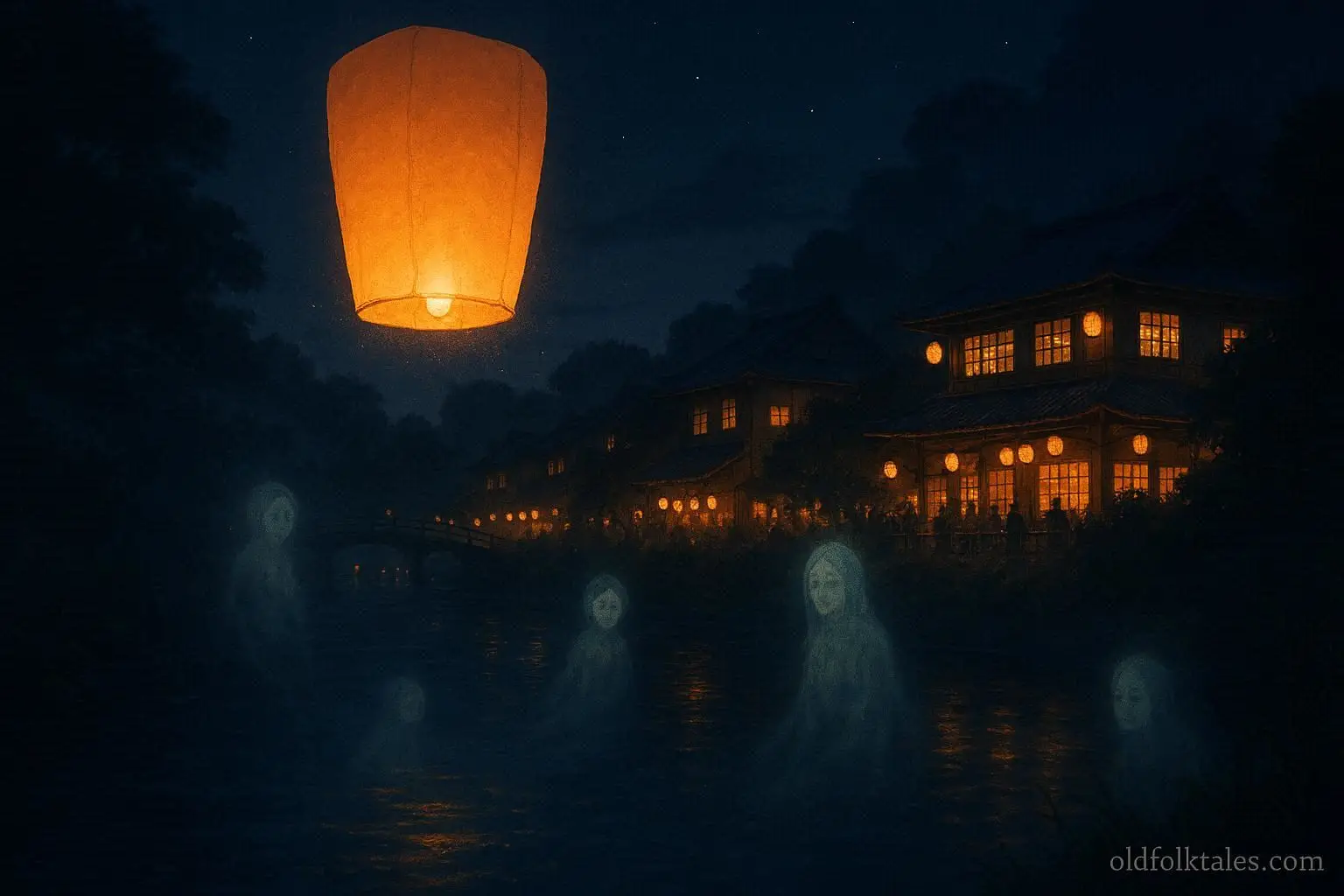
One evening, as dusk settled and the river reflected the deepening sky, a young monk named Haruto noticed a single lantern floating above the water. It did not rest on the river’s surface, nor did it drift with the current. Instead, it glided slowly, its light steady and calm, as though carried by an unseen hand. The lantern shone brighter than the others, casting a gentle glow that softened the shadows around it. Haruto watched in silence, sensing that what he beheld was no ordinary flame.
Explore ancient tales from Thailand, Cambodia, and the Philippines in Southeast Asian Folktales.
As the night deepened, villagers began to notice the lantern as well. Children clutched their parents’ sleeves, and elders whispered prayers under their breath. The lantern moved with purpose, drifting toward the forest path that led away from the village. Though fear stirred among some, others felt an unexpected sense of peace. The lantern’s glow did not threaten. It soothed, as if offering reassurance to all who gazed upon it.
Haruto followed at a respectful distance. The lantern led him beyond the rice fields, past the old shrine gate, and into the forest where the air grew cool and still. There, beneath an ancient cedar tree, stood the faint silhouettes of spirits. Their forms shimmered like reflections on water, their faces marked with confusion and longing. These were the lost souls, unable to find their way during Obon. The lantern hovered among them, its light growing brighter, illuminating a path back toward the village.
One by one, the spirits turned toward the glow. Their expressions softened as recognition dawned. Some wept silently. Others bowed in gratitude. The lantern moved slowly, patiently, guiding them along the forest path. Haruto followed, chanting softly, his voice steady and calm. The spirits drifted behind the lantern, their forms becoming clearer as they drew closer to the village.
As they reached the riverbank, the lantern paused. Families had gathered there for the sending off ritual, releasing floating lanterns onto the water to guide their ancestors back to the spirit world. The lost souls, now reunited with the greater flow of ancestral spirits, joined the procession. The lantern that had guided them flickered gently, its light mingling with the countless other flames upon the river. Slowly, it descended, becoming indistinguishable from the rest.
The following morning, the villagers spoke in hushed tones of what they had witnessed. Some claimed to have seen the lantern bow before disappearing. Others felt a warmth in their hearts, as though a burden had been lifted. Haruto shared what he had seen with the temple elders, who recognized the lantern as a manifestation of compassion itself. They taught that during Obon, kindness could take form, and that remembrance could become a guiding light for those who had lost their way.
From that year onward, the villagers placed an extra lantern at the riverbank each Obon. It was left unmarked, offered not to a specific ancestor but to all wandering souls. They believed that the Lantern Ghost would return whenever compassion was needed, appearing only to guide and never to frighten. Children were taught that the lantern was a reminder to honor the dead with sincerity and to live in a way that would leave no regrets behind.
The story spread to neighboring villages, carried by monks and travelers. Over time, the Lantern Ghost of Obon became a symbol of gentle guidance, reminding the living that remembrance is an act of love, and that compassion can illuminate even the darkest paths. Though few claim to see the lantern now, many say they feel its presence in the quiet moments of Obon, when lantern light reflects upon water and the air feels heavy with memory.
The Lantern Ghost is not feared, nor worshiped as a god. It is understood as a manifestation of collective kindness, born from the desire to guide others home. Its story endures as a testament to the bonds between generations and the belief that no soul is ever truly alone, so long as someone remembers to light the way.
Moral Lesson:
Remembrance and compassion have the power to guide those who are lost. By honoring the past and showing kindness to unseen others, harmony can be maintained between the living and the departed.
Knowledge Check:
1 During which festival does the Lantern Ghost appear?
Answer: The Lantern Ghost appears during Obon.
2 What form does the wandering spirit take?
Answer: It appears as a floating lantern.
3 Who follows the lantern into the forest?
Answer: A young monk named Haruto follows the lantern.
4 What is the purpose of the Lantern Ghost?
Answer: It guides lost souls back to the proper path during Obon.
5 How do the villagers honor the Lantern Ghost after the event?
Answer: They place an extra unmarked lantern at the riverbank each Obon.
6 What does the Lantern Ghost symbolize?
Answer: It symbolizes compassion, remembrance, and the guiding power of kindness.
Source:
Adapted from Japanese Folklore Society Obon Narrative Collection, 2014.
Cultural Origin:
Buddhist seasonal festival folklore of Japan.