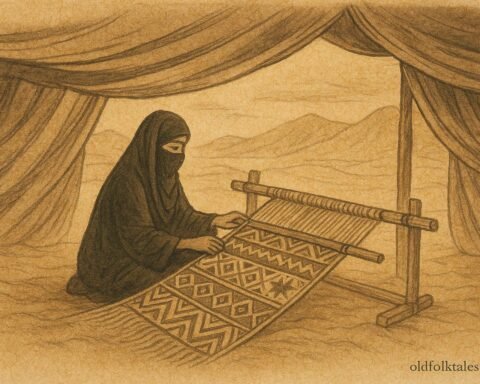
In the age when caravans stitched the desert together and the souq was the heart of every town, there lived a woman whose name traveled faster than the camels themselves. She was called Dhalilah. Some spoke her name with admiration, others with caution, and a few with quiet resentment. She was known not for wealth or lineage, but for her sharp mind and her ability to twist words until they bent to her purpose.
Dhalilah lived by her wits. In a world governed by reputation, hospitality, and unspoken rules, she understood the value of appearances and the power of polite speech. She was neither wholly virtuous nor openly cruel. Instead, she occupied the narrow space between necessity and cunning, where survival often demanded cleverness rather than honesty.
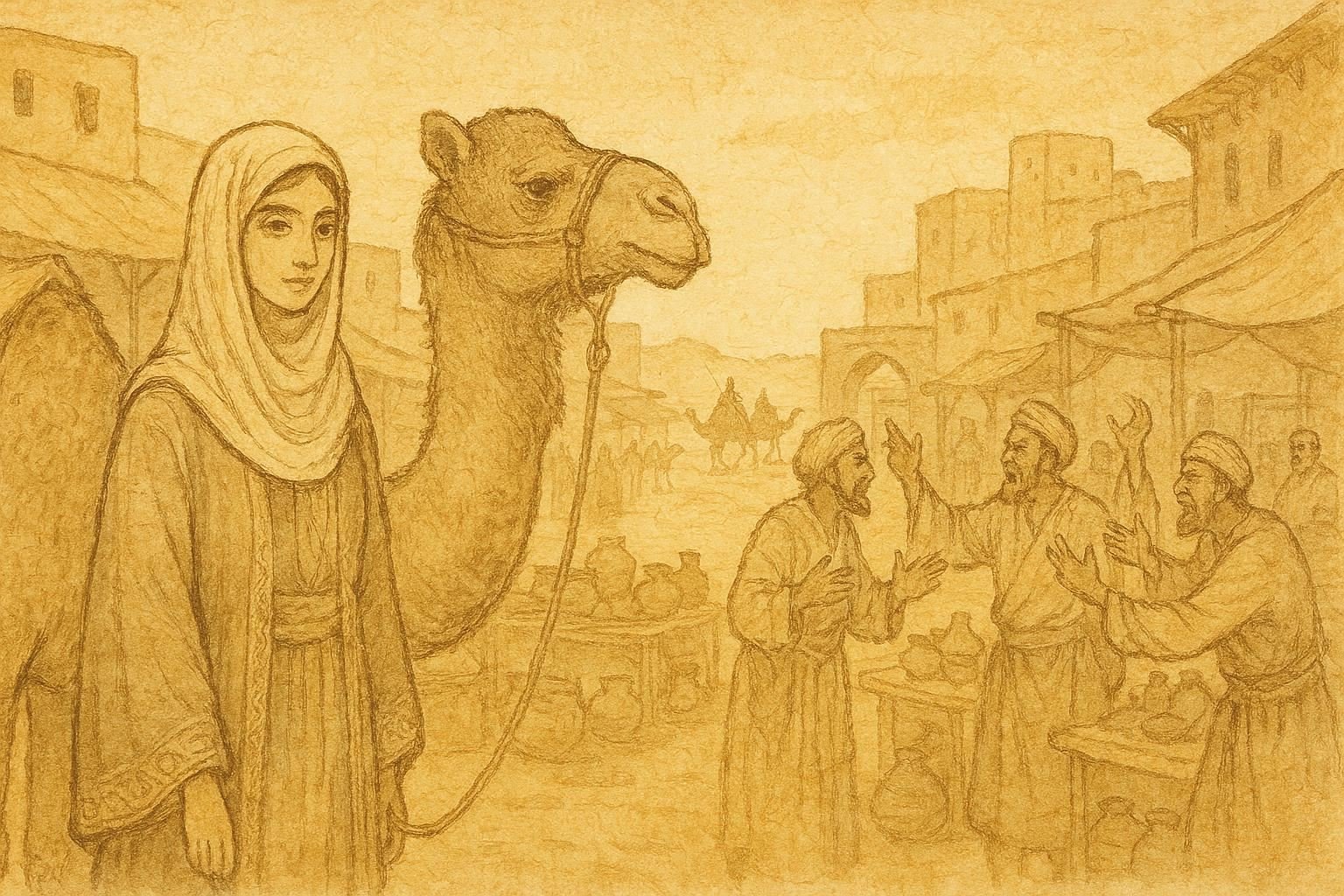
One season, when traders from distant regions filled the market with noise and color, Dhalilah came into possession of a prized camel. The animal was strong, well-fed, and carried itself with the calm dignity that only the finest camels possessed. Its hide shone in the sun, and its gait was smooth and unburdened. Such a camel could fetch a handsome price, and many eyes followed it as Dhalilah led it into the souq.
The market buzzed with voices, bargaining, and ritual greetings. Buyers examined goods not only with their hands, but with careful attention to social cues. Dhalilah knew this well. She dressed modestly, spoke respectfully, and carried herself as a woman who deserved trust.
Her first buyer was a merchant preparing for a long caravan journey. Dhalilah praised the camel’s endurance and lineage, speaking of its ability to cross harsh land without complaint. The merchant, satisfied by her confident manner and the animal’s appearance, agreed to the sale. He handed her payment and left the camel in her care, intending to return later with his men to collect it.
Before the dust of his departure settled, Dhalilah turned to her second buyer. This man was a local trader who valued strength above all else. To him, Dhalilah spoke of the camel’s power and obedience, how it could carry heavy loads and respond gently to its handler. She emphasized that the sale must be discreet, as too many eyes brought envy. Persuaded, the trader paid her and agreed to return at sunset.
As the day unfolded, Dhalilah repeated her performance. To a third buyer, she described the camel as a breeding treasure. To another, as a symbol of status suitable for a wedding procession. Each buyer heard a version of truth shaped carefully to his desires. Each accepted her words, trusting in custom, politeness, and the assumption that no one would dare commit such bold deception in broad daylight.
By afternoon, the camel stood calmly at the edge of the market, unaware that it had been sold many times over. Dhalilah, however, was fully aware. She moved through the souq with practiced ease, greeting acquaintances, accepting coins, and offering reassurances. No written contracts bound her, only spoken words shaped by expectation and trust.
As the sun began to lower, the first buyer returned. Then the second. Soon others followed. Confusion rose like heat from the ground. Voices sharpened, accusations flew, and hands gestured toward the camel, now the center of growing unrest. Each man claimed ownership, each insisting he had paid fairly.
They searched for Dhalilah. But she was gone.
Some said she had slipped into the alleys behind the market. Others claimed she had joined a departing caravan. No one knew for certain. What remained was the lesson she left behind. The buyers were forced to confront their assumptions, their haste, and their reliance on appearances.
Dhalilah’s story spread quickly. Some laughed at the cleverness of her scheme. Others warned against trusting smooth speech. Her tale became a mirror held up to society, reflecting both admiration for wit and discomfort with deception.
Moral Lesson
This folktale teaches that intelligence without ethics can succeed briefly, but it exposes the weaknesses of social trust and the risks of valuing words over wisdom.
Knowledge Check
-
Who is Dhalilah in Gulf folklore?
A clever and morally ambiguous trickster known for her wit and deception. -
What item does Dhalilah sell repeatedly?
A single prized camel. -
How does Dhalilah deceive multiple buyers?
By tailoring her words to each buyer’s expectations and relying on social norms. -
Why do the buyers trust her?
Because of her polite speech, respectable appearance, and accepted market customs. -
What does the camel symbolize in the story?
Wealth, trust, and the value placed on appearances in trade. -
What cultural setting frames the tale?
The traditional Gulf souq and caravan trade environment.
Source: Analyzed in a scholarly study by Markaz al-Dhafra for Studies and Research, comparing Emirati and Omani variants of the Dhalilah folktale cycle, focusing on market and caravan storytelling traditions.