In ancient China, during the Northern Wei dynasty, there lived a young woman named Hua Mulan. She was the only daughter in a humble family, known for her strength, intelligence, and deep love for her aging parents. Her father, once a brave soldier, had grown weak with illness, and her younger brother was too young to fight.
One spring morning, the Emperor’s decree spread across the land: every family must send one man to join the army and defend the kingdom against invading forces. When Mulan saw her father’s trembling hands as he read the scroll, her heart filled with sorrow. She knew that if he went to war, he would never return alive.
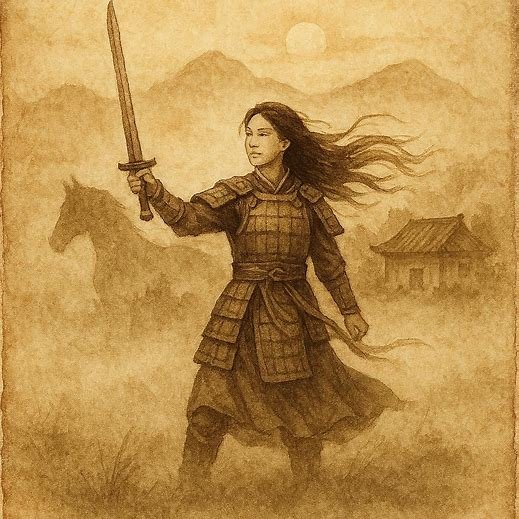
That night, while the household slept, Mulan made a bold decision. She took her father’s armor, sharpened his sword, and cut her long black hair. Dressed as a man, she mounted the family horse and quietly rode away before dawn, leaving behind a note that simply said: “Your daughter has gone to serve in your place. Do not worry.”
Journey through enchanted forests and islands in our Southeast Asian Folktales collection.
At the army camp, Mulan called herself Hua Jun, the son of Hua Hu. Her courage, discipline, and cleverness quickly earned the respect of her fellow soldiers. Though surrounded by men, she kept her secret hidden.
Through countless battles and bitter winters, Mulan fought bravely. She led her unit with wisdom and heart, always putting others before herself. She became a trusted companion to the general and a hero among her comrades.
Years passed, and the war finally ended in victory. The Emperor summoned Mulan to the palace to reward her for her service. “You have shown the courage of ten thousand men,” he declared. “Name your wish, and it shall be granted.”
But Mulan bowed deeply and said, “I do not seek riches or rank. I only ask to return home to my family.”
The Emperor, moved by her humility, granted her request and offered gifts of gold and fine silks for her parents.
When Mulan returned home, her family ran to greet her. Before their eyes, she removed her helmet, let her hair fall freely, and exchanged her armor for her old robe. Her comrades, who had followed her to her village, gasped in disbelief the brave soldier they had fought beside was a woman.
They knelt before her, honoring not only her courage but also her heart. Mulan smiled and said gently, “A hero’s worth is not measured by strength or gender, but by love and duty.”
From that day, the story of Hua Mulan became a lasting symbol of devotion, bravery, and the power of one woman’s sacrifice for her family and country.
Moral Lesson
True strength comes from love, duty, and courage. Hua Mulan teaches that honor is not limited by gender and that selflessness for family and nation is the highest form of heroism.
Knowledge Check
1. Who is Hua Mulan?
A brave young woman who disguises herself as a man to take her father’s place in the army.
2. Why does Mulan join the army?
To protect her ailing father and fulfill her family’s duty to the Emperor.
3. How does Mulan prove herself in battle?
Through courage, leadership, and loyalty that earn her the respect of all soldiers.
4. What does Mulan request from the Emperor after the war?
She asks only to return home to her family rather than accept wealth or power.
5. What lesson do her comrades learn when they discover her identity?
That bravery and virtue are not defined by gender but by character and devotion.
6. What values does the story of Hua Mulan represent in Chinese culture?
Filial piety, courage, humility, loyalty, and respect for family and duty.
Source:
Adapted from “The Ballad of Mulan”, an anonymous Chinese poem from the Northern Wei dynasty, later included in The Music Bureau Collection (Yuefu Shiji) compiled by Guo Maoqian during the 6th century.
Cultural Origin: China (Northern Wei, Han Chinese folklore)