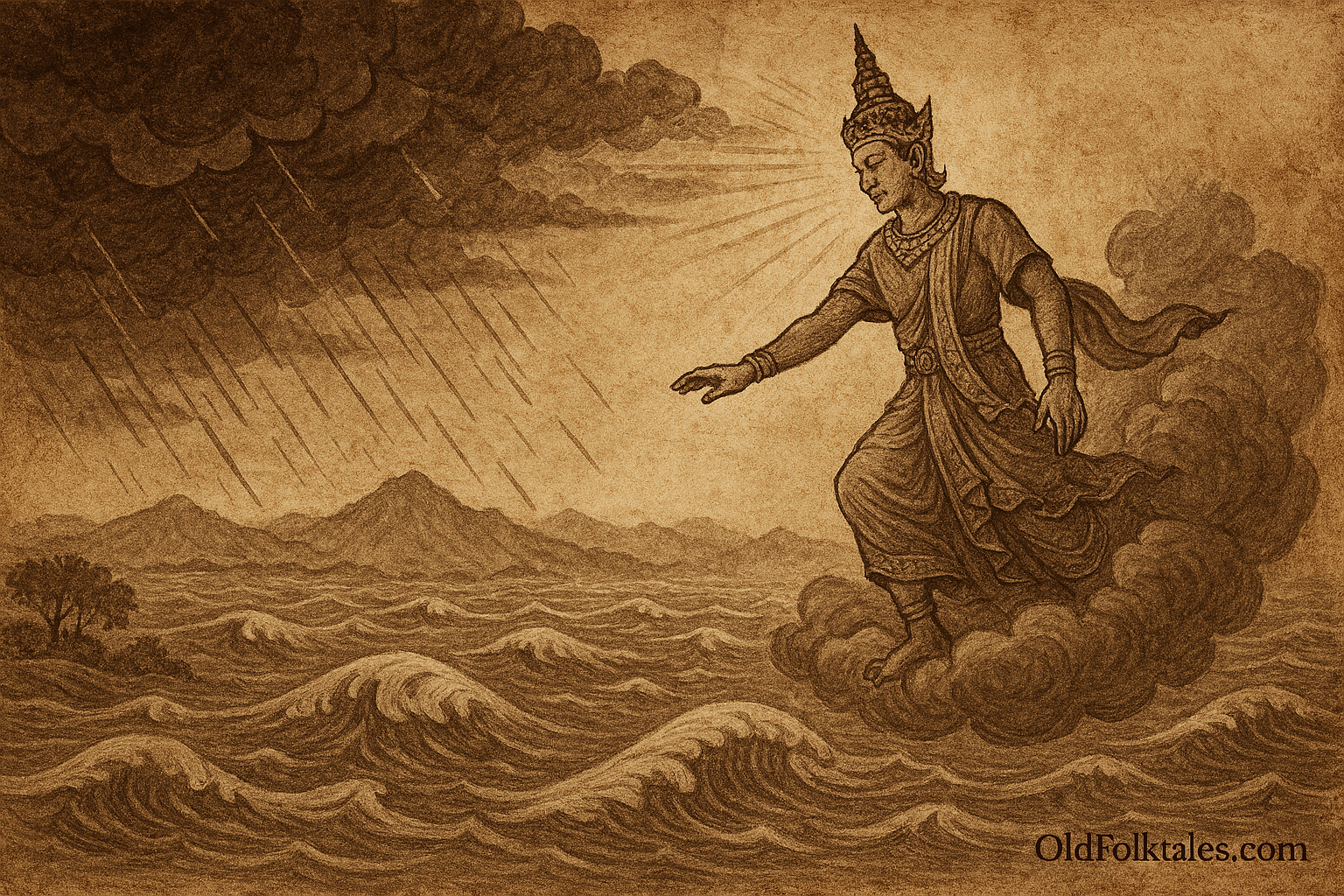
In the time before memory, when the world was young and the boundaries between heaven and earth were not yet firmly drawn, a great catastrophe befell the land. The skies opened with fury, and rain poured down in torrents that seemed to have no end. Rivers swelled beyond their banks, valleys became lakes, and mountains disappeared beneath rising waters. This was the primordial flood a cleansing deluge that swept away the old world and prepared the earth for a new beginning.
The waters covered everything, transforming the landscape into a vast, endless sea. For days that stretched into months, the flood continued until finally, gradually, the rains ceased. The waters began to recede, revealing muddy plains, reshaped mountains, and fertile valleys ready to birth new life. But the earth was empty, desolate, waiting for someone to bring order to the chaos and establish civilization upon its renewed surface.
Click to read all East Asian Folktales — including beloved stories from China, Japan, Korea, and Mongolia.
It was then that the heavens took notice of the silent, waiting world below. In the celestial realm, where divine beings dwelt among clouds and starlight, the decision was made to send a ruler to the earth one who would bring wisdom, establish justice, and guide humanity toward prosperity. The chosen one was Khun Borom, a being of divine origin whose name would echo through the ages as the founder of kingdoms and the father of nations.
Khun Borom descended from the heavens like a shaft of golden light breaking through storm clouds. He came not as a conqueror but as a bringer of civilization, carrying with him the knowledge of the gods and the mandate to rule with righteousness. His arrival marked the beginning of a new era, the transition from chaos to order, from wilderness to cultivated land, from scattered peoples to organized kingdoms.
With divine authority and earthly wisdom, Khun Borom established his rule over the rejuvenated land. He taught the people how to plant rice in the fertile valleys, how to build houses that would shelter them from the elements, and how to live in harmony with the spirits that inhabited the mountains, rivers, and forests. Under his guidance, villages sprang up like lotus flowers after rain, and the sound of human activity laughter, conversation, the rhythmic pounding of rice once again filled the land.
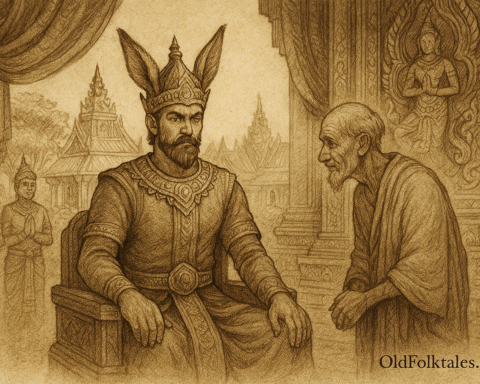
Khun Borom was not merely a king but a sacred figure whose legitimacy flowed directly from heaven itself. His presence sanctified the land, and his decisions carried the weight of divine will. The people revered him not only for his wisdom and justice but also for his connection to the celestial realm. He was the bridge between gods and mortals, the one who could interpret the will of heaven and translate it into earthly governance.
As the years passed and his kingdom flourished, Khun Borom was blessed with seven sons. These were no ordinary princes each possessed the noble character of their father and the divine essence that flowed through their bloodline. When they reached manhood, Khun Borom knew that the time had come to expand the reach of civilization and establish order across the vast territories that stretched beyond his kingdom’s borders.
Gathering his seven sons before him, Khun Borom spoke with the authority of both father and divine king. He explained that the world was large and that many peoples needed guidance, governance, and connection to the sacred order he had established. Each son would receive a territory to rule, becoming the founding ancestor of a distinct people, yet all would remain connected through their common heritage and their father’s divine legacy.
The first son was given the lands that would become the heart of Lan Xang, the kingdom of a million elephants, where the mighty Mekong River flowed like a silver serpent through green mountains. This son would become the ancestor of the Lao people, establishing a civilization that would endure for generations, its temples reaching toward heaven and its rice fields spreading across the valleys like emerald carpets.
The second son journeyed to the territories that would become the kingdoms of the Shan people, where misty highlands and fertile valleys created a land of striking beauty. The third son ventured into the regions that would give birth to the Thai kingdoms, establishing dynasties that would build great cities and develop sophisticated cultures of art, literature, and statecraft.
The fourth son traveled to the lands of the northern Tai peoples, where terraced rice fields climbed mountain slopes like steps to the sky. The fifth son was given the territories of the Black Tai, where rivers carved deep gorges through ancient limestone and villages perched on hillsides like eagles’ nests.
The sixth and seventh sons also received their domains, each becoming the progenitor of distinct Tai-speaking peoples who would spread across the regions we now know as parts of Laos, Thailand, Burma, Vietnam, and southern China. Though separated by distance and developing their own customs, languages, and traditions, all these peoples would share a common origin story the descent of Khun Borom and his divine mandate to rule.
Before they departed, Khun Borom blessed each of his sons and gave them sacred objects and knowledge to carry into their new kingdoms. He taught them the proper rituals to maintain connection with the heavens, the ceremonies to ensure fertile harvests, and the principles of just governance that would legitimize their rule. Each son would establish his own royal lineage, but all would trace their authority back to Khun Borom and through him to the celestial realm itself.
The seven sons went forth as their father commanded, and true to the prophecy embedded in the myth, they founded kingdoms, established cities, and became the ancestors of the Tai-speaking peoples. Their descendants would build magnificent temples with multi-tiered roofs that echoed the shape of mountains, create intricate systems of irrigation that transformed valleys into gardens, and develop rich cultural traditions of music, dance, and storytelling.
The legend of Khun Borom became more than just a story it became the foundation of political legitimacy, the explanation of ethnic identity, and the spiritual connection binding diverse peoples to a common heritage. Royal families across the Tai-speaking world would invoke Khun Borom’s name to justify their rule, pointing to their descent from his sacred lineage. Rituals and ceremonies would commemorate his descent from heaven and his establishment of divine kingship on earth.
Even today, in the temples and villages of Laos, the story of Khun Borom is remembered and retold. It explains not only the origins of the Lao people but also their relationships with neighboring Tai-speaking groups. It provides a cosmic framework for understanding kingship, legitimacy, and the proper order of society. The myth reminds the people that their rulers should embody the qualities Khun Borom brought from heaven wisdom, justice, and a sacred responsibility to maintain harmony between the human world and the divine.
Click to read all Southeast Asian Folktales — featuring legends from Thailand, Indonesia, Vietnam, and the Philippines.
The Moral Lesson
The myth of Khun Borom teaches that legitimate authority must be grounded in wisdom, justice, and service to the people. It emphasizes the interconnectedness of all Tai-speaking peoples despite their diversity, reminding us that shared heritage creates bonds that transcend political boundaries. The story also illustrates the sacred responsibility of leadership that rulers are not merely powerful individuals but bridges between heaven and earth, entrusted with maintaining cosmic order and ensuring the wellbeing of their people. Finally, it shows how origin stories shape identity, providing peoples with a sense of purpose, belonging, and connection to both their ancestors and their neighbors.
Knowledge Check
Q1: Who was Khun Borom in Lao mythology and where did he come from?
A1: Khun Borom was a divine ruler who descended from the heavens to establish civilization on earth after a great primordial flood. He was sent by the celestial realm to bring order, wisdom, and just governance to the renewed world, making him the founding figure of Lao kingship and the ancestor of the Tai-speaking peoples.
Q2: What was the significance of the primordial flood in the Khun Borom myth?
A2: The great flood represented a cosmic cleansing and renewal, washing away the old world to prepare the earth for a new beginning. It created the conditions that necessitated divine intervention and set the stage for Khun Borom’s descent, marking the transition from chaos to ordered civilization under heavenly mandate.
Q3: How many sons did Khun Borom have and what was their role in the myth?
A3: Khun Borom had seven sons who each became the founding ancestor of different Tai-speaking peoples. Their father sent them to rule various territories, establishing kingdoms across the regions now known as Laos, Thailand, Burma, Vietnam, and southern China, thus explaining the origins and connections between these distinct but related ethnic groups.
Q4: What does Khun Borom’s descent from heaven symbolize in Lao political culture?
A4: Khun Borom’s heavenly descent symbolizes the divine legitimacy of kingship in Lao culture. It establishes that rulers derive their authority directly from the celestial realm, creating a sacred mandate that connects earthly governance to cosmic order. Royal families invoked this lineage to justify their right to rule and their role as intermediaries between heaven and earth.
Q5: How does the Khun Borom myth explain the relationships between different Tai-speaking peoples?
A5: The myth explains that all Tai-speaking peoples including the Lao, Thai, Shan, and various Tai groups share a common ancestry through Khun Borom’s seven sons. Though they developed distinct languages, customs, and kingdoms, they remain connected through their shared divine heritage, providing a cultural and spiritual framework for understanding both their diversity and unity.
Q6: What is the cultural and ritual significance of the Khun Borom legend in modern Laos?
A6: The Khun Borom legend continues to serve as a foundation for understanding Lao identity, legitimacy, and cosmology. It is preserved in rituals and ceremonies that commemorate the establishment of divine kingship, provides a framework for political legitimacy, and reminds the people of their sacred origins and connections to neighboring Tai-speaking groups. The myth remains central to Lao cultural memory and national identity.
Source: Adapted from oral traditions documented by Grant Evans in “The Politics of Ritual and Remembrance: Laos Since 1975
Cultural Origin: Lao oral tradition and mythology, Laos (Southeast Asia)