Long ago, in the time of King Hùng, ruler of the ancient land of Văn Lang, there lived a man named Mai An Tiêm. Though he was not born into nobility, his character was noble in every way. He had been an adopted servant of the king’s household, a young man known throughout the palace for his diligence, intelligence, and honesty. Over time, his hard work earned him the king’s deep trust and admiration.
The king, impressed by Mai An Tiêm’s humble spirit and remarkable mind, granted him freedom and treated him as a son. He married a woman of noble birth and began a new life filled with promise. In the royal court, he managed trade and resources with skill and fairness. Yet, his rise to favor also stirred jealousy among the courtiers.
Whispers began to spread rumors claiming that Mai An Tiêm had grown proud of his success and had boasted that his fortune came not from the king’s generosity but from his own merit and Heaven’s blessing. These words, twisted by envy, reached King Hùng’s ears.
Explore timeless legends from China, Japan, and Korea in our East Asian Folktales collection.
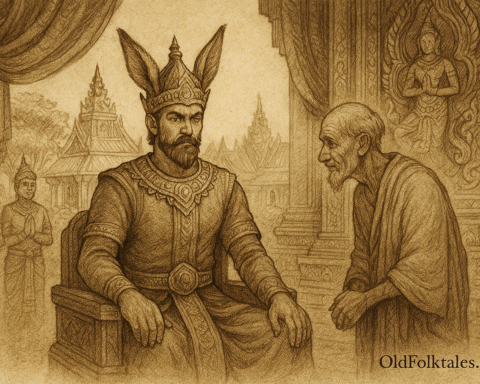
Feeling betrayed, the king summoned Mai An Tiêm. “Is it true,” he asked, “that you believe your success is of your own making?”
Mai An Tiêm bowed low and replied calmly, “Your Majesty, I believe that while wealth and favor come from the king, one must also earn Heaven’s blessings through hard work and virtue.”
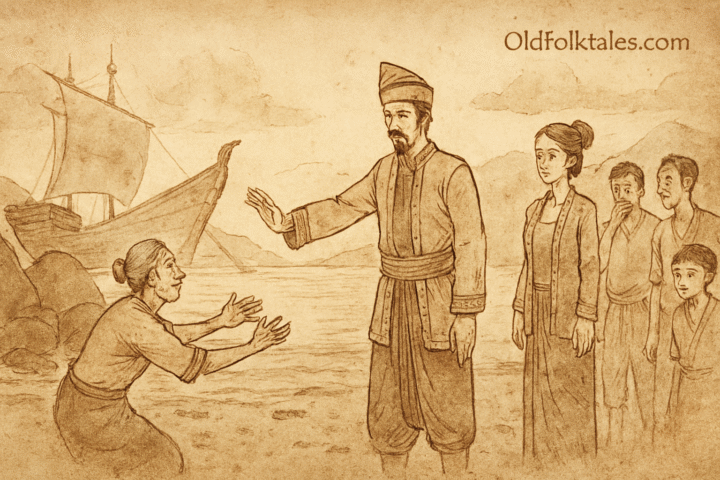
The king, misinterpreting his words as arrogance, was filled with anger. In his fury, he banished Mai An Tiêm, his wife, and his children to a deserted island, far from the mainland.
The courtiers rejoiced, but Mai An Tiêm remained steadfast. As he and his family were taken across the sea, he said to his wife, “Do not fear. Heaven helps those who help themselves.”
The island was barren and lonely, with no crops, no tools, and no homes. Yet the family did not despair. They built a shelter from bamboo, caught fish, and gathered roots for food. Mai An Tiêm worked tirelessly, his hands rough and blistered, his faith unwavering.
One morning, as he walked along the beach, he found a strange gift of nature a handful of black seeds washed ashore. He picked them up and wondered if they were Heaven’s message. With careful hands, he planted the seeds near his hut and watered them daily.
Weeks passed, and soon vines spread across the sand, blossoming with yellow flowers. From them grew round green fruits larger than any he had ever seen. When they ripened, he cut one open to find red, juicy flesh and glossy black seeds inside. The fruit was sweet, refreshing, and unlike anything they had tasted.
Overjoyed, Mai An Tiêm named it “dưa hấu,” meaning “water fruit.” The family lived well from that day forward. Each harvest brought more fruit, and the seeds multiplied, filling the island with green vines and red-fleshed treasures.
Grateful to Heaven, Mai An Tiêm decided to share his blessing with the world. He carved messages on the fruits’ green rinds, writing, “Mai An Tiêm, exiled by the king, lives by the gift of Heaven.” He cast the fruits into the sea, trusting the waves to carry them where they were meant to go.
Fishermen along the coast later found the strange fruits. Curious, they cut them open, tasted their sweetness, and read the words carved upon them. The fruits were taken to the royal court, where King Hùng himself tasted the delicious fruit and read the message.
Realizing his mistake, the king was deeply moved. He saw that Mai An Tiêm’s humility and resourcefulness had turned misfortune into blessing. The next morning, he sent royal boats to bring the family home.
When Mai An Tiêm and his wife returned to the palace, the king embraced him and said, “Your faith, patience, and virtue have taught even a king the meaning of true wisdom. From your hands has come a gift that will nourish our land.”
From that time onward, watermelons became a cherished fruit across Vietnam, a symbol of prosperity and renewal. During the Lunar New Year, families place them on their altars as offerings for good fortune.
The story of Mai An Tiêm is told to this day, reminding every generation that hard work and virtue can turn even exile into opportunity, and that those who trust in Heaven and themselves will always find a path to light.
Journey through enchanted forests and islands in our Southeast Asian Folktales collection.
Moral Lesson
The legend of Mai An Tiêm teaches that true success is earned through perseverance, humility, and faith. Virtue and hard work transform adversity into prosperity, and Heaven rewards those who live with integrity and gratitude.
Knowledge Check
-
Who was Mai An Tiêm before he was exiled?
He was an adopted servant of King Hùng who rose to prominence through hard work and virtue. -
Why was Mai An Tiêm exiled to the island?
Because jealous courtiers lied that he had become arrogant and ungrateful toward the king. -
What did Mai An Tiêm find on the island?
He found black seeds washed ashore, which he planted and that grew into watermelons. -
How did he share his discovery with others?
He carved messages on the fruits and set them adrift at sea to reach the mainland. -
What happened when the king learned of the fruit?
He tasted it, realized Mai An Tiêm’s virtue, and invited him and his family back in honor. -
What does the watermelon symbolize in Vietnamese culture?
It symbolizes renewal, prosperity, and the reward of honest labor and faith.
Source
Adapted from The Legend of Mai An Tiêm, recorded in Lĩnh Nam Chích Quái, a classical collection of Vietnamese legendary tales.
Cultural Origin: Vietnam (Ancient Vietnamese folklore)