Long ago, across the endless grasslands of Mongolia, there lived a young herder named Namjil. From dawn until dusk, he tended his small flock of sheep, guiding them over rolling hills and through sparkling streams. Though his life was simple, Namjil had a deep love for the animals in his care, and among them, one horse stood out: a majestic, black stallion with eyes as bright as the morning sky and a mane that flowed like river silk. Namjil named him Aranjagaan, and they became inseparable companions.
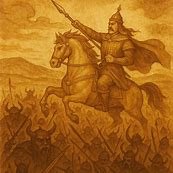
Namjil’s bond with Aranjagaan went beyond friendship. When storms lashed the steppe, the horse guided the sheep to safe pastures. When wild wolves prowled, Aranjagaan defended them, fearless and strong. Villagers spoke of the horse as if it were touched by the spirits themselves, a gift from the Eternal Blue Sky.
One bitter winter, as the wind cut like knives across the frozen plains, a rival herder, envious of Namjil’s success, devised a cruel plan. He cornered Aranjagaan during a blizzard and attacked, wounding the horse and leaving it to die. Namjil searched for his beloved companion through snow and ice, calling his name until his voice was hoarse. But by the time he found Aranjagaan, the stallion’s spirit had departed, leaving only a lifeless body upon the frost.
Journey through enchanted forests and islands in our Southeast Asian Folktales collection
Overcome with grief, Namjil wandered alone through the hills. Night after night, he lay beneath the stars, clutching the horse’s tail hair, feeling the void where Aranjagaan’s warmth had been. One night, as he wept beneath the glimmering sky, a vision appeared. The spirit of Aranjagaan shimmered before him, golden and radiant, and spoke without words. Namjil understood the message in his heart: the horse’s spirit wanted to remain with him, even after death, and there was a way to make that possible.
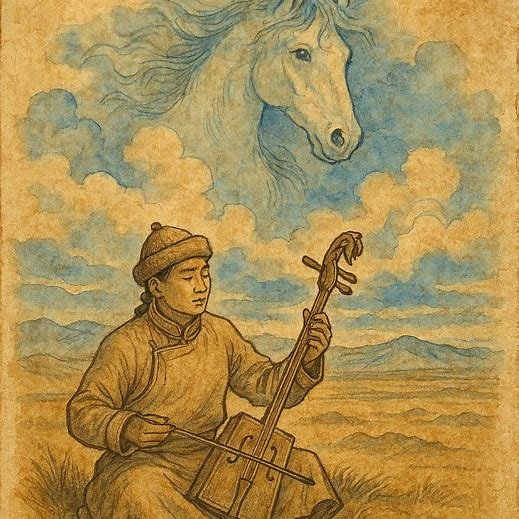
At dawn, Namjil gathered the remains of Aranjagaan and, following the spirit’s guidance, he carved the horse’s skull into the head of a musical instrument. He stretched strings of horsehair along the body and crafted a bow from a sacred branch. When he first drew the bow across the strings, a sound unlike any other filled the valley. It was deep and mournful, yet beautiful, carrying the memory of Aranjagaan’s spirit. The wind itself seemed to dance to the notes, and the mountains echoed with the music of the horse’s soul.
Word spread across the steppe about Namjil’s instrument. Nomads from distant tribes came to hear the sound, saying it touched the heart like the voice of the Eternal Blue Sky. They called it the morin khuur, the horse-head fiddle. Over time, the morin khuur became more than a musical instrument; it became a bridge between the living and the spirit world, a way to honor the memory of lost loved ones and the sacred bond between humans and their animals.
Namjil continued to play for his people, and as he did, he found peace. Though he missed Aranjagaan every day, he felt the horse’s spirit riding the wind and listening to the music that now carried across the steppes. Children grew up hearing the song and learning to care for horses with respect and love. Warriors and hunters found courage when the bow struck its first note, and elders wept for those long gone, comforted by the living voice of the horse they cherished.
Through the generations, the story of Namjil and Aranjagaan was passed down orally. Bards would sing it beside campfires, in yurts, and at festivals. Each telling reminded the people of Mongolia that love, grief, and respect for nature are intertwined. Even today, when a morin khuur is played beneath the vast Mongolian sky, listeners feel a connection to the past, to the land, and to the loyal spirit of a horse whose friendship never died.
Moral Lesson
The Legend of the Morin Khuur teaches that love and loyalty transcend life itself. True devotion honors memory, respects all living beings, and transforms grief into something enduring and beautiful. It reminds us that sorrow can inspire creation, and that respect for nature and animals carries cultural and spiritual significance.
Knowledge Check
-
Who was Namjil, and why was Aranjagaan special to him?
He was a young herder, and Aranjagaan was his loyal horse whose courage and intelligence saved the flock. -
What caused Namjil to lose his horse?
A jealous rival herder attacked Aranjagaan during a blizzard, leaving the horse dead. -
How did Namjil honor Aranjagaan’s spirit?
He created the morin khuur, a horse-head fiddle, using parts of the horse’s remains. -
Why did the morin khuur become important to the people?
It served as a bridge between the living and spirit worlds and conveyed the memory of Aranjagaan’s spirit. -
What is the moral of the story?
Loyalty, love, and respect for nature can transform grief into something lasting and meaningful. -
How does the story reflect Mongolian culture?
It emphasizes the spiritual bond between humans and horses, the importance of the steppe, and the role of music in preserving history and memory.
Source
Adapted from The Legend of the Morin Khuur, collected in Mongolian Folktales, translated by Dashdondog Jamba, 2008, Santa Barbara: Libraries Unlimited (World Folklore Series).
Cultural Origin
Mongolia (Khalkha Mongol folklore)