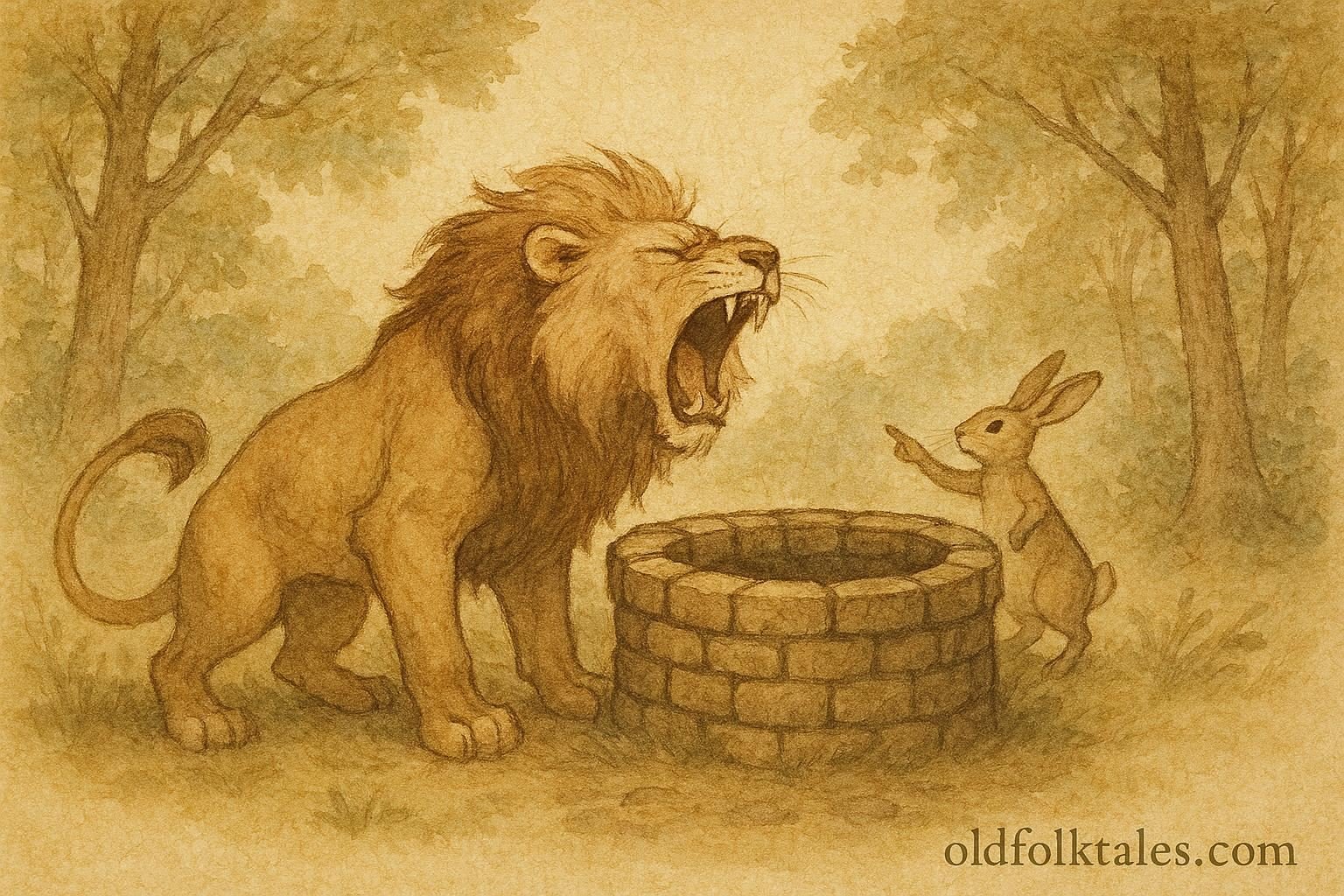
In the deep heart of a Sri Lankan forest, thick with towering trees, tangled vines, and the steady hum of insects, there lived a mighty Lion, feared by every creature that crossed his path. One warm afternoon, as golden sunlight poured between the branches, the Lion captured a small Hare hiding among the roots of a tamarind tree. With the Hare trembling between his claws, the Lion readied himself for a meal.
The Hare, desperate but quick-thinking, lifted his small voice. “O friend, do not eat me yet. I can tell you a good thing, something you would want to know.”
The Lion paused, curiosity flickering in his amber eyes. “What is that good thing?”
Gathering courage, the Hare said, “There is another Lion in this forest. He boasts that he is stronger than you. He says you are nothing compared to him.”
The Lion’s pride stirred like a flame touched by wind. “Another Lion? Stronger than me?” He let out a deep growl that shook the leaves overhead. “Show him to me. I must see this rival.”
“It is good,” said the Hare, bowing slightly. “Come with me.”
And so the small Hare ran ahead, guiding the great Lion along a narrow forest path. The Lion followed with heavy, confident steps, his mane brushing against low branches. Birds fled from the treetops at the sound of his approach. The Hare, though outwardly calm, was carefully choosing every turn, every clearing, until they reached an ancient stone well hidden beneath overgrown creepers.
The well was wide, deep, and filled with still, dark water that mirrored whatever leaned over its edge. The Hare approached it first and pointed downward with one paw.
“Look there,” the Hare said. “That Lion is below.”
The great Lion stepped forward, muscles tightening as he peered over the stone rim. The moment he looked into the well, he saw a Lion staring back—his own reflection shimmering on the water’s surface. At once he roared, a thunderous sound that rolled across the forest floor.
From the well, the reflected Lion roared back.
The Lion bristled. “Friend,” he shouted down the shaft, “come out of the well! Face me if you dare!”
But of course, the Lion below did not move. It only echoed his fury.
Enraged by the imagined challenge and blinded by pride, the Lion crouched low. “I will not let him mock me!” And without hesitation, he sprang over the edge, plunging straight into the dark water.
A splash echoed up the stone walls, and then the forest grew silent again.
The Hare waited only a moment, then stepped back from the well. His heart thumped fast, not from fear anymore, but from relief. He had saved his life not through strength, but through wit, turning the Lion’s own pride against him.
With the danger gone, the Hare hopped quietly away between the tall grasses, disappearing into the safety of the forest he knew so well.
And from that day forward, it was said that even the mightiest can fall when blinded by their own pride, while the smallest may yet survive through clarity of mind.
Moral Lesson
This tale teaches that pride can destroy the powerful, while wisdom, calm thinking, and cleverness can protect the vulnerable. Arrogance blinds, but insight guides.
Knowledge Check
1. Who are the main characters in “The Lion and the Hare”?
The story centers on a proud Lion and a clever Hare who outsmarts him to save his own life.
2. What lesson does the Sri Lankan folktale “The Lion and the Hare” teach?
It highlights the dangers of pride and the power of intelligence over brute strength.
3. How does the Hare escape the Lion in this folktale?
The Hare tricks the Lion into looking into a well, where the Lion mistakes his reflection for a rival.
4. Why does the Lion jump into the well?
The Lion, believing his reflection to be another Lion challenging him, leaps in to fight and perishes.
5. What cultural symbolism appears in this Sri Lankan folktale?
The Lion symbolizes unchecked pride, while the Hare represents wisdom, strategy, and survival through intellect.
6. Where does the folktale “The Lion and the Hare” originate?
It is a Sinhalese folktale from Sri Lanka, collected by Henry Parker in Village Folk-Tales of Ceylon (1910).
Source: Adapted from the Sinhalese folktale “The Lion and the Hare” in Village Folk-Tales of Ceylon, Vol. I, collected by H. Parker (1910), London: Luzac & Co.
Cultural Origin: Sri Lanka (Sinhalese folklore)