Deep in the forests of ancient Sri Lanka, where towering trees interlaced their branches to form cool canopies and the ground was soft with fallen leaves, a Jackal wandered alone in search of food. He moved carefully, avoiding the paths of larger beasts, for though he was clever, he was not strong. The forest was a place where survival belonged to those who understood when to advance and when to retreat.
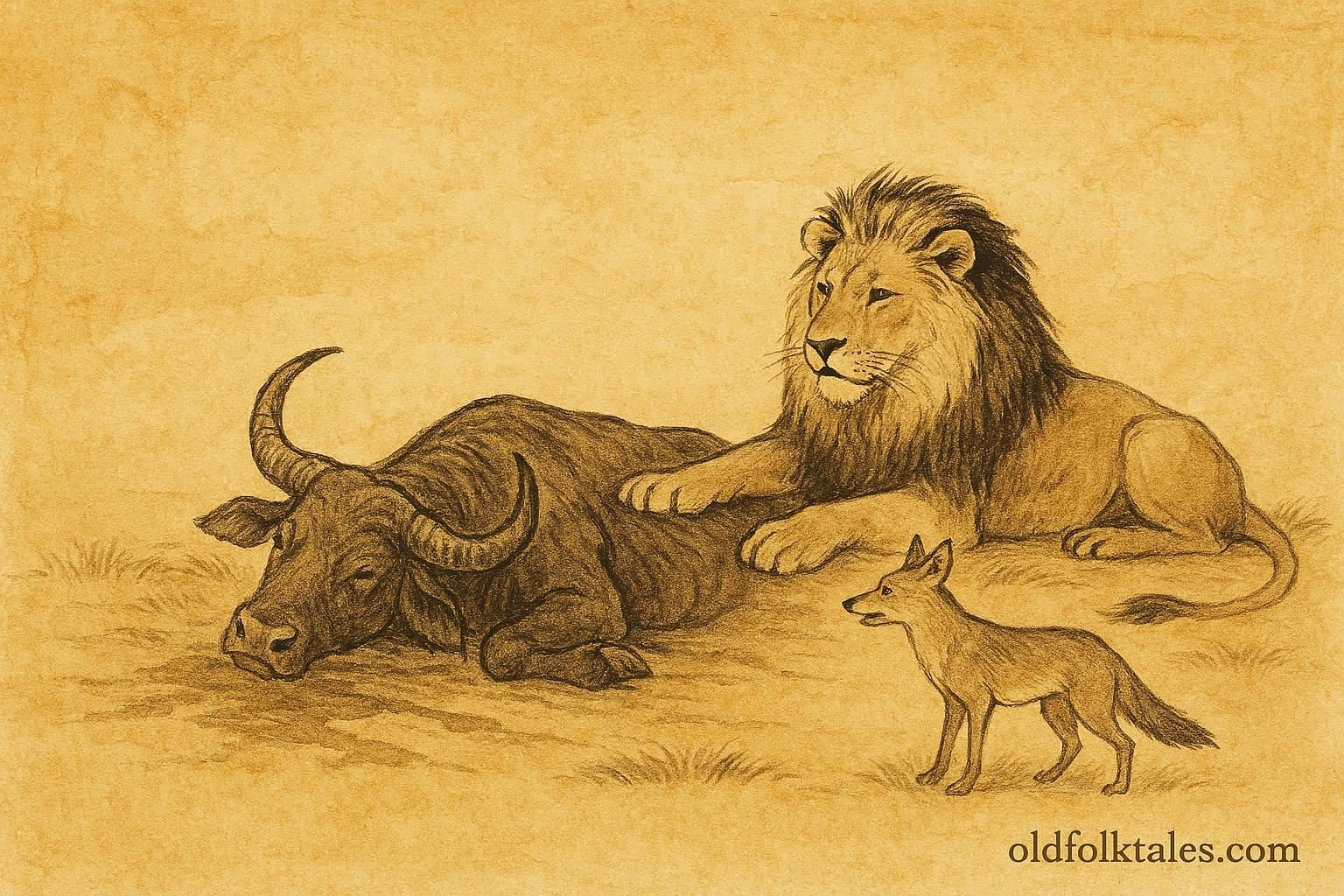
As he trotted through a shaded clearing, a scent drifted toward him, rich, heavy, unmistakably that of a dead animal. The Jackal’s sharp nose twitched with excitement. Following the smell, he soon found a dead Buffalo lying beneath a cluster of vines. Its massive form was still untouched, and the Jackal’s eyes gleamed.
“It is good,” he murmured to himself.
He approached cautiously, then tore off a small bite and ate. The forest around him remained quiet. After satisfying himself just enough, the Jackal padded away, intending to return once his hunger stirred again.
Later, he slipped back through the trees toward the same spot. But as he neared the clearing, he paused. A new scent mingled with the Buffalo’s, one far more powerful, one that made his fur rise.
A Lion.
The Jackal peered forward and saw the Lion lying beside the carcass, its mane stirring with the breeze, its claws resting casually on the earth. The Lion had clearly eaten, though plenty of the Buffalo remained. The Jackal knew he was no match for a creature so strong, yet hunger and cunning pushed him forward.
“O friend,” the Jackal called out boldly, stepping into view. “I came to eat that Buffalo. You also came. Let us divide it.”
The Lion lifted his massive head, golden eyes narrowing with curiosity rather than anger. “How,” he asked, “shall we divide it?”
The Jackal, already planning his strategy, replied smoothly, “I will lick it; you eat it.”
The Lion considered this. It seemed a harmless suggestion. The Jackal, being small and weak, surely needed very little. The Lion, used to dominance, saw no trick in the offer.
“It is good,” the Lion agreed.
The Jackal immediately set to work. He lowered his head and began licking the carcass diligently, running his tongue over the hide, tasting only the faint traces of flesh and the heavy scent of meat. Meanwhile, the Lion began tearing into the Buffalo properly, eating his fill with powerful jaws.
For a while, both animals remained absorbed in their chosen task. But the Jackal, who had no intention of staying longer than necessary, soon stopped and took a step back.
He turned to leave.
The Lion glanced up from the carcass and asked, “Friend, why are you going?”
The Jackal answered with perfect seriousness, “My belly is full.”
The Lion blinked. “Oh! Licking is very good for filling the belly.”
The Jackal nodded politely and disappeared into the forest, knowing full well he had lost nothing, except hunger, and gained the Lion’s trust in a harmless illusion.
From that day on, it is said, Lions continue to eat flesh, tearing meat with teeth meant for strength and power. But Jackals only lick at what they find, for the memory of this old forest bargain lingers in their nature. And so the world remembers how cunning may shape a creature’s habits as surely as claws and teeth.
Moral Lesson
This folktale teaches that cleverness can be as valuable as strength, but also that knowing your limits, and using wisdom rather than confrontation, is often the key to survival.
Knowledge Check
1. Who are the main characters in “The Lion and the Jackal”?
A Lion and a Jackal are the central figures, representing strength and cunning in Sinhalese folklore.
2. What does the Jackal propose as their method of dividing the Buffalo?
He suggests that he will lick the carcass while the Lion eats the flesh.
3. What cultural lesson does the story symbolize?
It highlights Sri Lankan values surrounding clever survival, caution, and understanding one’s place in the natural order.
4. Why does the Lion accept the Jackal’s suggestion?
The Lion sees no threat in the Jackal and believes the division is fair due to their unequal strength.
5. What is the outcome for the Jackal in this folktale?
He tricks the situation safely, fills his belly through small bites earlier, and avoids danger through wit.
6. What is the cultural origin of this story?
It comes from Sinhalese folklore in Sri Lanka, as collected by Henry Parker.
Source:Adapted from the Sinhalese folktale “The Lion and the Jackal” in Village Folk-Tales of Ceylon, Vol. I (1910), collected by H. Parker, London: Luzac & Co.
Cultural Origin: Sri Lanka (Sinhalese folklore)