In the golden days of old Anatolia, when mountains whispered to clouds and caravans crossed sunlit plains, there lived a humble youth named Ali. He was the son of a poor widow who wove cloth for travelers. Though his hands were rough from work, his heart was filled with kindness and courage.
The Mysterious Encounter
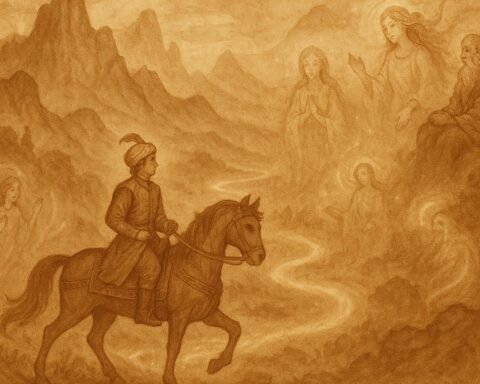
One day, while gathering wood in the hills, Ali came across an old dervish resting beneath a cypress tree. The holy man, weak with hunger, asked for water. Without hesitation, Ali gave him the last of his food and drink. In gratitude, the dervish revealed three objects wrapped in silk: a turban, a whip, and a carpet.
“These are no ordinary gifts,” the old man said. “The turban will grant you the power to vanish, the whip will summon mighty servants, and the carpet will fly wherever you wish. But remember, use them with wisdom and a pure heart.”
Before Ali could speak, the dervish disappeared into thin air.
Journey through enchanted forests and islands in our Southeast Asian Folktales collection.
The Journey of the Magical Gifts
Ali soon tested the wonders. With a wish, the carpet soared high above the valleys like a falcon. The turban cloaked him in invisibility, and a strike of the whip brought forth servants of the wind who obeyed his every command.
Wishing to see the world, Ali journeyed across deserts and forests until he reached a distant kingdom shrouded in sorrow. There he learned that a mighty dragon had captured the sultan’s daughter, imprisoning her in a mountain cave. Many heroes had tried to rescue her, but none had returned.
The Rescue of the Princess
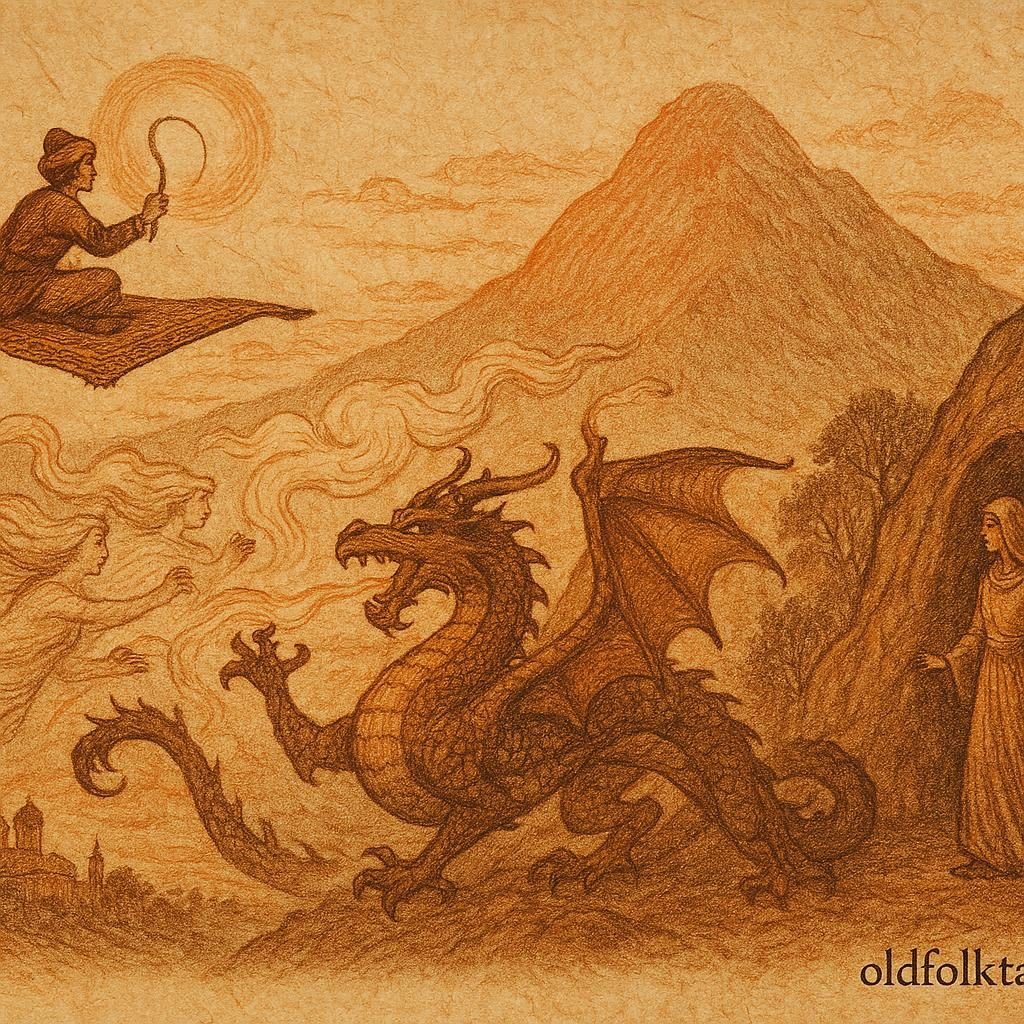
Ali’s heart stirred with compassion. Mounting his flying carpet, he sped through clouds and wind until he reached the mountain. From afar he saw the cave glowing with the dragon’s fiery breath. Using the turban, he turned invisible and crept inside.
There lay the princess, her eyes filled with fear but her bearing still noble. The dragon, vast and scaled in green fire, slept coiled around her. Ali took out his whip and struck the air, and from nowhere, thunderous spirits emerged, roaring like storms. A fierce battle followed; fire and lightning clashed, echoing through the mountain.
At last, Ali drove the whip again, summoning a final gust that hurled the dragon into the depths below. When silence returned, the princess opened her eyes to see her savior appear from the shimmer of invisibility.
“Who are you?” she whispered.
“Only a traveler,” he replied softly, bowing with humility.
The Return and Betrayal
Ali carried the princess home upon his carpet, the wind trailing ribbons of dawn. The kingdom rejoiced, and the sultan declared that whoever had saved his daughter would be her husband and heir to the throne.
But before Ali could speak, three jealous courtiers claimed the deed as their own. They had seen the princess’ return and sought to take credit. Ali, unwilling to reveal his magic before such deceit, said nothing and slipped away unnoticed.
That night, as the court prepared for the false heroes’ wedding, the princess stood silent, her eyes searching the skies. Suddenly, a wind swept through the palace, and Ali appeared, descending upon his flying carpet, shining like starlight.
With a flick of his whip, he summoned the spirits who had fought the dragon, and they roared the truth before all. The sultan, struck with awe, knelt before the humble youth who had risked everything for honor alone.
The Rise of the Just King
Ali and the princess were married amid celebration that lasted seven nights. He ruled the kingdom with wisdom, keeping the three magical gifts as symbols of his humble beginnings. He used them sparingly, the turban to protect the weak, the whip to uphold justice, and the carpet to bring aid wherever needed.
Years passed, and his name became known as Ali the Just, the king who rose not through greed or power, but through courage, kindness, and faith in destiny.
Discover the wisdom of Persian poets and Arabian storytellers in Western Asian Folktales.
Moral Lesson
This Turkish folktale teaches that true greatness comes from humility, wisdom, and the righteous use of power. Even the smallest acts of kindness can open the path to destiny, while courage guided by compassion conquers all obstacles.
Knowledge Check
1. Who gifted Ali the magical objects?
A dervish (holy man) rewarded Ali’s kindness with the turban, whip, and carpet.
2. What power did each magical item hold?
The turban granted invisibility, the whip summoned spirits, and the carpet enabled flight.
3. What creature did Ali defeat?
He defeated a mighty dragon that had imprisoned the sultan’s daughter.
4. How did Ali prove his innocence?
He revealed his magic during the false heroes’ wedding and summoned spirits to bear witness.
5. What is the story’s moral lesson?
Courage, honesty, and the wise use of power lead to lasting honor and justice.
6. What cultural values are reflected in this tale?
The story reflects Turkish ideals of humility, generosity, and divine reward for good deeds.
Source: Turkish folktale, Turkey.
Adapted from: Turkish Fairy Tales and Folk Tales (Kúnos, 1901), Project Gutenberg.