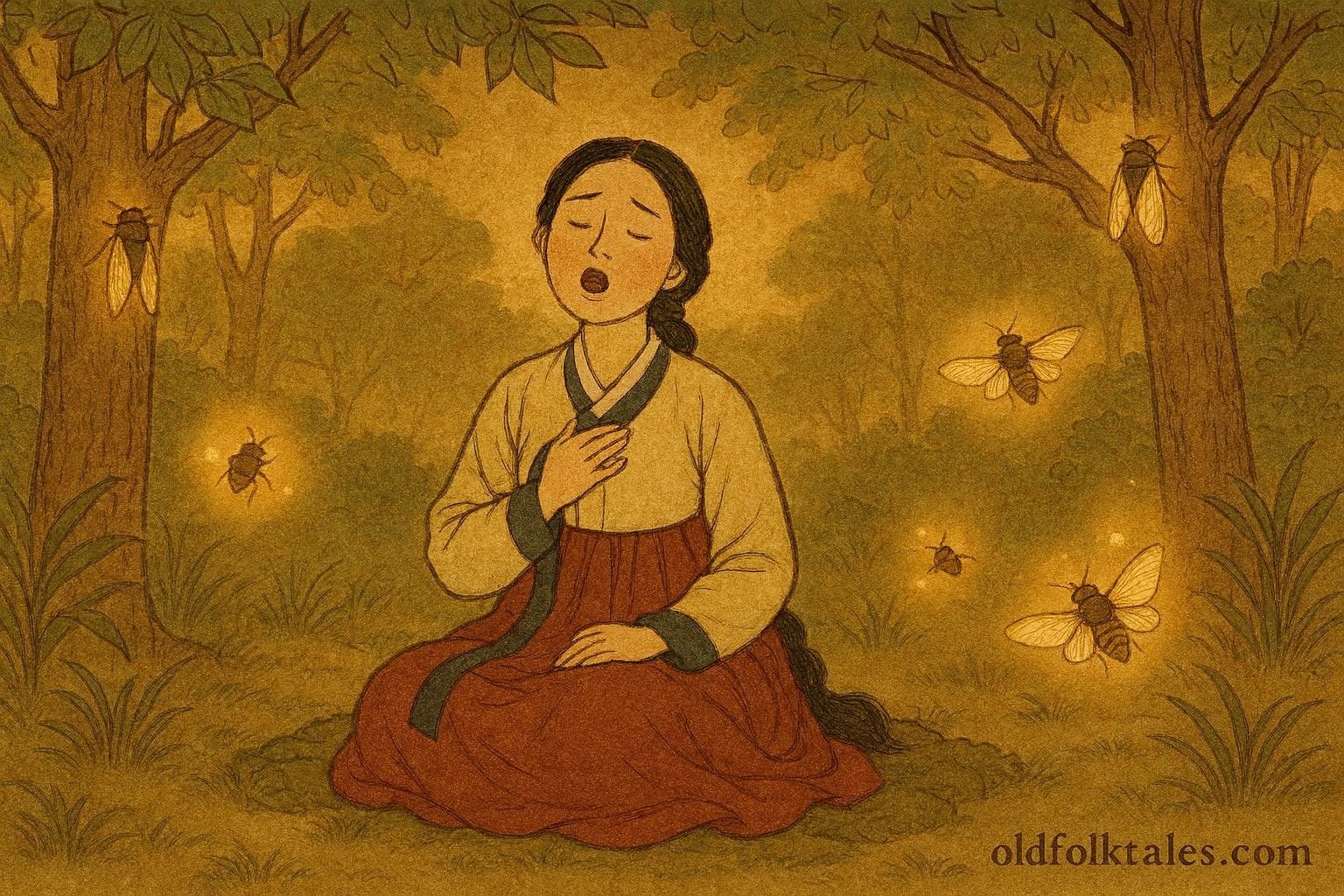
In a quiet village nestled among rolling green hills in central Korea, there once lived a gentle maiden named Suna. Her voice was known throughout the countryside as the purest and most soothing ever heard. When she sang by the river, the water seemed to slow its flow as though listening. When she sang while tending the fields, even the birds gathered closer. Music was her greatest joy, and she filled each day with soft melodies that drifted across the valley like warm sunlight.
Suna lived with her father and her stepmother, who had arrived in their home after her mother’s passing. While her father loved Suna dearly, he traveled often for work and was away for long stretches. During these times, the stepmother ruled the household with cold authority. She disliked anything she could not control, and Suna’s singing, which she considered idle nonsense, irritated her. Instead of hearing beauty in Suna’s voice, she heard only defiance.
As the months passed, the stepmother’s disapproval grew. She assigned Suna harsher chores and punished her whenever she caught her humming. Eventually she confronted the maiden directly. She told Suna that singing brought shame upon the household, that only frivolous girls wasted their time with music, and that from that day forward she was forbidden to sing at all. Suna stood still, stunned and heartbroken. Her voice was not only her talent but the deepest part of her spirit. Losing it felt like losing herself.
Explore ancient tales from Thailand, Cambodia, and the Philippines in Southeast Asian Folktales.
Still, she obeyed. She tried to remain silent as she swept the floors, prepared meals, and cared for the animals. But songs lived in her heart, and sometimes a whisper escaped her lips before she could stop it. Whenever this happened, the stepmother scolded her sharply, reminding her that silence was her only acceptable behavior.
Without music, Suna felt her world becoming dim. Her days grew heavy, and her nights filled with dreams of melodies she could no longer share. She began rising early to walk alone by the river, where she let herself hum quietly to the water. But even there, she felt fear of being discovered. The joy that singing once brought her now came tangled with sorrow.
One summer afternoon, when the air shimmered with heat and cicadas buzzed in the distant trees, Suna’s stepmother returned home unexpectedly and heard a faint song coming from the courtyard. The stepmother’s anger rose like fire. She burst through the gate and shouted at Suna with such cruelty that the villagers nearby flinched at the sound. The stepmother accused her of disobedience and selfishness. She called her a burden, a useless girl who could not respect simple rules.
Suna stood trembling under the harsh words, tears gathering at the corners of her eyes. She tried to explain that singing was the only way she could feel close to her late mother, who had taught her every song she knew. But the stepmother refused to hear a single word. She commanded Suna never to sing again, not by the river, not in the fields, and not even in her dreams.
That evening Suna’s heartbreak overflowed. She walked quietly into the forest behind the village, a place filled with tall trees and the soft rustling of summer leaves. The air trembled with the sound of cicadas, their voices rising and falling like a great, sorrowful chorus. Suna felt as if the forest itself understood her pain.
She wandered deeper into the woods, following the sound of the cicadas until she reached a clearing bathed in golden light. The sun shimmered through the branches and turned the world warm and blurry. Suna sat beneath an old tree, pressed her face into her hands, and finally allowed herself to sing. It was a soft, trembling melody filled with longing for the mother she lost, the father who was far away, and the voice she feared she would soon lose entirely.
As her song drifted through the clearing, the cicadas quieted as though listening with tender respect. Suna sang until her tears stopped, until her voice faded to a whisper. Then she leaned against the tree and closed her eyes. Her sorrow was so deep that it seemed to dissolve into the air around her.
The villagers say that at that moment something extraordinary happened. A warm breeze circled through the clearing, carrying with it the sound of Suna’s own trembling melody. The trees rustled in reply. And when the breeze settled, the maiden was gone. The forest held only the echo of her song.
When her father returned days later and heard the news, he searched for her endlessly. He called her name through the woods, but only the cicadas answered. Their voices rose in a gentle, mournful sound that seemed to carry Suna’s spirit within it. Even her stepmother, shaken by guilt, could not deny that the cicadas now sang with a strangely human sorrow.
From that summer on, every year when the heat settles over the hills and cicadas fill the air with their resonant cry, the villagers say they can still hear Suna. Her voice rises with theirs, a reminder that the heart seeks expression even when silenced, and that sorrow, when transformed, becomes a song the world never forgets.
Discover more East Asian Folktales from the lands of dragons, cherry blossoms, and mountain spirits.
Moral Lesson
True expression of the heart can never be completely suppressed, and sorrow often transforms into lasting beauty.
Knowledge Check
- Why did Suna love singing so deeply?
Answer: Singing connected her to her late mother and brought her joy. - Why did the stepmother forbid Suna from singing?
Answer: She saw singing as useless and disliked anything she could not control. - What happened when Suna tried to sing secretly?
Answer: Her stepmother always scolded her harshly when she discovered it. - Why did Suna flee into the forest?
Answer: She was overwhelmed by grief after being forbidden from singing completely. - What did the villagers believe happened in the forest?
Answer: Suna disappeared and her spirit transformed into the sorrowful voice of the cicada. - How is Suna remembered each summer?
Answer: Through the mournful song of the cicadas that echoes her longing.
Source
Adapted from Ewha Womans University Folklore Collection, 2014.
Cultural Origin
Central Korean lyrical folklore.