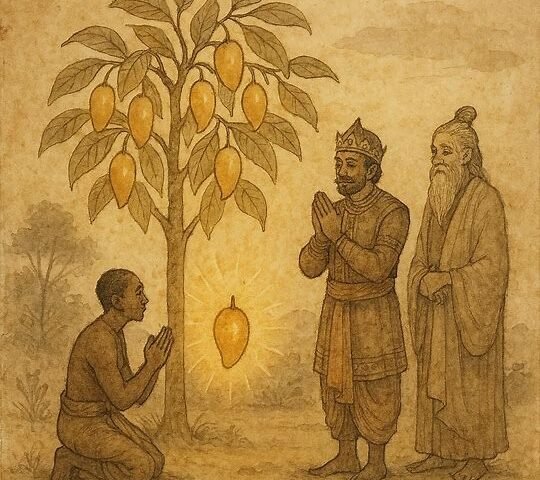
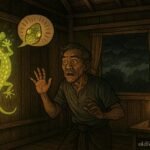
In the heart of a quiet Lao village, where the air smelled of jasmine and the soft hum of cicadas filled the fields, there lived a humble farmer named Kham. His home stood near the edge of a paddy field, where water buffalo waded lazily under the golden sun. Behind his small bamboo hut grew a single mango tree, tall and green, its branches spreading wide like a giant umbrella over the land.
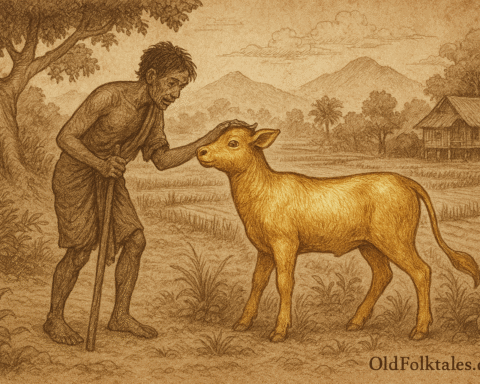
This mango tree was his pride and comfort. It had been planted by his grandfather, who used to say, “A tree grows best when tended with kindness.” Every morning, Kham swept away fallen leaves from its roots, poured water from his clay jar, and whispered a short prayer to the spirit of the tree.
Each season, the tree bore fruit so sweet that people from nearby villages came to buy them. The mangoes were golden and soft, their fragrance filling the air. Kham sold them modestly at the market, earning just enough rice and salt to feed his wife and two children. Life was peaceful and good.
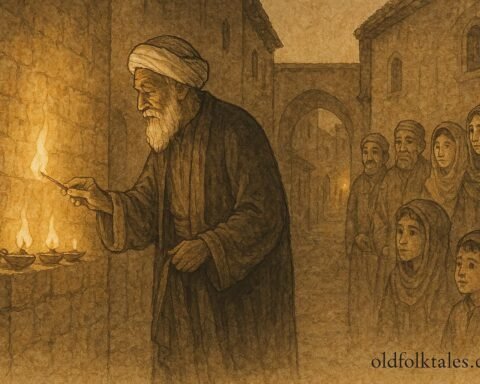
Explore desert legends and palace tales in our Western Asian Folktales archive
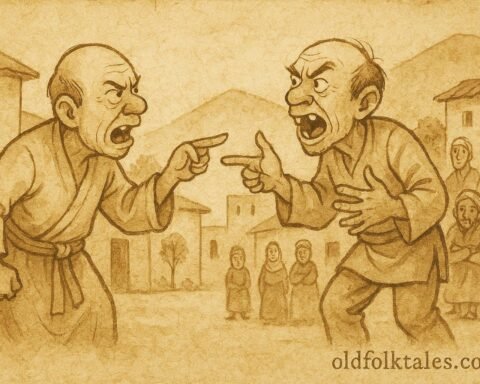
One day, as the fruit began to ripen, a wealthy landowner named Somchai passed by. He was known for his greed and his hunger for control over every patch of fertile land. Seeing the mango tree heavy with fruit, he frowned. “That tree grows too close to my boundary,” he said. “I believe it stands on my land.”
Kham bowed politely. “Respectfully, sir, this tree has stood beside my family’s home for three generations. It was planted by my grandfather, long before your fields reached this edge.”
Somchai’s eyes narrowed. “It does not matter who planted it. Its roots stretch onto my side. Therefore, it belongs to me. From this day forward, the fruit is mine.”
The farmer tried to reason with him, but Somchai was firm. He sent his servants to gather the mangoes while Kham stood helplessly by, his heart heavy. That night, Kham went to the village elder, an old man named Nai Pha, who was known for his fairness and wisdom.
After hearing both sides, the elder said calmly, “We shall let the spirits decide. The tree has a soul. If it truly belongs to Kham, it will make its will known. We will meet tomorrow beneath its branches and wait for a sign.”
The next morning, the whole village gathered around the mango tree. Somchai stood proudly with his servants, while Kham waited quietly, eyes lowered in respect. The elder sat between them, leaning on his cane.
“The spirits hear our quarrels,” he said. “If this tree belongs to Kham, let it protect him. If it belongs to Somchai, let it favor him.”
The air was still. Not a leaf moved. Then, as the elder finished speaking, a faint buzzing sound broke the silence. From the top of the mango tree, a small wasp flew down, circling once before landing on Somchai’s shoulder. The man waved it away impatiently. The wasp returned again, this time stinging him sharply on the neck.
Somchai cried out in pain and stumbled backward. “The spirits are unfair!” he shouted. “That insect has cursed me!” He ran from the gathering, clutching his neck, while the villagers murmured in surprise.
The elder nodded slowly. “The spirit of the tree has spoken. Its guardian has punished greed and arrogance. The mango tree belongs to the man who tends it with care.”
From that day on, no one questioned Kham’s right to the tree. He continued to care for it with love, offering the first mango of every harvest to the local shrine in gratitude. When people asked about the sting that had changed his fortune, Kham smiled gently and said, “Even the smallest creature can defend what is right when guided by the spirits.”
The story spread across the countryside, told by monks in temples and by grandparents beside evening fires. Children learned that justice does not always come from power or wealth but often from patience, honesty, and the unseen hands of nature.
Years later, when Kham grew old, his children took over his small field. The mango tree still stood tall, shading their home, its fruit as golden as ever. And though the wasp was never seen again, villagers said they could still hear its faint hum when someone tried to claim what was not theirs.
The mango tree, in its quiet strength, became a living symbol of fairness and peace, a reminder that truth will always find its voice, even through the smallest of wings.
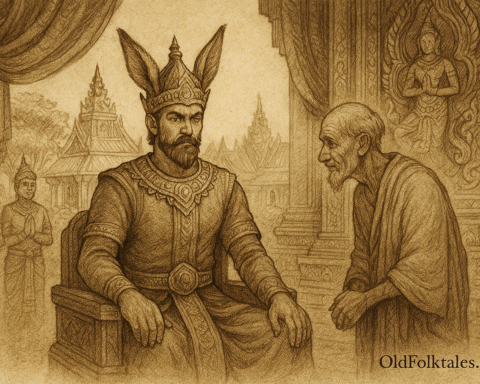
Journey through enchanted forests and islands in our Southeast Asian Folktales collection.
Moral Lesson
The story teaches that honesty and patience are stronger than greed or deceit. True justice often comes not from human power, but from the harmony between people, nature, and the spirits who guard the world.
Knowledge Check
-
Who was the farmer in the story, and what did he value most?
Answer: The farmer was Kham, and he valued his family and the mango tree he lovingly cared for. -
What did the rich man Somchai claim about the mango tree?
Answer: He claimed the tree grew on his land and demanded all the mangoes for himself. -
Who was asked to settle the dispute between Kham and Somchai?
Answer: The wise village elder, Nai Pha, was asked to decide fairly. -
How did the spirit of the tree reveal the truth?
Answer: A wasp, believed to be the tree’s guardian, stung the greedy man, showing who was in the wrong. -
What lesson did the villagers learn from this event?
Answer: They learned that the spirits favor honesty, and that patience and kindness bring justice. -
What became of the mango tree in the end?
Answer: It continued to flourish under Kham’s care, symbolizing fairness and the blessings of nature.
Source
Adapted from Lao Folk Tales, collected by Maha Sila Viravong (1957), Vientiane: Lao National Literature Project.
Cultural Origin: Laos (Rural Lao animist-Buddhist folktale tradition)