In the ancient days before the great river carved its path through the heart of Southeast Asia, the land of the Khmer people was a different place entirely. The kingdom stretched across fertile plains blessed by gentle rains and dotted with sacred pools where lotus flowers bloomed in profusion. The people prospered under wise rulers, built magnificent temples, and honored the spirits that dwelled in every tree, every stone, every body of water. And beneath the earth, in vast underground kingdoms that humans could scarcely imagine, lived the nagas, the great serpent spirits whose power over water and weather made them both feared and revered.
Among these serpent beings was one of particular magnificence, a naga prince whose scales shimmered with every color imaginable, whose eyes held the depth of the deepest oceans, and whose wisdom was said to rival that of the gods themselves. He dwelled in a palace of crystal and coral far beneath the earth, surrounded by treasures accumulated over countless centuries. Yet despite all his wealth and power, despite the honor shown to him by lesser spirits and the respect granted by the divine realm, he felt a restless longing he could not name.
Click to read all East Asian Folktales — including beloved stories from China, Japan, Korea, and Mongolia.
One day, drawn by curiosity or perhaps by fate, the naga prince rose from his underground realm and transformed himself into human form. He walked among the Khmer people, marveling at their cities, their art, their devotion to both the earthly and spiritual worlds. And there, in the royal palace during a festival celebrating the new year, he saw her.
She was a princess of the Khmer royal line, a young woman whose beauty was matched only by her grace and intelligence. She moved through the ceremonial dances with a elegance that seemed almost otherworldly, her silk garments flowing like water, her eyes bright with life and curiosity. When she smiled, it was as if the sun itself had blessed the gathering. The naga prince, watching from the crowd in his human disguise, felt something shift in his immortal heart. For the first time in his long existence, he understood what humans meant when they spoke of love.
He began to court her, appearing at festivals and ceremonies always as a handsome young nobleman from a distant province. He brought her gifts, rare pearls from the depths of the underground seas, flowers that bloomed in caves where no sunlight reached, stories of wonders that existed beyond the human world. The princess, intrigued by this mysterious stranger who spoke with such knowledge and depth, found herself drawn to him despite her better judgment.
Their courtship blossomed into love, genuine and profound. The naga prince revealed his true nature to her, expecting fear or rejection, but the princess possessed a brave and open heart. She had grown up with stories of the nagas, knew they were not demons but spirits deserving of respect, beings who had existed long before humans walked the earth and who would endure long after. She accepted him as he was, serpent and man, spirit and suitor.
When the naga prince asked for her hand in marriage, the princess agreed, and her father the king, recognizing the potential for a powerful alliance between the human and spirit realms, gave his blessing. The wedding was celebrated with unprecedented grandeur, with offerings made to both earthly and celestial powers, with music and dancing that lasted for seven days and seven nights. The union of princess and naga was seen as auspicious, a bridge between worlds that might bring great fortune to the Khmer people.
And indeed, prosperity followed. The rains came in perfect measure, neither too much nor too little. The rice paddies yielded abundant harvests. Trade flourished. Sickness seemed to diminish. The people attributed these blessings to the presence of the naga prince, who had brought the favor of the spirit world into the human realm through his marriage to their princess. Temples were built honoring this sacred union, and the couple was beloved throughout the kingdom.
But the heavens watched with growing displeasure.
The gods and celestial beings who governed the order of the cosmos had established certain boundaries for good reason. The realms were meant to remain separate, human with human, spirit with spirit, each in their proper sphere. The naga prince, by crossing this boundary and taking a human wife, had violated divine law. The princess, by accepting him, had done the same. Their love, however pure and genuine, represented a disruption of cosmic order that could not be permitted to stand.
Warnings came first, subtle and then increasingly direct. Strange omens appeared in the sky. Sacred pools began to dry up mysteriously. Monks experienced troubling visions during meditation. But the naga prince and the princess, secure in their love and the happiness they had brought to the kingdom, did not heed these signs. They believed their union was blessed, not cursed. They could not imagine that the heavens would punish something as beautiful as the love they shared.
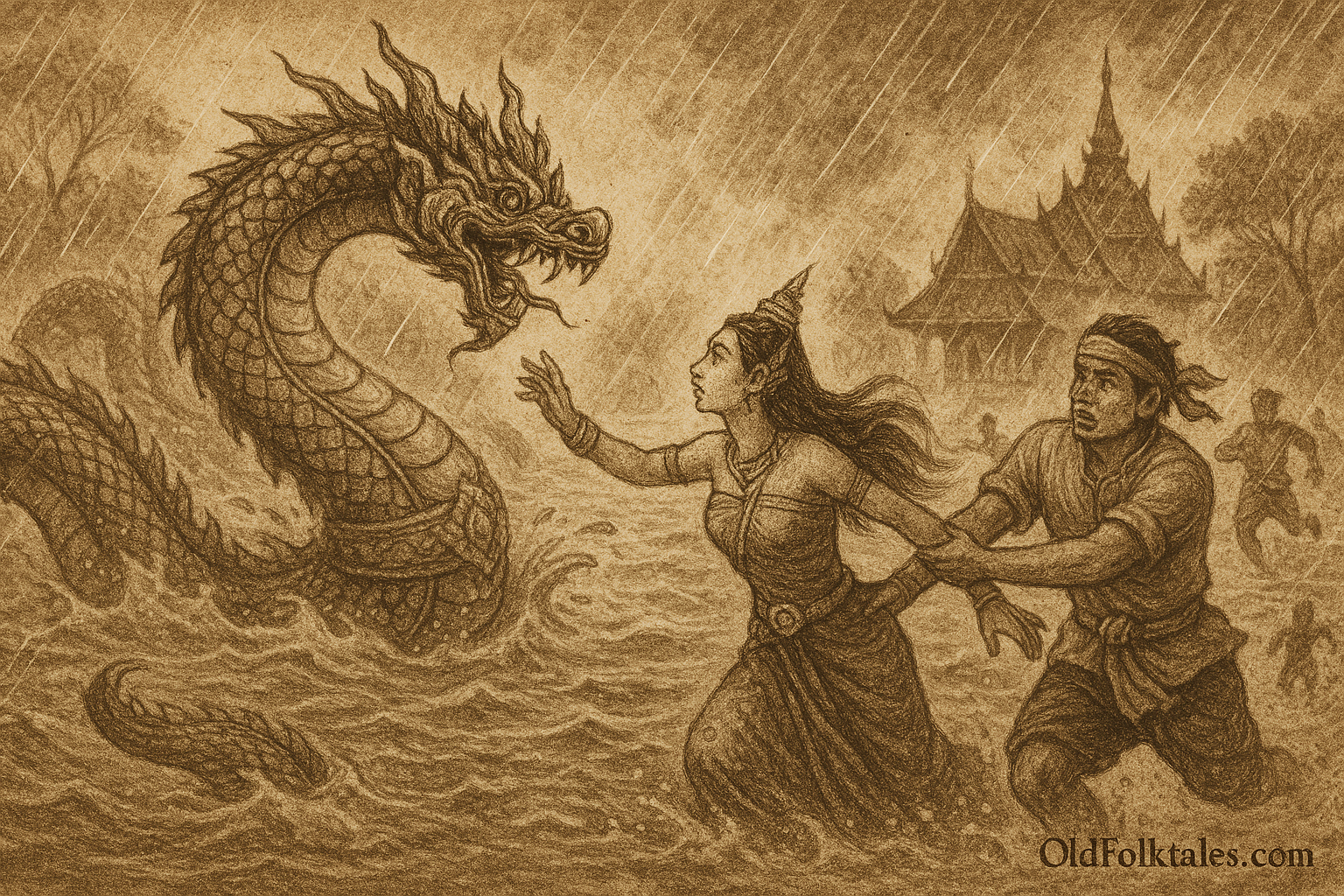
The divine realm’s patience finally exhausted itself. The heavens opened, and rain began to fall. Not the gentle, life-giving rain that nourished crops and filled wells, but a deluge of biblical proportions. Water poured from the sky in sheets, in walls, in cascades that seemed intent on washing the entire earth clean of its transgressions. Rivers burst their banks. Lakes overflowed. The carefully tended rice paddies disappeared beneath rising water. Villages were submerged. People fled to higher ground, carrying what they could, watching in horror as everything they had built was consumed by the flood.
The naga prince understood immediately what was happening. This was divine punishment for his violation of cosmic law. The heavens were drowning the land he had come to love, destroying the people his wife cherished, all because he had dared to cross the boundary between worlds. Anguish and guilt tore at him. His love had brought this catastrophe. His happiness had become his people’s doom.
The princess stood beside him on the highest hill in the kingdom, watching the waters rise, tears streaming down her face. “What can we do?” she whispered. “How can we stop this?”
The naga prince looked at the devastation spreading across the land, looked at his wife’s grief-stricken face, and made a decision that would cost him everything. He knew what he had to do, knew the sacrifice that would be required. If the heavens demanded the separation of realms, he would give them that separation, but he would not let the human world drown.
He transformed back into his true form, his serpent body expanding to an enormous size, scales gleaming even in the dim light filtered through the endless rain. The princess cried out, reaching for him, but he was already moving, already executing the desperate plan forming in his ancient mind.
The naga prince opened his great jaws and began to swallow the floodwaters. He drank the rising seas that threatened to consume the kingdom, drank the overflow from lakes and rivers, drank the very rain that fell from the angry heavens. His body swelled with the volume of water, growing larger, heavier, until he was so massive that the earth itself groaned beneath his weight.
But simply containing the water was not enough. It had to go somewhere, had to be channeled away from the human settlements, had to be given a path that would allow it to flow harmlessly to the sea. Using his immense body as both vessel and tool, the naga prince began to move across the land. His massive form carved deep into the earth, his scales scraping away soil and stone, his weight pressing down to create a channel.
He moved from north to south, following the natural contours of the land but deepening them, widening them, creating a path for the water to follow. As he moved, he released the waters he had swallowed, allowing them to fill the channel he was carving, creating a flow rather than a flood. The rain began to ease as the heavens, seeing his sacrifice, began to relent.
The effort was beyond anything even a naga prince should endure. His scales were torn, his body bruised and bleeding from the rocks he pushed aside. The sheer volume of water he had swallowed and was now releasing strained his immortal form to its limits. But he did not stop. He could not stop. Not while humans still needed protection. Not while his beloved princess still watched from her hilltop refuge.
Finally, exhausted beyond measure, the naga prince completed his task. Behind him stretched a great river, wide and deep, flowing from the mountains in the north all the way to the southern sea. The floodwaters that had threatened to destroy the kingdom now had a path, a channel that would carry them safely away. The villages that had survived could now rebuild. The fields would drain and become fertile again. Life would continue.
But the naga prince himself was spent. He had poured all his power, all his life force, into this final act of love and redemption. As his wife ran down from the hill toward the riverbank where his massive form lay, he transformed one last time into human shape so he could look upon her face with human eyes.
“I must return to the spirit realm,” he whispered, his voice weak. “The heavens will not permit me to stay, not after this. But I have given you and your people this river. It will sustain you, provide fish and water, connect your kingdom to the sea. Every time you see its waters flowing, remember that love, even when it breaks cosmic law, can still create something beautiful and life-giving.”
The princess held him as his human form began to dissolve, as his spirit separated from the earthly realm and returned to the hidden kingdoms beneath the earth and water. She wept, but her tears fell into the river he had created, becoming part of its eternal flow.
The great river that the naga prince carved came to be known as the Mekong, the Mother of Waters. It flows through Cambodia and beyond, just as it has for thousands of years, sustaining millions of people, connecting nations, bringing life to the land. The Khmer people never forgot the story of its creation, never forgot that their greatest river was born from a naga’s love and sacrifice.
To this day, Cambodians honor the nagas as sacred beings. Images of serpent spirits adorn temples and palaces. Festivals celebrate the connection between the human and spirit realms. Fishermen make offerings to the naga spirits before casting their nets. And when people stand on the banks of the Mekong, watching its mighty waters flow past, they remember that this river is not merely a natural feature but a testament to a love so powerful it reshaped the very land itself.
Click to read all Southeast Asian Folktales — featuring legends from Thailand, Indonesia, Vietnam, and the Philippines.
The Moral Lesson
The legend of the Mekong River’s origin teaches us profound truths about love, sacrifice, and redemption. The naga prince’s transgression, crossing the boundaries between the spirit and human worlds, brought divine punishment upon the land. Yet his response to this catastrophe demonstrates that genuine love is measured not by its defiance of rules, but by its willingness to sacrifice everything for the beloved. When faced with the consequences of his actions, the naga prince did not flee to safety or abandon the humans he had endangered. Instead, he gave his very life force to save them, transforming destruction into creation, turning floodwaters into a life-giving river.
Knowledge Check
Q1: Who was the naga prince in the Cambodian Mekong River legend?
A1: The naga prince was a powerful serpent spirit who lived in an underground kingdom beneath the earth. Nagas are revered in Cambodian culture as water spirits who control weather and rivers. This particular naga prince possessed magnificent scales that shimmered with every color, eyes with the depth of the deepest oceans, and wisdom rivaling the gods. He ruled over vast treasures and commanded respect from both lesser spirits and the divine realm, but felt incomplete until he encountered the Khmer princess.
Q2: Why did the heavens punish the naga prince and the Khmer princess?
A2: The heavens punished them because their marriage violated divine law and cosmic order. The gods and celestial beings had established boundaries between realms, with humans, spirits, and divine beings meant to remain in their proper spheres. By crossing this boundary to marry a human princess, the naga prince disrupted cosmic order. Despite the genuine love they shared and the prosperity their union brought to the kingdom, the heavens viewed their relationship as a transgression that required correction through divine punishment.
Q3: How did the divine realm punish the kingdom for the forbidden union?
A3: The heavens opened and sent a catastrophic flood, with rain pouring in sheets and walls that seemed intent on washing the earth clean. This was not life-giving rain but a deluge of biblical proportions. Rivers burst their banks, lakes overflowed, rice paddies disappeared, and villages were submerged. People fled to higher ground as everything they had built was consumed by rising floodwaters. The divine flood was meant to punish the violation of cosmic law and force the separation of the human and spirit realms.
Q4: How did the naga prince save the Khmer people from the flood?
A4: The naga prince transformed into his true serpent form and swallowed the massive floodwaters, drinking the rising seas, lake overflows, and rain itself. His body swelled enormously with the volume of water. Then, using his immense body as both vessel and tool, he moved across the land from north to south, carving a deep channel into the earth with his massive form. As he moved, he released the swallowed waters into this channel, creating a controlled flow rather than a destructive flood. This carved path became the Mekong River, providing a safe route for water to flow to the sea.
Q5: What happened to the naga prince after he created the Mekong River?
A5: The effort of swallowing the floodwaters and carving the river channel exhausted the naga prince beyond his limits. His scales were torn, his body bruised and bleeding from pushing aside rocks and earth. Having poured all his power and life force into saving the kingdom, he was spent. He transformed one final time into human form to say goodbye to his beloved princess, telling her he must return to the spirit realm as the heavens would no longer permit him to stay. His spirit then separated from the earthly realm and returned to the hidden kingdoms beneath earth and water.
Q6: What is the cultural significance of nagas and the Mekong River in Cambodia?
A6: The Mekong River origin legend reflects the profound spiritual connection between Cambodian people and the naga serpent spirits. Cambodians honor nagas as sacred beings, adorning temples and palaces with serpent spirit images. The story establishes the Mekong River not as mere geography but as a sacred gift born from a naga’s love and sacrifice. This legend reinforces the historical and spiritual ties between the Khmer people and the water serpent kingdom. Today, fishermen make offerings to naga spirits, festivals celebrate the human spirit realm connection, and the Mekong is revered as the Mother of Waters, a testament to supernatural love that reshaped the land itself for human benefit.
Source: Adapted from Cambodian mythology studies by Ashley Thompson and folklore.
Cultural Origin: Cambodia (Khmer Kingdom), Southeast Asia.