In the bustling coastal markets of Kuwait City, where traders called out prices of pearls and spices glimmered under the sun, there once lived a wealthy merchant and his only son. The father was known for his honesty and skill in trade, while the son was known for the opposite, lazy, indulgent, and careless with money.
One morning, tired of his son’s idleness, the merchant called him to his study. “My son,” he said gravely, “wealth does not last in the hands of the foolish. Take this bag of pearls to Basra and trade them wisely. If you fail, you will learn what it means to work.”
The young man, eager for adventure but untested in hardship, agreed. He set out across the shimmering Arabian Gulf, with a small caravan and a merchant’s pride in his heart.
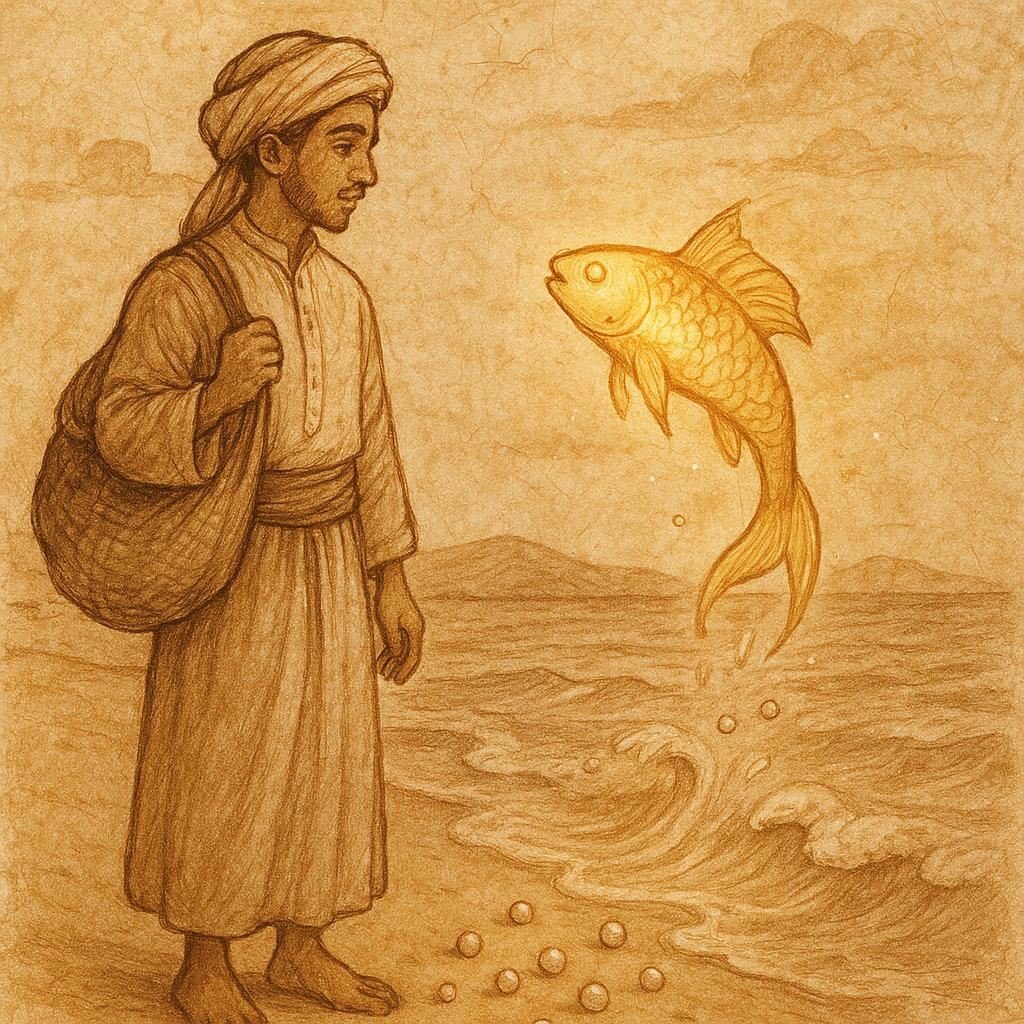
As he travelled, he stopped by a fishing village along the coast. There, by the docks, he saw a crowd gathered around a fisherman who had caught something strange. In his net shimmered a golden fish, its scales glinting like sunlight on water. The crowd gasped as the fish opened its mouth and spoke:
“Good sir, please let me go, and I shall repay you threefold for your mercy.”
The fisherman, terrified, almost dropped it. “A talking fish!” he cried. “I should take this to the emir, he’ll pay a fortune!”
But the merchant’s son, moved by pity, stepped forward. “Please,” he said gently, “set the creature free. No life should be sold for gold.” He handed the fisherman a handful of pearls, enough to buy his silence and his freedom. The man, stunned by the boy’s generosity, released the fish into the sea. The golden fish flicked its tail and vanished beneath the waves.
The onlookers murmured that the youth was a fool. “He trades pearls for water,” one said. Another laughed, “A merchant who pities fish will soon beg for bread.”
Ignoring them, the young man continued to Basra, where he hoped to sell the rest of his pearls. But fate was not kind. On the road, he was robbed by bandits, who stripped him of all his goods and left him wandering the desert. Hungry and alone, he trudged home to Kuwait with nothing but regret.
When he reached his father’s house, the old merchant looked upon him with disappointment but said nothing. The son went to bed that night with tears in his eyes, thinking himself a failure.
But just before dawn, a servant rushed to his room shouting, “Master! Come quickly!” The young man ran to the courtyard, where the family fountain, usually a dry stone basin, was overflowing with pearls. The water shimmered like moonlight, and the pearls poured over the edge in cascades of white and silver.
The father stared in awe. “How can this be?” he asked.
The son fell to his knees. “The fish,” he whispered. “The golden fish kept its promise.”
From that day, everything changed. The young man used part of the newfound wealth to help the poor, rebuild wells, and feed hungry travellers. When others asked him what had brought such fortune, he always replied,
“A kind deed returns in its own time. A good heart is worth more than a ship of pearls.”
And so, he became known not as the lazy son of a rich merchant, but as the Wise Trader of Kuwait, whose compassion turned loss into abundance.
Moral
Charity brings reward where greed fails. True wealth lies not in what we keep, but in what we give.
Knowledge Check
-
Who were the main characters in “The Merchant’s Son and the Talking Fish”?
A wealthy Kuwaiti merchant, his son, a fisherman, and a magical golden fish. -
What did the merchant’s son trade to free the fish?
He gave the fisherman pearls in exchange for the fish’s freedom. -
How was the son punished after freeing the fish?
He was robbed on his way to Basra and returned home penniless. -
What miracle occurred after the son returned home?
His courtyard fountain overflowed with pearls as the fish kept its promise. -
What lesson does the Kuwaiti folktale teach?
Acts of kindness and generosity are rewarded, while greed leads to loss. -
What cultural value does this story reflect in Kuwaiti society?
It highlights charity, faith, and integrity, virtues central to Gulf traditions and Islamic ethics.
Source: Adapted from “Kuwait: The Merchant’s Son and the Talking Fish” in Folktales from the Arabian Peninsula (Taibah & MacDonald, 2016), pp. 2–5.
Cultural Origin: Kuwait City (Urban Coastal Oral Tradition)