
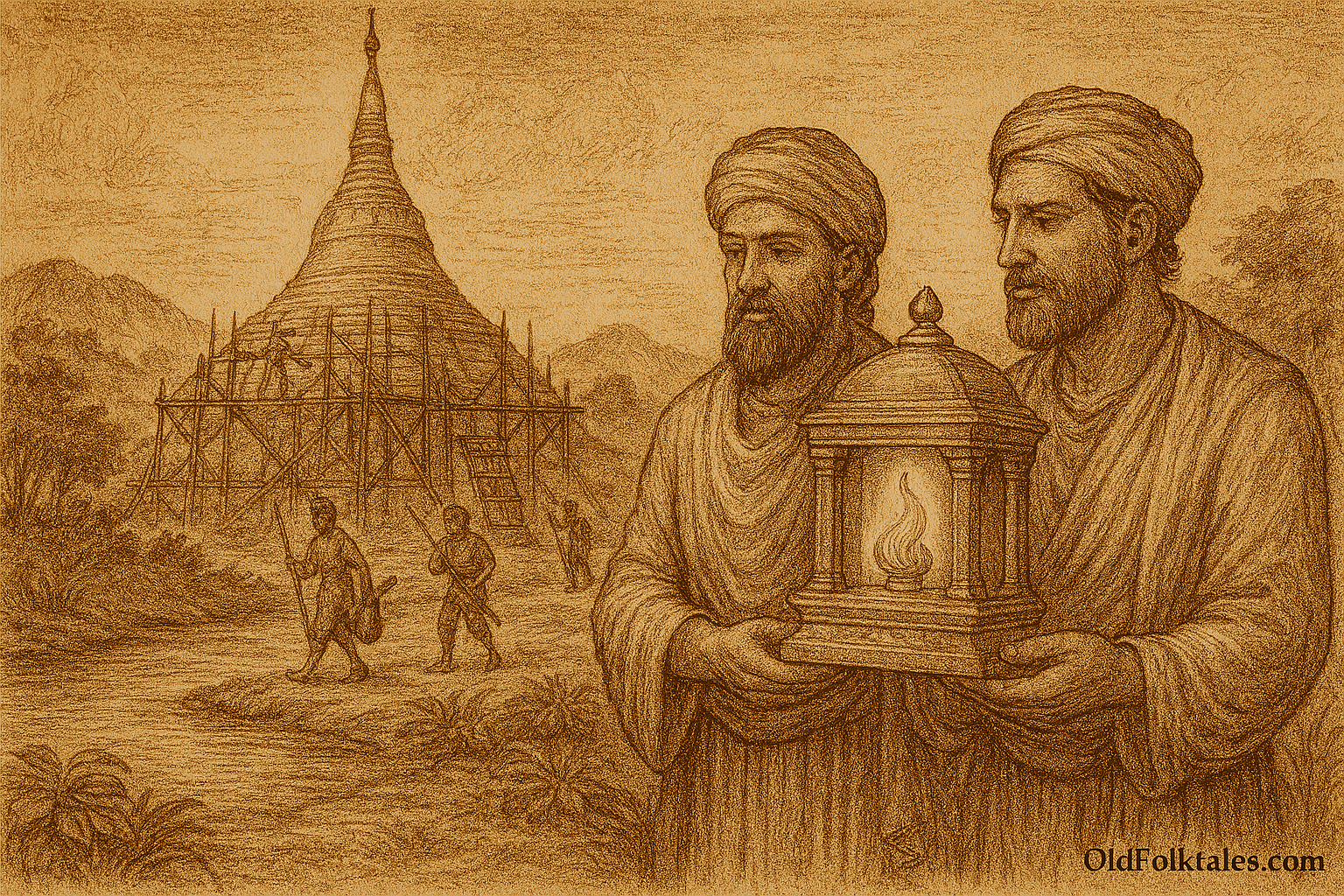
In the ancient days when the world was young and the Buddha had just attained perfect enlightenment beneath the Bodhi tree, two merchant brothers from a distant land set out on a journey that would change the spiritual destiny of their homeland forever. Their names were Tapussa and Bhallika, and they came from the golden land that would one day be known as Myanmar.
The brothers were traders by profession, traveling the vast networks of roads that connected kingdoms and cultures across the ancient world. They carried fine goods from their homeland precious gems, fragrant oils, woven silks that shimmered like water in sunlight. But they were also men of curious minds and seeking hearts, always alert for wisdom as well as profit, always listening for truths that might illuminate the path of life.
Click to read all East Asian Folktales — including beloved stories from China, Japan, Korea, and Mongolia.
It was during one of their journeys through India that fate or perhaps something greater than fate led them to a grove of trees where the air seemed to shimmer with an otherworldly peace. There, beneath the shade of spreading branches, sat a man whose very presence radiated tranquility. His eyes held depths that seemed to contain all the suffering and all the joy of existence, perfectly balanced, perfectly understood. This was the Buddha, Siddhartha Gautama, who had just achieved enlightenment and sat in the sublime afterglow of that profound awakening.
The brothers approached with reverence, sensing immediately that they stood before someone extraordinary. They offered him food honey cakes and rice balls they had prepared for their journey and in return, the Buddha spoke to them of the path to liberation from suffering, of the nature of impermanence, of the way to find peace in a world of constant change. His words fell upon their hearts like rain upon parched earth, and they knew they had found something more precious than all the jewels in their trading caravans.
As they prepared to continue their journey homeward, filled with the Buddha’s teachings, the brothers made a humble request. They wished to take something back to their homeland, some tangible reminder of this transformative encounter, something that could serve as a focus for devotion and remembrance. The Buddha, moved by their sincerity, reached up and pulled eight strands of hair from his own head. These he placed in the brothers’ hands, and as he did so, the hairs seemed to glow with an inner light.
“Take these relics to your land,” the Buddha told them, his voice gentle as wind through leaves. “Build a shrine to house them, and let it stand as a reminder of the path to enlightenment. Where these relics rest, the teachings will flourish, and countless beings will find their way to liberation.”
With hearts overflowing with gratitude and awe, Tapussa and Bhallika began the long journey home, carrying the sacred hairs with reverent care. They traveled across mountains and rivers, through forests and plains, never letting the precious relics out of their sight, never forgetting the weight of responsibility they carried.
When they finally reached Myanmar, they sought an audience with the local king, telling him of their extraordinary encounter and showing him the sacred hairs. The king, a righteous ruler who understood the spiritual significance of what the brothers brought, immediately pledged his support for building a suitable shrine. But where should such a sacred structure be erected?
The king consulted with the most powerful spirits of the land the nats who had dwelled in Myanmar since time immemorial, the guardians of mountains and rivers, forests and plains. These ancient beings recognized the power of the Buddha’s relics and agreed to help. They guided the king and the brothers to Singuttara Hill, a place where, they revealed, three previous Buddhas of ancient times had also left relics: a staff, a water filter, and a piece of robe. This hill, they said, was destined to become the most sacred site in all the land.
And so the construction began. The king commanded his finest craftsmen and laborers to work alongside the two merchant brothers. They dug deep into the earth of Singuttara Hill, creating a chamber where the sacred hairs would rest alongside the relics of the previous Buddhas. The moment they placed the Buddha’s hairs into this sanctified space, the earth itself responded.
The ground began to tremble not with violence, but with a vibration that felt almost like joy, as if the very bones of the world were celebrating this sacred union. Trees swayed though no wind blew. Birds took flight in spiraling patterns that formed mandalas against the sky. The trembling spread outward in waves, felt across the entire kingdom, announcing that something momentous had occurred.
Then came the light. It began as a soft glow emanating from the chamber where the relics rested, but it quickly grew in intensity and breadth. Golden light poured forth from the hill, cascading down its slopes like liquid sunshine, spreading across the land in shimmering waves. It was said that this radiance was visible for miles in every direction, that ships at sea could see it blazing on the horizon like a second sun, that travelers in distant provinces turned their faces toward it and felt inexplicable peace wash over them.
The sky above Singuttara Hill transformed into a tapestry of colors that no painter could capture gold and crimson, violet and rose, colors that seemed to exist between the ordinary spectrum of light, hues that belonged more to dreams than to waking reality. The clouds themselves seemed to bow down toward the hill, as if the heavens themselves paid homage to what was occurring below.
But perhaps most miraculous of all were the flowers. All across Singuttara Hill, blossoms began to appear flowers blooming in impossible profusion, in seasons when they should have been dormant, in places where no seeds had been planted. Lotus flowers opened their petals though no water nourished their roots. Jasmine perfumed the air though it was not jasmine season. Orchids in colors never before seen draped themselves from trees, and carpets of tiny white flowers covered the ground like fallen stars.
The people of Myanmar witnessed these miracles with wonder and devotion, understanding that their land had been blessed beyond measure. The king ordered that a great pagoda be built over the sacred chamber, a structure worthy of housing such holy relics. Master builders designed a monument that would reach toward the heavens, its golden spire visible from all directions, a beacon of enlightenment for all who sought the path.
Over the years and centuries that followed, the Shwedagon Pagoda grew in size and splendor. Kings and queens donated gold to plate its surfaces, so that it gleamed like a small sun even in the moonlight. Devotees added jewels and precious stones until the pagoda sparkled with thousands of points of light. The structure became the spiritual heart of Myanmar, drawing pilgrims from across the world, all seeking to pay respects to the sacred hairs of the Buddha that Tapussa and Bhallika had carried home so long ago.
The two brothers, having fulfilled their sacred mission, became revered figures in Myanmar’s spiritual history. Their journey from merchants seeking profit to devotees carrying enlightenment itself back to their homeland—embodied the transformation that the Buddha’s teachings could bring about. They had left Myanmar as traders and returned as something far greater: as bridges between the Buddha and their people, as bearers of light to the golden land.
To this day, the Shwedagon Pagoda stands atop Singuttara Hill, its golden spire reaching three hundred feet into the sky, visible for miles in every direction. Pilgrims still climb its steps, circumambulating the sacred shrine, offering flowers and prayers. And sometimes, in the quiet hours of dawn or the purple twilight, visitors say they can still feel the ground beneath them hum with that ancient vibration, can still sense the presence of the sacred hairs that rest at the pagoda’s heart, can still see if their hearts are open a shimmer of that miraculous light that once covered the hill when two merchant brothers brought the Buddha’s gift home to Myanmar.
Click to read all Southeast Asian Folktales — featuring legends from Thailand, Indonesia, Vietnam, and the Philippines.
The Moral Lesson
The legend of the Shwedagon Pagoda teaches us that genuine spiritual transformation transcends worldly ambitions and material success. Tapussa and Bhallika began as merchants pursuing profit but became something far greater when they recognized and honored the sacred opportunity before them. Their story demonstrates that enlightenment spreads not through force or conquest, but through sincere devotion, careful stewardship of sacred trusts, and the willingness to dedicate oneself to something larger than personal gain. The miracles that accompanied the placement of the Buddha’s relics the trembling earth, the celestial light, the impossible flowers symbolize how authentic spiritual practice can transform not just individuals but entire communities and lands.
Knowledge Check
Q1: Who were Tapussa and Bhallika in the Shwedagon Pagoda legend?
A1: Tapussa and Bhallika were two merchant brothers from Myanmar (the ancient golden land) who traveled across Asia trading precious goods. They encountered the Buddha shortly after his enlightenment in India and became the first lay disciples to receive his teachings. The Buddha gave them eight sacred hairs from his head, which they carried back to Myanmar and which became the foundation for the Shwedagon Pagoda, transforming them from merchants into sacred figures in Myanmar’s spiritual history.
Q2: What sacred relics are housed in the Shwedagon Pagoda according to Myanmar legend?
A2: According to the legend, the Shwedagon Pagoda houses eight hairs of Gautama Buddha given to the brothers Tapussa and Bhallika, along with relics from three previous Buddhas of ancient times a staff, a water filter, and a piece of robe. These sacred objects were placed together in a chamber on Singuttara Hill, making it the most spiritually significant site in Myanmar, as it contains relics from four different Buddhas.
Q3: What miracles occurred during the construction of Shwedagon Pagoda?
A3: When the Buddha’s sacred hairs were placed in the chamber on Singuttara Hill, multiple miracles manifested: the ground began to tremble with a joyful vibration felt across the entire kingdom; golden light poured from the hill, visible for miles and creating a spectacle in the sky; and flowers bloomed in impossible profusion out of season and in places where no seeds had been planted, including lotus, jasmine, and orchids in colors never before seen, covering the hill in supernatural beauty.
Q4: What role did local spirits play in the creation of Shwedagon Pagoda?
A4: The local spirits of Myanmar, known as nats guardians of mountains, rivers, forests, and plains played a crucial role in the pagoda’s creation. These ancient beings recognized the power of the Buddha’s relics and guided the king and the two brothers to Singuttara Hill, revealing that it was a sacred site where three previous Buddhas had also left relics. The nats’ guidance ensured the pagoda was built in the most spiritually significant location, where multiple Buddhist relics could be united.
Q5: Why is Singuttara Hill significant in Myanmar Buddhist tradition?
A5: Singuttara Hill is profoundly significant because it was chosen as the site where relics from four different Buddhas would rest together. According to the legend, three previous Buddhas of ancient times had already left relics there (a staff, water filter, and robe piece) before Tapussa and Bhallika brought the Buddha Gautama’s eight hairs. This convergence of sacred relics from multiple Buddhas made Singuttara Hill the most holy site in Myanmar and the perfect location for the Shwedagon Pagoda.
Q6: What does the Shwedagon Pagoda legend symbolize in Myanmar culture?
A6: The Shwedagon Pagoda legend symbolizes Myanmar’s deep spiritual connection to Buddhism and represents the transformation of the nation into a land of enlightenment. The story embodies several key cultural values: the importance of recognizing and honoring sacred opportunities, the transformation from worldly pursuits to spiritual devotion, and the belief that genuine faith can manifest miracles. The pagoda itself stands as Myanmar’s spiritual heart, representing the country’s identity as a Buddhist nation and serving as a physical manifestation of the Buddha’s presence and teachings in the golden land.
Cultural Origin: Myanmar (Burma), Southeast Asia.








