In a quiet neighborhood of an old Israeli town lived a man whose reputation spread far beyond his street. He was known not for kindness, generosity, or wisdom, but for a stinginess so extreme that even his neighbors joked the sun would charge him for its warmth. This man, the notorious miser, guarded his possessions with a vigilance that bordered on obsession.
Of all his belongings, there was one treasure he valued above everything else: a large clay jar filled to the brim with thick, golden honey. Honey was precious, sweetness captured from the labor of thousands of bees, and in his eyes, it was as good as gold. The miser kept the jar suspended from the ceiling of his small room with a sturdy rope, believing that this would keep it safe from ants, thieves, and even dust.
Every evening, after bolting his door and securing every latch, he would sit beneath the hanging jar and admire it. The golden glow of sunset filtering through his tiny window would illuminate the honey inside, and something strange would happen to him. As he stared at the shimmering sweetness, his imagination would begin to wander.
One night, as warm light danced across the room, the miser folded his arms and allowed himself a rare indulgence, daydreaming.
“If I sell this honey,” he mused, his eyes gleaming, “I will earn enough money to buy two more jars. Then I will sell those jars and buy a small herd of goats. The goats will give milk, and with that milk, I will make cheese. I can sell the cheese in the market… oh, the fortune I will build!”
The more he imagined, the grander the fantasy grew. Soon he envisioned himself owning a large house, one far bigger than anything his neighbors had. He pictured servants at his call, merchants seeking his partnership, and travelers admiring his wealth.
And then, as dreams often do, the fantasy carried him even further.
“Yes,” he said aloud, “with such riches, I’ll find myself a fine wife. A good, obedient wife!”
He leaned back proudly, enjoying the imagined life that was forming in his mind like a palace built from air.
But fantasies are unpredictable things. As he imagined his wife, he also imagined her disobeying him one day, perhaps talking back or ignoring a command. In his mind, she stood before him with crossed arms and a stubborn expression. The scene enraged him. His face reddened, and without realizing it, he lifted his arm in fury, acting out the scolding he was giving his imaginary wife.
“You will NOT defy me!” he shouted at the empty air, waving his hands dramatically.
His gesture was too wild, too uncontrolled. His hand swung upward and struck the rope from which the honey jar hung. The jar swung violently, hit the ceiling beam, and in an instant came crashing down with a deafening smash.
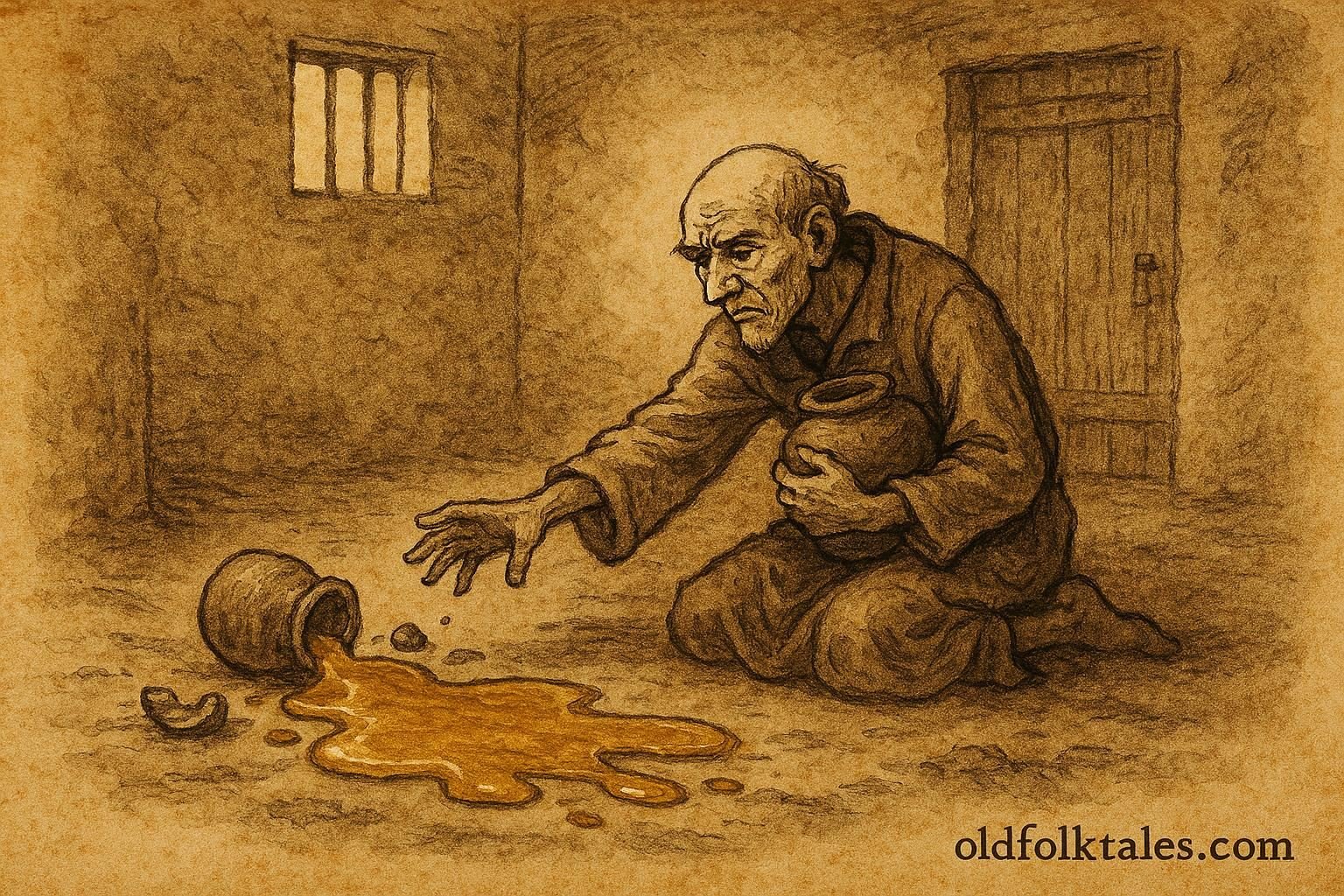
Honey splattered across the floor like liquid gold. Shards of the clay jar scattered across the room. The precious treasure he had admired for so long spread in thick, sticky pools across the dirt, soaking into the earth.
The miser froze. His outstretched hand trembled in the air. Slowly, he looked down at the ruined mess, and the realization struck him harder than any blow.
His dreams, his goats, his dairy, his house, his servants, even the imagined wife, had all dissolved into sticky mud.
He sank to the floor, scooping handfuls of honey into his palms as though he could still save it. But the honey slipped through his fingers, coating them uselessly. A deep wail escaped him, part anger, part grief, part bitter regret. For a long time, he sat there staring at the ground, mourning both the honey and the fantasies he had built upon it.
By morning, only the ants benefited from his misfortune.
His neighbors, hearing the story (for such stories always find a way to spread), shook their heads knowingly.
“Better to enjoy what you have,” they said, “than lose everything while dreaming of what you don’t.”
And so the miser became a cautionary tale, one told in homes, marketplaces, and gatherings as a gentle reminder that greed and idle fantasies often lead to nothing but loss.
Moral Lesson
This Israeli folktale teaches that wealth built on fantasies is fragile and fleeting. True wisdom lies in valuing what one has rather than chasing uncertain dreams fueled by greed.
Knowledge Check
1. What object does the miser treasure most in the tale?
A large clay jar of honey that he believes will make him wealthy.
2. What triggers the miser’s daydream in the story?
He imagines the fortune he could build by selling the honey.
3. Why does the jar of honey break?
He angrily gestures at an imaginary wife during his fantasy and hits the rope.
4. What cultural lesson does this Israeli folktale teach?
It warns against greed and depending on imagined future wealth instead of appreciating the present.
5. How does the miser react after the jar breaks?
He tries to salvage the honey but realizes he has lost everything.
6. Why is the tale considered a fable within Israeli folklore?
Because it uses a simple scenario to teach moral wisdom through symbolic consequences.
Source
Adapted from the Israeli folktale “The Miser and the Jar of Honey,” Israel Folktale Archives (IFA 14287), University of Haifa.
Collected from Shalom Zarviv. Recorded in Ashdod, Israel, 1985.