Mist hung low over the forest at dawn, clinging to the trees as though reluctant to release the night. Birds remained silent, and even the wind seemed to avoid the narrow path that wound through the dense greenery. Travelers who knew this forest never entered it lightly, for it was said that a violent ogre lived deep within its heart, striking fear into nearby villages and monasteries alike.
The ogre had once been a human, according to whispers passed between elders. Rage, greed, and cruelty had twisted his spirit until his form followed his heart. Whatever the truth, his presence was undeniable. Broken trees, scattered animal bones, and vanished woodcutters bore witness to his wrath. The villagers avoided the forest entirely, abandoning sacred shrines and old footpaths rather than risk crossing his domain.
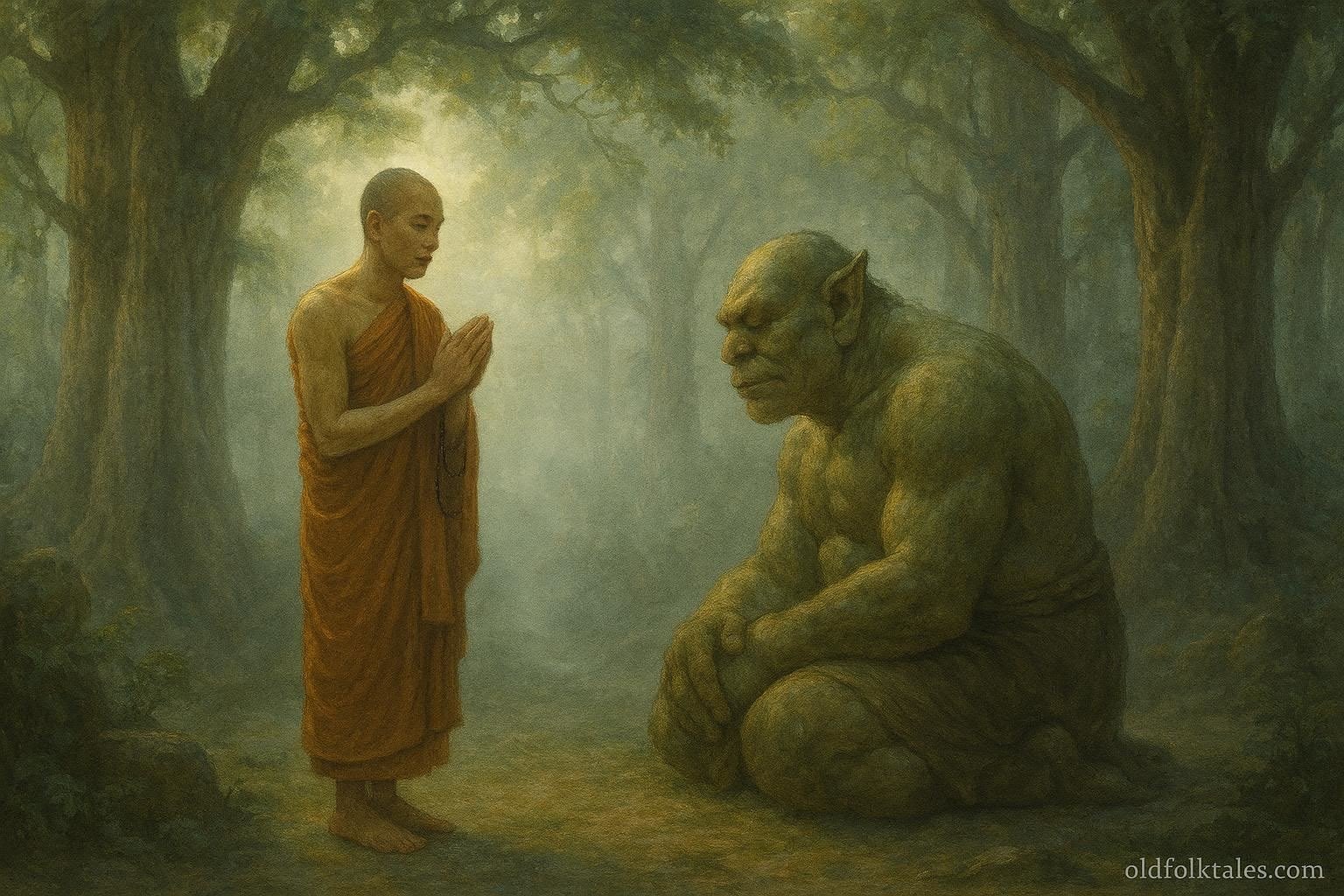
One morning, a lone monk arrived at the edge of the forest. His robes were worn but clean, his alms bowl empty, his eyes calm. He had traveled from a distant monastery after hearing the villagers speak of fear and loss. While others spoke of weapons and hunters, the monk listened quietly. When the village head begged him not to enter the forest, the monk bowed respectfully and thanked him for the warning.
He stepped onto the path anyway.
Discover more East Asian Folktales from the lands of dragons, cherry blossoms, and mountain spirits.
With each step, the forest grew darker and heavier, as though pressing against his presence. Branches snapped under unseen weight. Growls echoed between the trees. Still, the monk continued, his breath steady, his mind focused on compassion. He began to chant softly, ancient verses meant to calm restless spirits and awaken forgotten kindness.
The ogre heard the chanting long before he saw the monk.
Enraged by the intrusion, the ogre charged through the undergrowth, shaking the earth beneath his feet. His body was massive, scarred, and twisted. His eyes burned with fury sharpened by years of isolation and violence. When he burst into the clearing where the monk stood, he roared, demanding to know why a fragile human dared enter his territory.
The monk did not flee.
He bowed.
The ogre froze, confused by the gesture. No one had ever shown him respect. Fear and hatred were the only responses he knew. His roar faltered, replaced by a growl of suspicion. He raised his fist, ready to strike, but the monk began chanting again, louder now, filling the clearing with rhythmic calm.
The ogre screamed for the monk to stop, yet the sound pierced something deep within him. Memories surfaced uninvited. A childhood long forgotten. A mother who once sang softly. A village that had turned away when anger consumed him. His raised fist trembled.
The monk spoke gently, addressing the ogre not as a monster, but as a suffering being trapped by his own pain. He said the forest did not fear him, but mourned him. He said violence had only deepened the ogre’s loneliness. He said transformation was still possible.
Enraged by the monk’s words yet unable to strike him, the ogre fled into the forest, tearing through trees in confusion. The monk remained where he was, chanting until night fell.
The next day, the monk returned to the same clearing.
The ogre watched from a distance, torn between rage and curiosity. Again the monk bowed. Again he chanted. This continued for many days. The monk did not demand change. He did not threaten or command. He simply remained, offering presence and compassion.
Slowly, the ogre approached closer each day.
When the ogre finally spoke, his voice was raw with pain rather than anger. He asked why the monk was not afraid. The monk replied that fear grows when suffering is ignored. He said the ogre’s violence was a cry for release, not proof of evil.
The ogre collapsed to the ground, overwhelmed. For the first time in years, he wept.
Through continued chanting and guidance, the monk taught the ogre how to sit in stillness, how to breathe, how to watch thoughts without obeying them. The ogre struggled, often failing, but the monk never withdrew his compassion.
Weeks passed.
The forest changed.
Animals returned. Broken trees began to sprout new leaves. The ogre’s form softened, his posture less hunched, his eyes less wild. He began repairing shrines he had once destroyed, standing guard at forest paths instead of blocking them.
When the villagers finally gathered the courage to return, they found the ogre standing peacefully at the forest entrance. Fear gripped them until the monk stepped forward and explained what had occurred. The ogre bowed deeply, promising never again to harm those who respected the forest.
From that day on, travelers passed safely. Hunters took only what they needed. Woodcutters prayed before cutting trees. The ogre became a silent guardian, protecting the forest from destruction and guiding the lost back to safety.
When the monk eventually departed, he left no monument behind. Only a forest restored and a spirit transformed.
The villagers never forgot the lesson. They taught their children that true strength lies not in force, but in compassion powerful enough to tame even the fiercest heart.
Journey through enchanted forests and islands in our Southeast Asian Folktales collection.
Moral Lesson
Violence cannot be defeated by greater violence. Compassion, patience, and spiritual discipline possess the power to transform even the most destructive beings. When suffering is met with understanding instead of fear, true change becomes possible.
Knowledge Check
- Why did villagers fear the forest?
Answer: A violent ogre was believed to live there and attack anyone who entered. - How did the monk respond when he first met the ogre?
Answer: He bowed respectfully and began chanting instead of fighting or fleeing. - What caused the ogre to hesitate during the confrontation?
Answer: The monk’s chanting and words awakened forgotten memories and emotions. - Did the monk force the ogre to change?
Answer: No, he showed consistent compassion and guidance without force. - How did the forest change after the ogre transformed?
Answer: Animals returned, shrines were repaired, and travelers became safe again. - What lesson did the villagers pass down to their children?
Answer: That compassion is stronger than violence and can heal even great suffering.
Source
Adapted from International Association of Buddhist Studies Myanmar Folklore Papers, 2012.
Cultural Origin
Theravada Buddhist Monastic Folklore.