Deep in the lush forests of Vietnam, where bamboo groves swayed in the mountain breeze and ancient trees stretched their branches toward the sky, a monkey lived renowned throughout the animal kingdom for his remarkable intelligence. His eyes sparkled with quick wit, his voice carried the confidence of one who had solved countless riddles, and his reputation for wisdom had spread from the lowland jungles to the highest peaks.
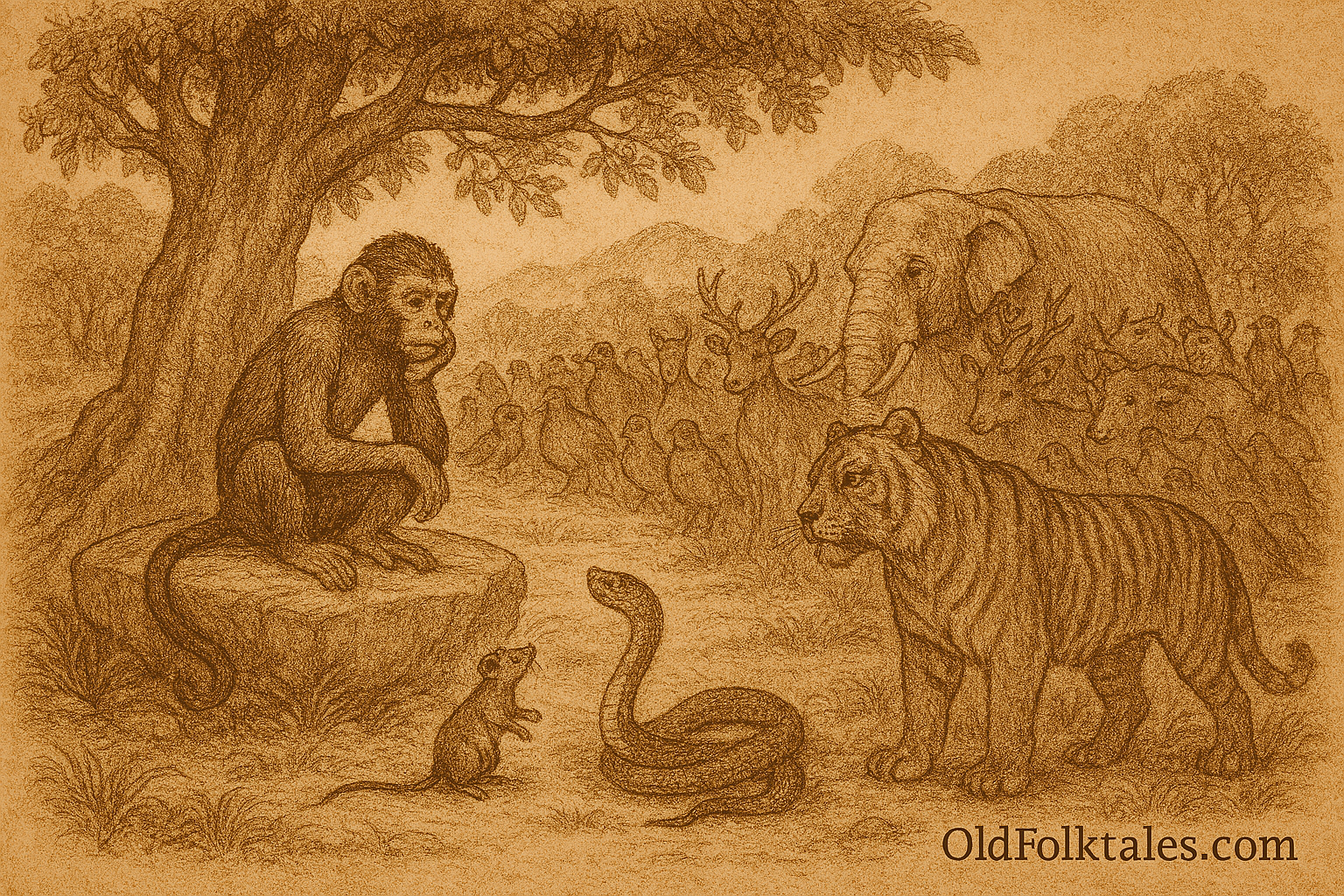
Animals traveled from distant corners of the forest to seek his counsel. The monkey sat upon a smooth stone beneath a spreading fig tree, his court of justice, where he would listen to disputes and render judgments. Birds would fall silent when he spoke. Even the great tiger showed respect for the monkey’s clever mind.
Click to read all East Asian Folktales — including beloved stories from China, Japan, Korea, and Mongolia.
In the beginning, the monkey judge took his responsibility seriously. When two deer quarreled over grazing rights in a meadow, he divided the land fairly between them. When a fox accused a rabbit of stealing vegetables from his garden, the monkey investigated carefully and discovered the true culprit was a wandering boar. The animals praised him, bringing gifts of ripe mangoes, sweet bananas, and fragrant flowers to honor his fairness.
“Truly, we are blessed to have such a wise judge,” the animals would say, bowing respectfully before him.
But as seasons passed and the monkey’s fame grew, something began to change in his heart. The constant praise fed his vanity like rain nourishing a growing vine. He began to see himself not as a servant of justice but as someone superior to those who came before him. His clever mind, once used for good, began to twist toward selfish purposes.
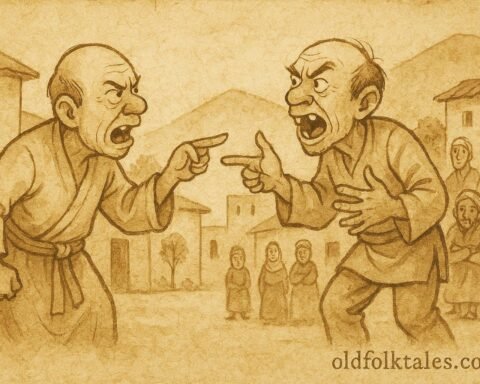
One morning, a water buffalo and an ox appeared before the monkey, their faces troubled. They had been friends and farming partners for many years, sharing a rice field beside the river. Now they stood in disagreement over how to divide their harvest.
The water buffalo explained his case first. “I pulled the plow through the muddy soil for months,” he said, his deep voice steady. “My strength made the field ready for planting. I should receive the larger share.”
The ox stepped forward, his horns gleaming in the dappled sunlight. “But I carried all the harvested rice on my back to the storage barn,” he countered. “Without my labor, the grain would have rotted in the field. My share should be greater.”
The monkey stroked his chin thoughtfully, his eyes moving between the two large animals. His mind worked quickly, but not toward justice. He saw an opportunity.
“This is indeed a complex matter,” the monkey announced with great solemnity. “Both of you have worked hard and deserve compensation. However, I must carefully weigh each contribution against the other. This will require much thought and consideration.”
The water buffalo and ox nodded, trusting in his wisdom.
“I shall keep the entire harvest here under my protection,” the monkey declared, “while I deliberate on the proper division. Return in seven days, and I will announce my judgment.”
The two friends agreed and departed, believing their harvest was in safe hands. But as soon as they disappeared into the forest, the monkey began feasting on their rice, sharing portions with his family and friends. By the time the water buffalo and ox returned, more than half the harvest had vanished into the monkey’s stores.
When confronted about the missing rice, the monkey waved his hand dismissively. “Court fees,” he said smoothly. “My wisdom and time are valuable. What remains will be divided fairly between you.”
The water buffalo and ox left angry and betrayed, but they were simple creatures who did not know how to challenge such a clever judge.
Word of this injustice spread quietly through the forest, but the monkey’s power seemed unshakable. He became bolder in his corruption. When a peacock and a pheasant disputed over nesting territory, the monkey ruled in favor of the peacock, but only after the peacock promised him the finest feathers for his collection. When squirrels argued over a cache of nuts, the monkey kept the best nuts for himself as payment for his judgment.
The animals whispered among themselves, their respect turning to resentment. Yet they felt helpless against the monkey’s cunning words and quick mind.
Then came the day when a small mouse appeared before the monkey judge. The mouse accused a snake of threatening to eat his children. The snake, coiled and patient, denied the charge, claiming he had only been passing through the mouse’s territory.
The monkey barely listened to either creature. He had grown lazy in his corruption, confident that no one would dare challenge him. “The snake is innocent,” he declared carelessly. “The mouse is merely being paranoid. Case dismissed.”
But the mouse, though tiny, possessed a brave heart and a sharp eye. He had been watching the monkey judge for many months, noting every unfair ruling and every stolen portion. That evening, the mouse called a secret meeting in a hollow log, inviting every animal who had been wronged by the monkey’s false judgments.
They came in numbers: the water buffalo and ox, the pheasant still mourning her lost nesting site, the squirrels who had gone hungry, and dozens of others. Together, they shared their stories and realized the pattern of corruption that had poisoned their justice system.
The next morning, the animals gathered beneath the fig tree in great numbers. The monkey judge arrived at his stone seat, expecting another day of easy manipulation. Instead, he found himself surrounded by angry, determined faces.
The mouse stepped forward, his small voice carrying clearly in the still morning air. “We come not as supplicants but as accusers,” he announced. “You have betrayed the trust we placed in you. Your cleverness was a gift meant to serve justice, but you used it only to serve yourself.”
One by one, the animals recounted the monkey’s crimes: the stolen harvest, the biased rulings, the collected bribes. The evidence was overwhelming, undeniable even by the monkey’s clever tongue.
The monkey tried to defend himself with fast words and confusing arguments, but this time the animals would not be swayed. His intelligence, once admired, now seemed hollow and corrupt. His reputation crumbled like old leaves beneath many feet.
The tiger, who had long respected the monkey’s wisdom, spoke the final judgment. “You had the gift of intelligence and the privilege of trust,” the great cat rumbled. “You wasted both. Leave this forest and never claim to be a judge again.”
The monkey slunk away in shame, his cleverness unable to save him from the consequences of his dishonesty. The animals chose a new judge, an elderly elephant known not just for wisdom but for unshakable integrity. Peace and fairness returned to the forest, and the fig tree stood empty, a reminder of how power corrupted and how justice requires not just intelligence but honor.
Click to read all Southeast Asian Folktales — featuring legends from Thailand, Indonesia, Vietnam, and the Philippines.
The Moral Lesson
This tale teaches us that intelligence and cleverness are worthless without integrity and moral character. A leader or judge who uses their gifts for selfish gain ultimately destroys the trust that gives them authority. True wisdom lies not in manipulating others for personal benefit but in serving justice fairly, even when no one is watching. The story warns against corrupt leadership and reminds us that those who betray trust will eventually face the judgment of the community they have wronged.
Knowledge Check
Q1: Who was the Monkey Judge and why did animals seek him out?
A1: The Monkey Judge was a clever and intelligent monkey living in the Vietnamese forests who was initially renowned for his wisdom and fair judgments. Animals from throughout the kingdom traveled to his court beneath a fig tree to have their disputes resolved, trusting in his ability to deliver justice.
Q2: How did the Monkey Judge’s character change over time in the story?
A2: The Monkey Judge began as a fair and conscientious arbiter of justice, but as his fame grew, vanity and greed corrupted him. He became biased, manipulative, and dishonest, using his intelligence to benefit himself rather than serve justice, accepting bribes and stealing from those who trusted him.
Q3: What was the significance of the water buffalo and ox dispute?
A3: The water buffalo and ox dispute marked the turning point where the Monkey Judge openly displayed his corruption. Instead of fairly dividing their shared harvest, he kept it under false pretenses, consumed more than half for himself and his allies, and justified the theft as court fees, betraying their trust completely.
Q4: Who exposed the Monkey Judge’s corruption and how?
A4: A small but brave mouse exposed the corruption by organizing a secret meeting of all the wronged animals. By gathering their testimonies and evidence together, the mouse helped the community realize the pattern of corruption and unite to confront the dishonest judge with undeniable proof of his crimes.
Q5: What does this Vietnamese fable teach about leadership and power?
A5: The fable teaches that leadership requires both intelligence and integrity, and that power without moral character leads to corruption and downfall. It warns that leaders who abuse their positions and betray trust will ultimately face consequences, and that cleverness alone cannot substitute for honesty and ethical behavior.
Q6: What cultural values does the Monkey Judge story reflect?
A6: The story reflects Vietnamese cultural values emphasizing moral integrity, honest governance, community justice, and the importance of holding leaders accountable. It teaches that wisdom must be paired with virtue, that corruption destroys social trust, and that even the smallest members of society can challenge injustice when they unite.
Source: Adapted from traditional Vietnamese folklore, with variations found in “Vietnamese Animal Tales and Fables” compiled by Lê Huy Bắc and “Southeast Asian Folk Stories” collected by Margaret Read MacDonald.
Cultural Origin: Vietnamese Folk Tradition, Vietnam