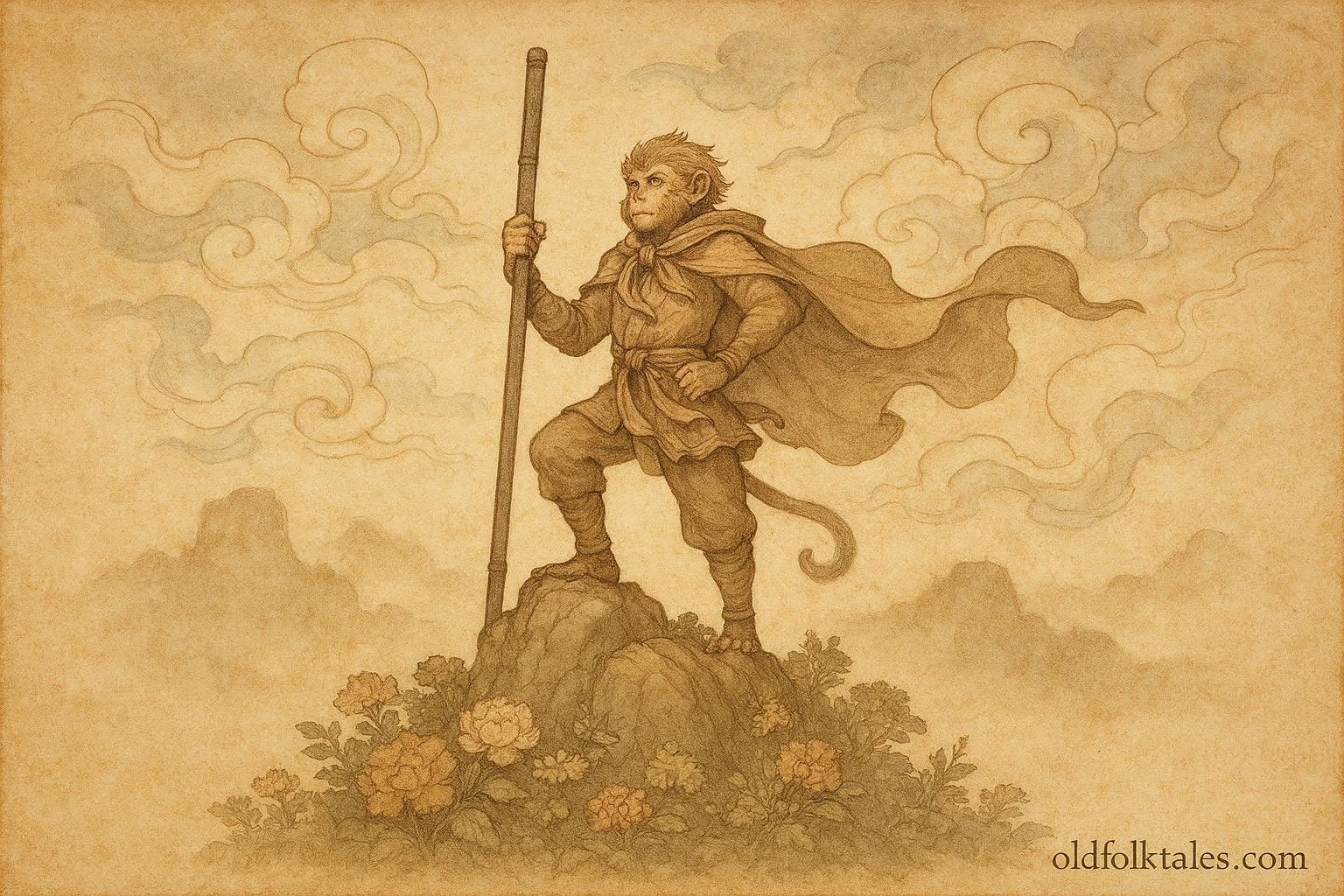
Sun Wukong, the legendary Monkey King, began his life in a wondrous and extraordinary way. On the Mountain of Flowers and Fruit, where mist wound through jade-green valleys and peach blossoms fluttered like drifting snow, there stood a massive stone unlike any other. For countless ages it drank in the breath of the heavens and the pure essence of the earth. Then, on a dawn filled with thunder and shimmering light, the stone split open. From within leapt a small monkey with bright golden eyes, lively spirit, and a boundless curiosity that stirred the mountain itself into excitement. The other monkeys welcomed him warmly, sensing something remarkable in his presence.
Life atop the Mountain of Flowers and Fruit was a paradise of rushing waterfalls, sunlit groves, and hidden caves. Sun Wukong grew into the most daring and clever of the monkeys. One day, while exploring the curtain of water beneath the tallest falls, he discovered a secret cavern sparkling with glowing moss and natural stone bridges. Overjoyed, the monkeys crowned him their king, granting him the name that would echo across the ages: the Monkey King.
Yet joy alone could not protect him from the truth he soon faced. When an elder monkey passed away, a deep fear filled Sun Wukong’s heart. What force could steal life from even the strongest? Determined to escape such a fate, he set off from his beloved mountain in search of the secret to immortality.
Journey through enchanted forests and islands in our Southeast Asian Folktales collection.
He traveled across seas and distant lands, observing human customs and disguising himself among travelers. After much searching, he encountered a wise Daoist sage who immediately recognized the extraordinary nature hidden within his playful form. Under this master’s discipline, Sun Wukong learned magical transformations, cloud-somersault flight, and a variety of powerful spells. His brilliance impressed even the immortals, but his mischievous temperament often stirred trouble. When his pranks became too disruptive, the master dismissed him, though with respect for his abilities and the immortality he had already earned.
Returning to his mountain kingdom, Sun Wukong now sought a weapon equal to his newfound power. He descended to the underwater palace of the Dragon King and boldly demanded a fitting treasure. After much reluctance, the Dragon King presented him with an enormous iron pillar that had once anchored the seas. The Monkey King lifted it with ease, and the staff magically shrank to a size he could tuck behind his ear. This wondrous weapon became his constant companion.
But Sun Wukong’s ambition grew even faster than his skill. He stormed the underworld, erased his own name from the Book of Life and Death, and returned to the world proclaiming himself equal to the highest powers. The Jade Emperor attempted to pacify him by offering minor titles, but when Sun Wukong discovered he had been tricked with honors meant merely to control his pride, he rose against Heaven in full rebellion.
Across the celestial realm, Sun Wukong battled divine generals, heavenly warriors, and star spirits. He slipped through traps, transformed into countless shapes, and used his iron staff to scatter whole battalions. His uproar shook the Jade Palace itself, and the heavens trembled beneath his boundless confidence.
At last the Buddha intervened. When Sun Wukong boasted that no force could contain him, the Buddha extended his hand and suggested that the Monkey King attempt to leap beyond it. Certain of victory, Sun Wukong soared across mountains, deserts, and distant seas until he reached five towering pillars. Believing he had reached the edge of the universe, he marked a pillar with graffiti and returned in triumph. To his shock, he found the writing on the Buddha’s finger. He had never escaped the Buddha’s palm.
With a gentle motion, the Buddha pressed down his hand, and a great mountain fell upon Sun Wukong, pinning him in place. There the Monkey King remained for five hundred years, unable to break free despite all his strength. As seasons changed and eras passed, the once-wild spirit within him slowly softened. Regret, humility, and patience took root where reckless pride once lived.
In time, the monk Xuanzang was given a sacred mission to retrieve holy scriptures from the West. He was instructed to free Sun Wukong and take him as a companion and protector. When the Monkey King emerged from beneath the mountain, he pledged his service. A magical circlet was placed on his head, tightening whenever he acted impulsively or selfishly, guiding him toward discipline and restraint.
The journey that followed tested him beyond any battle. Sun Wukong fought demons, protected his companions, and faced trials that demanded not only strength but compassion, wisdom, and loyalty. Through each challenge, the Monkey King transformed slowly and steadily, learning to direct his tremendous power toward righteousness rather than rebellion. His pilgrimage became a path of redemption, shaping him into one of China’s most beloved figures: a hero whose greatest victory was mastering himself.
Thus the Monkey King’s tale endures as a reminder that transformation is possible for even the wildest heart. Through humility and purpose, one may rise above pride and find true enlightenment.
Moral lesson
True strength is not found in power alone but in humility, discipline, and the courage to grow beyond one’s flaws.
Knowledge Check
1. How is Sun Wukong born in the story?
He is born from a magical stone on the Mountain of Flowers and Fruit.
2. Why does Sun Wukong seek immortality?
He fears death after witnessing the loss of an elder monkey.
3. What magical weapon does he obtain from the Dragon King?
A shape-shifting iron staff that once stabilized the seas.
4. Why does the Buddha imprison him under a mountain?
To humble him after his prideful rebellion against Heaven.
5. How does Sun Wukong begin his redemption?
By serving the monk Xuanzang during a sacred pilgrimage.
6. What key theme defines his transformation?
Spiritual growth through discipline, humility, and self-mastery.
Source
Adapted from Internet Archive – Digitized Journey to the West Collection, 2012.
Cultural Origin: Ming dynasty folklore rooted in earlier legends.