Long ago, on the quiet island of Himiti, in the far reaches of the Northern Maldives, life was simple and full of rhythm. The people lived by the sea’s grace, fishing in the turquoise shallows by day, weaving mats from dried pandanus leaves, and tending to the tall coconut palms that swayed like guardians over their sandy homes. The island was small but peaceful, bound by the songs of the waves and the steady kindness of its people.
But one moonless night, peace fled Himiti.
Something vast and terrible came out of the dark sea. The fishermen who stayed late at the reef saw it first, a moving shadow, glinting faintly in the starlight. Its eyes blazed red like coals, and its scales were black as deep coral. When it roared, the sound rolled across the lagoon like thunder. The villagers called the creature Furēta, the monster of the deep.
At first, Furēta struck only at night. The fishermen found their nets torn to shreds, their boats half-dragged into the reef, the water foaming as though a storm had passed. Then came the livestock. One morning, the villagers awoke to find their goats and chickens gone, leaving only scattered feathers and hoof marks on the sand.
Soon, something far worse happened. A child disappeared.
The people were stricken with fear. Mothers kept their children indoors, and no one dared to fish after sunset. The men gathered at the village meeting house, whispering of curses and ancient sea spirits. None could remember such a terror since the days of their ancestors.
At last, they went to the fandita man, a wise elder known for his knowledge of charms, healing herbs, and the old words of protection. The fandita man listened in silence, his brow furrowed, his eyes like weathered shells that had seen many storms. Then he rose and said,
“Bring me to the shore where the creature walks.”
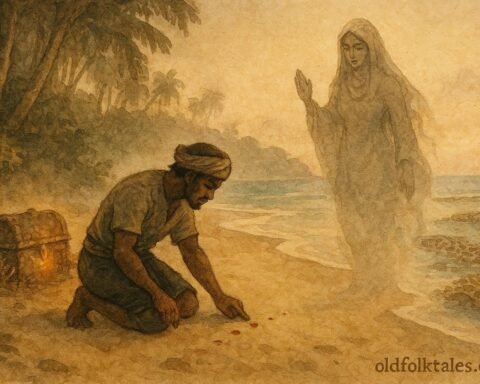
That evening, as the tide drew out, the fandita man studied the sand under the fading light. There, he saw the monster’s tracks, huge circular prints, deep and wide, as if bowls had been pressed into the earth. He knelt, touched the damp sand, and whispered words that had not been spoken for generations.
“This is no mere beast,” he said gravely. “It is a spirit of the dark water, angered by something unknown. If it has come to our land, then it seeks either atonement or return.”
He sent the people home and began his work.
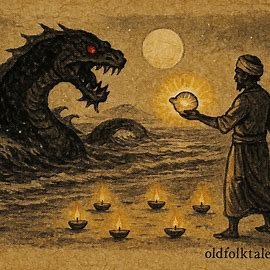
That night, he made seven lamps of coconut oil, each one small but bright, and placed them carefully in a circle upon the beach. Around them, he traced symbols in the sand with a frond of screw pine and laid a single polished sandara shell, a sacred shell believed to reflect the truth of spirits.
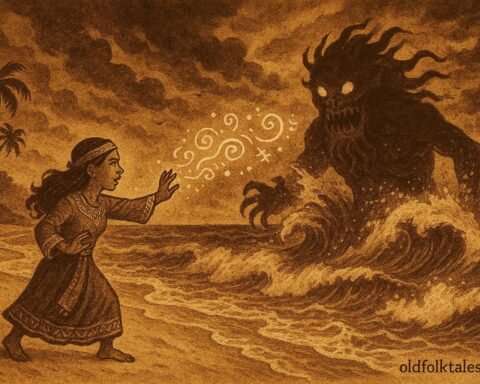
As the tide began to rise, the wind turned heavy and sharp. Clouds drifted across the stars. The sea shimmered with a strange blue light that seemed to pulse with life. Then, from the waves, Furēta emerged, its massive form glistening, its jaws opening to roar like a storm. Water poured off its back in shining cascades, and its eyes blazed so fiercely that the light reached the village hill.
But the fandita man stood firm. Raising the sandara shell high, he began to chant, his voice steady despite the crashing surf:
“Return to the deep, spirit of the dark water,
You belong to the depths where light dies.
Leave this island, leave its people,
Rest where the silence of the ocean lies.”
The monster thrashed, and the sea rose higher, waves curling like claws around the beach. Yet the seven lamps did not go out. They burned brighter, their flames bending but never breaking.
Then came a final roar, a sound that shook the palms and sent seabirds screaming into the night. And just as suddenly, the sea fell silent.
When dawn broke, the fandita man returned to the shore. The seven lamps still burned, their wicks small but alive. In the centre of the circle lay a heap of black scales, glimmering faintly in the new sunlight. Furēta was gone.
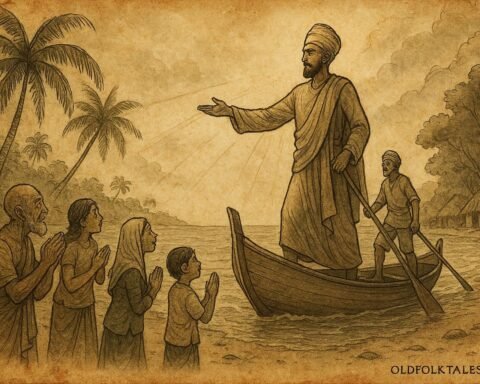
The people gathered in awe. They buried the monster’s remains near a grove of screw pines and placed a white coral stone above the grave as a mark of peace. The fandita man warned, “So long as you respect the sea and its spirits, Furēta shall never rise again.”
And so it was. The island of Himiti returned to its gentle ways. The fishermen sailed without fear, children played by the lagoon, and the nights were once again filled with songs instead of silence.
But even now, the elders say that when storms break over the island and lightning dances upon the sea, you can still hear the roar of Furēta beneath the waves, a warning from the deep to honour the balance between man and nature.
Moral Lesson
This story teaches that respect for nature and its unseen forces preserves peace. When people act with reverence and balance, harmony endures; when they disturb the order of creation, even the sea may rise in protest.
Knowledge Check
- Who are the main characters in “The Monster of Himiti”?
The wise fandita man, the island villagers, and Furēta, the sea monster. - What causes the terror on the island?
The peace of Himiti is shattered when Furēta emerges from the sea, attacking boats, livestock, and even a child. - How does the fandita man confront the monster?
He uses sacred charms, seven coconut oil lamps, and a polished sandara shell to return the spirit to the deep. - What do the seven lamps symbolise?
The lamps symbolise purity, protection, and the strength of light and wisdom over darkness and chaos. - Why did the people bury the monster’s remains?
To restore harmony between the human world and the ocean spirit, symbolised by the white coral stone of peace. - What cultural lesson does the tale reflect?
It expresses Maldivian respect for the sea, the balance of nature, and the wisdom of traditional healers and spiritual protectors.
Source
Adapted from the traditional Maldivian folktale “The Monster of Himiti,” preserved in oral storytelling traditions of the Northern Maldives.
Documented variations appear in early 20th-century Maldivian folklore collections and island oral histories.
Cultural Origin: Maldives (Himiti Island, Northern Atoll folklore)