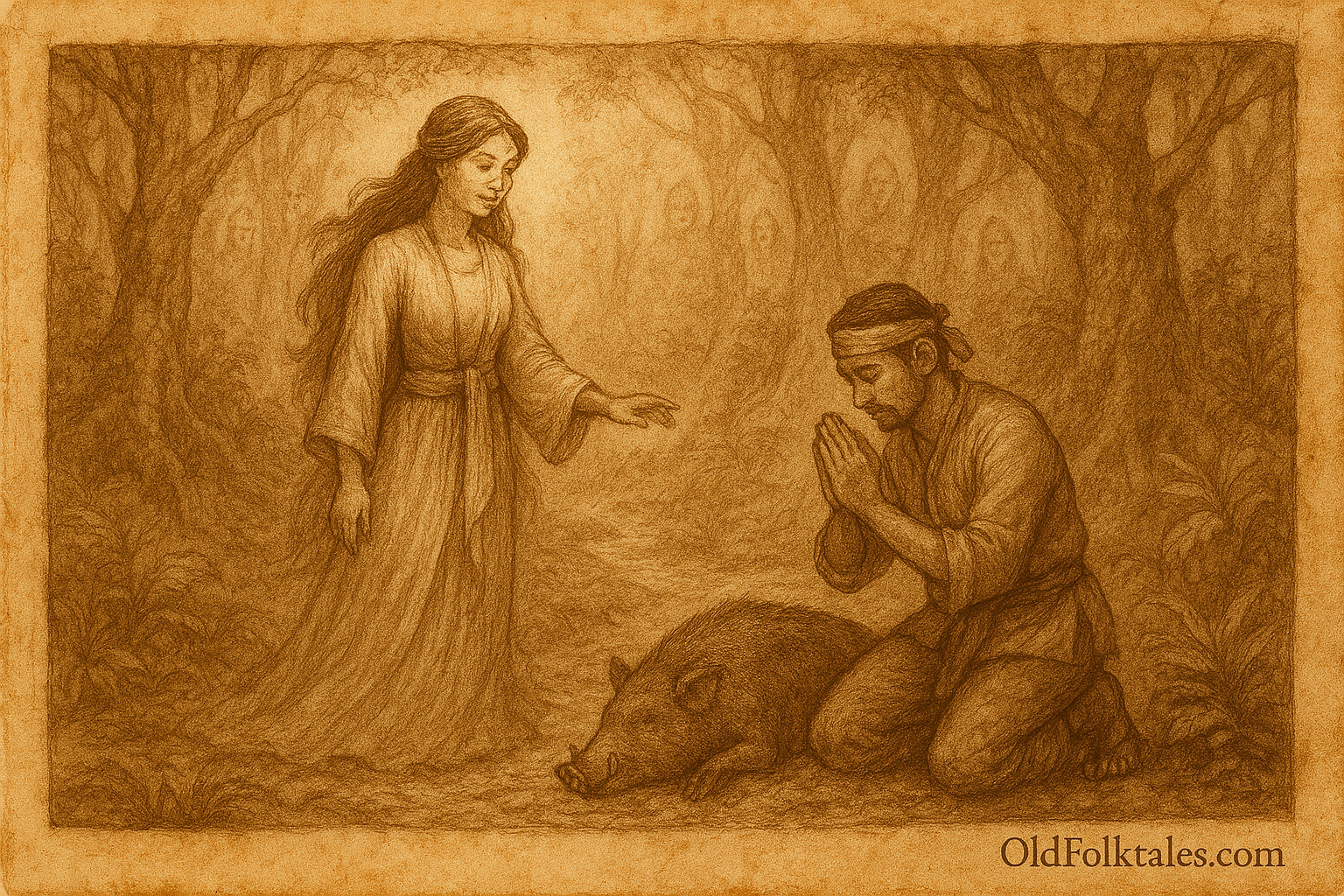
In the Belait district of Brunei, where the rainforest grows so thick that sunlight struggles to reach the forest floor and mist clings to the mountains like gossamer veils, there rises a peak known as Gunung Patoi. It is not the highest mountain in Brunei, nor the most dramatic in appearance, but it holds a special place in local consciousness. For Gunung Patoi is more than a geographical feature; it is a sacred space, home to a mysterious guardian whose presence has been felt by generations of hunters, travelers, and those who venture into the deep forest.
The people of the surrounding villages speak in hushed, reverent tones of Puteri Gunung Patoi, the Princess of Mount Patoi, a spirit being who has watched over the mountain and its forests since time immemorial. No one knows her origins with certainty. Some say she was a mortal princess who died tragically on the mountain and was transformed into its eternal guardian. Others claim she was never human at all but a manifestation of the mountain’s own consciousness, a spirit given form to interact with the people who depend on the forest’s resources.
What everyone agrees upon is that she is real, that she appears to certain people under certain circumstances, and that her presence means either blessing or warning depending on the heart and intentions of the person she encounters.
The princess, when she appears, is said to be of extraordinary beauty. Her hair flows like midnight streams down her back, adorned with flowers that bloom only in the highest reaches of the mountain. Her skin glows with an otherworldly luminescence, as if moonlight lives beneath its surface. She wears traditional dress of the finest weaving, yet somehow it never tears on thorns or becomes soiled by forest mud. Her eyes, those who have seen her report, are simultaneously kind and piercing, capable of looking past external behavior directly into a person’s true nature.
But Puteri Gunung Patoi does not reveal herself to everyone. She appears only to those with pure intentions, to individuals whose hearts hold respect rather than greed, humility rather than arrogance. And her actions toward these chosen few depend entirely on whether they observe the sacred taboos of the mountain or violate them through ignorance or willful disregard.
The taboos of Gunung Patoi are clear and have been passed down through generations. Hunters entering the forest must ask permission from the mountain before taking game, acknowledging that they are guests in a realm not their own. They must never take more than they need, never hunt during the sacred days when the forest spirits rest, and never show disrespect through crude language, wasteful behavior, or deliberate destruction of the environment. Those who gather forest products must offer thanks and leave the first find as tribute. Most importantly, anyone entering the mountain’s territory must maintain an attitude of reverence, recognizing that they walk on sacred ground.
There are countless stories of the princess’s interventions, passed down from father to son, mother to daughter, each tale reinforcing the lessons about proper conduct in the forest.
One such story concerns a young hunter named Awang, who came from a family of respected woodsmen. Awang had been taught the forest ways by his grandfather, a man who understood that hunting was not simply about skill with weapons but about relationship with the land and its spiritual guardians.
One morning, Awang set out alone to hunt wild boar, a task that would prove his readiness for marriage and establish his reputation as a provider. He entered the forest near Gunung Patoi with proper reverence, stopping at the forest’s edge to whisper the traditional prayer: “Spirits of this mountain, guardian of this forest, I come with respect and necessity. I take only what I need to feed my family. I honor your domain and ask permission to enter.”
As he ventured deeper into the forest, following signs of boar activity, Awang became aware of a presence nearby. Not threatening, but definitely observing. He caught glimpses of white fabric between the trees, heard the soft sound of footsteps that did not quite match his own rhythm, and sensed he was being accompanied though he could not see his companion clearly.
Hours passed, and Awang tracked his quarry with patient skill. Finally, he found a clear shot and took down a mature boar with a single arrow, ensuring the animal’s suffering was minimal. As he approached his kill, he spoke the words of gratitude his grandfather had taught him: “Thank you for your life, which will sustain mine. Thank you, spirits, for guiding my hand.”
It was then that the princess revealed herself fully, stepping from behind a massive tree trunk as if she had always been standing there, visible yet somehow having been invisible a moment before.
Awang’s breath caught in his throat. He knew immediately who she was, though he had never seen her before. Her presence was unmistakable, carrying an authority that came not from power over others but from deep connection to the place itself.
“You have honored the old ways,” Puteri Gunung Patoi said, her voice like wind through leaves, gentle yet carrying easily through the forest. “You entered with respect, hunted with skill and mercy, and gave thanks for what you took. Because of this, I will guide you safely home, for the path through my forest can be treacherous to those who lose their way.”
Indeed, as Awang prepared his kill for transport, he realized that the familiar landmarks he had used to navigate now seemed strangely altered. The forest, in its mysterious way, had shifted around him, and he was no longer certain of the path back to the village.
But the princess walked ahead of him, visible when he looked directly at her but somehow indistinct when seen from the corner of his eye. She led him by a route he did not know, through sections of forest he had never seen despite years of hunting these woods. Yet when they emerged, it was precisely at the edge of his village, and the journey that should have taken hours had somehow consumed only minutes.
“Remember what you learned today,” the princess said as she prepared to depart. “Share these lessons with others. The forest provides for those who respect it, protects those who honor it, and welcomes those who approach with pure hearts.”
Then she was gone, fading into the forest as if she had been made of mist rather than flesh.
But not all stories of Puteri Gunung Patoi end with guidance and blessing. There are darker tales of hunters who ignored the taboos and suffered for their arrogance.
Such was the case with a man named Hassan from a neighboring village. Hassan was skilled with weapons and proud of his hunting prowess, but he had little patience for what he called “old superstitions.” When elders spoke of forest spirits and proper protocols, Hassan would laugh dismissively.
“The forest is just trees and animals,” he would say. “There are no spirits, no guardians, no princesses on mountains. These are stories to keep children obedient and old people important.”
One day, Hassan ventured into the forest near Gunung Patoi during one of the sacred rest days when hunting was forbidden. Other hunters warned him against going, but Hassan ignored them. “I’ll hunt when I please,” he declared. “No invisible princess is going to tell me what to do.”
He entered the forest without prayers or permission, crashed through the undergrowth without care for what he disturbed, and when he found game, he wounded rather than killed cleanly, allowing animals to suffer as they fled. He took more than he could carry, wasting what he left behind, and he spoke crudely about the forest and its supposed guardian.
As the day wore on, Hassan noticed the forest was growing darker despite the sun being high. The paths he knew seemed to lead nowhere, circling back on themselves impossibly. He heard laughter in the trees, but when he looked, there was nothing. His compass spun uselessly, giving contradictory readings. Thorns seemed to reach out deliberately to tear his clothes and scratch his skin.
Then he saw her: Puteri Gunung Patoi, but not as she appeared to respectful visitors. Her beauty was still present but now seemed threatening rather than comforting, her luminous eyes cold rather than kind.
“You have violated every sacred law of my mountain,” she said, her voice no longer gentle but hard as stone. “You mocked what you do not understand, destroyed without need, and showed contempt for the life you took. Now you will learn that disrespect has consequences.”
Hassan tried to run, but the forest seemed to shift around him, trapping him in a maze of identical trees and endless loops. For three days and nights, he wandered lost in terrain he thought he knew, exhausted, terrified, and increasingly desperate. He heard voices mocking him, felt invisible hands pushing him away from any path that might lead home, and saw visions of his own disrespectful actions reflected in every stream and puddle.
On the fourth morning, searchers from the village found Hassan collapsed near the forest edge, barely conscious and thoroughly broken in spirit. He had aged visibly, his hair showing new grey, his face haggard with an experience that clearly went beyond simple physical ordeal.
When he recovered enough to speak, Hassan told of being lost in the forest, of the princess’s condemnation, of the three days of wandering where the mountain itself seemed to reject his presence. He swore he would never hunt again without proper respect, never mock the old ways, and never again ignore the wisdom that his arrogance had dismissed.
From that day forward, Hassan became one of the most careful observers of forest taboos, and when young hunters showed signs of the arrogance he had once displayed, he would tell them his story with a gravity that left no doubt about its truth.
These stories and countless others like them have been told and retold around cooking fires and during village gatherings, each one reinforcing the central truth: that Gunung Patoi is not merely a mountain but a sacred space, that Puteri Gunung Patoi is not merely a legend but a living presence, and that the forest demands respect not as superstition but as acknowledgment of a reality that transcends material understanding.
The mountain still rises in the Belait district, its forests still thick and mysterious. And those who venture into its realm still sometimes catch glimpses of a beautiful woman in traditional dress, moving between the trees like morning mist. Those with pure intentions feel comforted by her presence and find themselves guided safely through terrain that might otherwise prove dangerous. Those with disrespectful hearts feel her displeasure and often learn, as Hassan did, that some forces cannot be dismissed with skepticism and arrogance.
The legend serves not just as entertainment but as living guidance for how to interact with the natural world. It teaches that certain places are sacred, that respect is not optional, and that the unseen guardians of the forest are as real as the trees themselves, watching, judging, and responding to human behavior with either blessing or consequence.
And so Puteri Gunung Patoi continues her eternal watch, guardian of the mountain, protector of those who honor the old ways, and stern teacher to those who imagine themselves above the laws that govern the sacred spaces of the world.
Click to read all Southeast Asian Folktales — featuring legends from Thailand, Indonesia, Vietnam, and the Philippines.
The Moral Lesson
The legend of Puteri Gunung Patoi teaches us that certain places hold sacred status and require respectful conduct from all who enter them. Pure intentions and humble behavior attract protection and guidance from spiritual guardians, while arrogance and violation of taboos bring disorientation and misfortune. The story emphasizes that dismissing traditional wisdom as superstition does not make spiritual realities disappear but rather leaves us vulnerable to consequences we do not understand.
Knowledge Check
Q1: Who is Puteri Gunung Patoi in Bruneian folklore? A: Puteri Gunung Patoi is the Princess of Mount Patoi, a guardian spirit who protects the mountain and its forests in Brunei’s Belait district. She appears to those with pure intentions, guiding respectful visitors safely and punishing those who violate forest taboos. Her character represents the spiritual dimension of sacred geography, embodying the mountain’s consciousness and serving as enforcer of proper conduct in natural spaces.
Q2: What are the sacred taboos associated with Gunung Patoi? A: The taboos include asking permission before hunting, taking only what is needed, never hunting during sacred rest days, showing respect through proper language and behavior, offering thanks for forest resources, leaving the first find as tribute, and maintaining reverence while on the mountain. These rules represent accumulated wisdom about sustainable resource use and proper spiritual relationship with sacred natural spaces.
Q3: How does Puteri Gunung Patoi appear to different people? A: The princess appears only to those with pure intentions but responds differently based on their behavior. To respectful visitors like Awang, she appears kind and comforting, offering guidance and safe passage. To those who violate taboos like Hassan, she appears threatening and cold, causing disorientation and misfortune. Her appearance reflects the observer’s own spiritual state and treatment of the sacred space she guards.
Q4: What happens to Awang the respectful hunter? A: Awang, who enters the forest with proper prayers, hunts with skill and mercy, and gives thanks for his kill, receives the princess’s blessing. She guides him safely home through unfamiliar paths when he becomes disoriented, compressing what should be hours of travel into minutes. His experience demonstrates how respect and adherence to tradition earn spiritual protection and assistance.
Q5: What consequences does Hassan face for violating the taboos? A: Hassan, who hunts on a forbidden day, enters without permission, causes unnecessary animal suffering, wastes resources, and mocks the guardian spirit, becomes lost in the forest for three days despite knowing the terrain. He experiences supernatural disorientation, mocking voices, physical exhaustion, and encounters the princess in her stern aspect. His ordeal transforms him from skeptic to believer, teaching through harsh experience what he refused to learn through wisdom.
Q6: What does this legend teach about sacred geography in Bruneian culture? A: This Bruneian legend teaches that certain mountains and forests are sacred spaces inhabited by guardian spirits who must be respected through proper conduct and observance of traditional taboos. It reflects beliefs that the natural world has spiritual dimensions requiring acknowledgment, that places can have consciousness embodied in guardian beings, and that human behavior in these spaces has supernatural consequences. The story emphasizes that sacred geography is not metaphorical but real, requiring practical respect through specific behaviors and attitudes.
Source: Adapted from Bruneian oral folklore traditions.
Cultural Origin: Brunei Darussalam, Southeast Asia.