Long before the endless rice paddies stretched across the plains of Isan, before farmers built their wooden houses on stilts above the flood-prone earth, before the rhythms of planting and harvest defined the seasons, the landscape of northeastern Thailand was wild and untamed. Rivers carved their own paths through dense jungle, changing course with the monsoons. Ancient forests grew thick with trees whose roots remembered times before human memory. And beneath the waters of these rivers lived beings of immense power and mystery the Nagas.
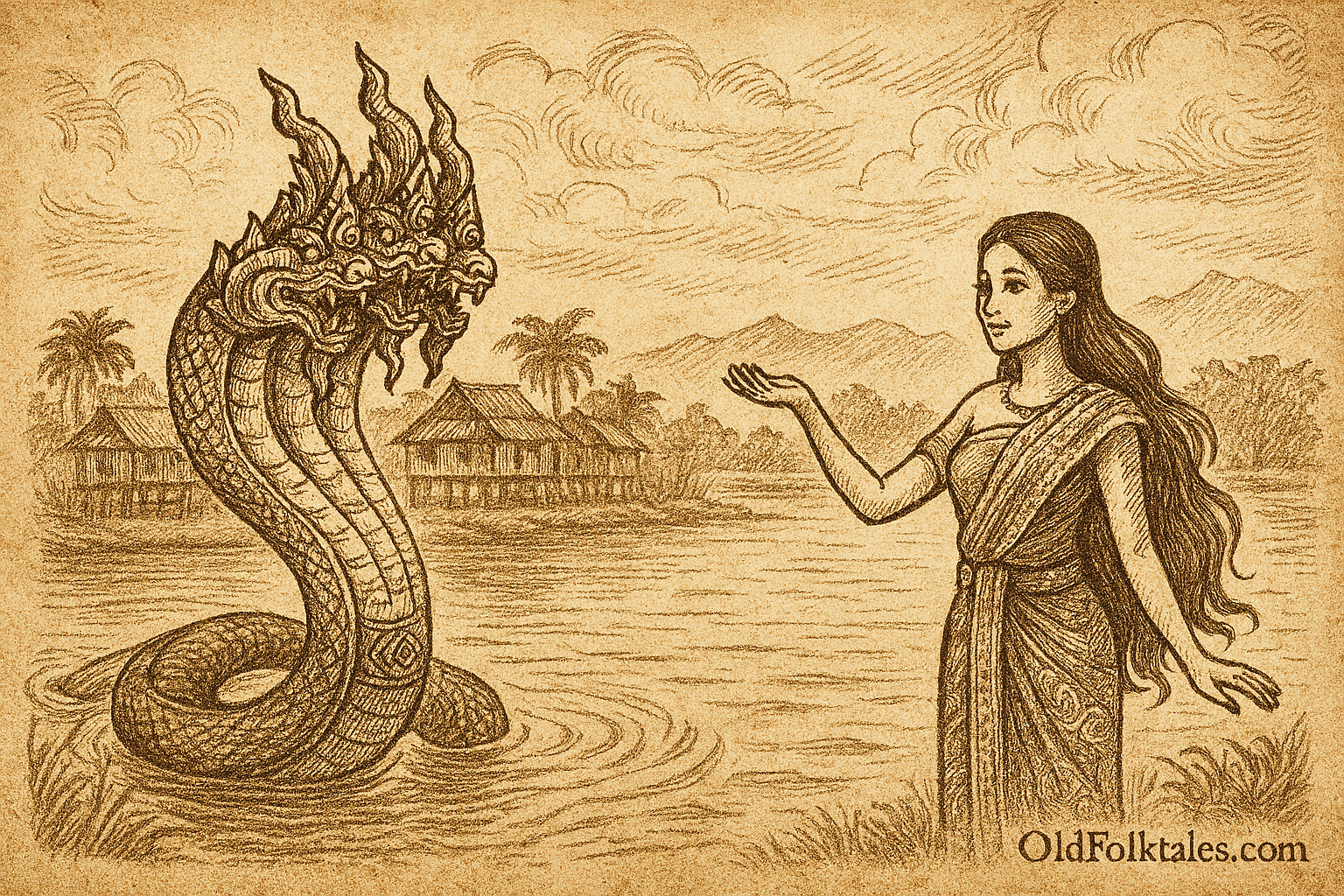
The Nagas were neither fish nor serpent, though they resembled both. They were something far older, far more magnificent divine creatures who ruled the aquatic realms with wisdom and magic. Their bodies gleamed with scales that shifted between emerald, sapphire, and gold, catching light even in the darkest depths. They possessed multiple heads crowned with elaborate crests, and their eyes held intelligence that spanned centuries. The Nagas controlled the rains, guarded treasures beyond imagination, and maintained the sacred balance between water and land.
Click to read all East Asian Folktales — including beloved stories from China, Japan, Korea, and Mongolia.
The greatest of these beings was Phaya Nak, the Naga King. His underwater palace was built from mother-of-pearl and coral, illuminated by luminescent stones that had never seen sunlight. Jewels adorned every surface, not for vanity but because they naturally accumulated around beings of such power. Phaya Nak ruled with stern justice, maintaining the ancient laws that governed his kind, chief among them the prohibition against mingling with the human world above.
The king had a daughter, a princess whose beauty was legendary even among the Nagas. Her scales shimmered like moonlight on water, her multiple heads moved with synchronized grace, and her voice could calm storms or summon them. But unlike her father, who was content to rule the depths, the princess possessed a restless curiosity about the world above. She would swim to the surface at night, watching the stars reflect on the water, listening to the distant sounds of human villages laughter, music, the crackle of cooking fires.
One day, unable to resist her curiosity any longer, the princess used the ancient magic known only to royal Nagas. In a shimmer of transformation, her serpentine form melted and reformed, scales becoming smooth skin, her multiple heads merging into one beautiful face framed by long, dark hair that fell like a waterfall of silk. She emerged from the river wearing a traditional pha sin that clung to her new human form, looking every bit like a mortal woman, though her eyes still held depths no human eyes could possess.
She walked toward the nearest village with tentative steps, marveling at the sensation of earth beneath her feet, of air against skin instead of water. The village was small but prosperous, its wooden houses neat and well-maintained, its temple gleaming with gold leaf that caught the afternoon sun. People moved about their daily tasks women weaving cloth, men repairing fishing nets, children playing games that filled the air with delighted shouts.
As she wandered through the village, trying not to reveal her amazement at every ordinary sight, she noticed a commotion near the temple. A young man had arrived with an entourage of attendants, though he himself wore simple clothes and moved without arrogance. This was a prince from a nearby kingdom, traveling through the region to understand the lives of his future subjects.
Their eyes met across the temple courtyard, and in that instant, something shifted in the fabric of fate. The princess felt her heart so recently transformed into human form flutter with an emotion she had never experienced in the cool, calm depths of her river palace. The prince, for his part, stopped mid-step, forgetting entirely what he had been about to say to his advisor, seeing only this mysterious woman whose beauty seemed to carry something otherworldly, something that called to his soul.
He approached her with the courtesy of his upbringing. “I have not seen you in this village before. Are you visiting from another province?”
“I am… new to this land,” she replied carefully, her voice carrying a melodic quality that reminded him of water flowing over stones. “I have only just arrived.”
They spoke for hours that day, sitting in the shade of a sacred bodhi tree while his attendants waited patiently and the villagers whispered curiously among themselves. The prince found himself captivated not just by her beauty but by the way she saw the world with wonder and fresh perspective, asking questions about things he had taken for granted his entire life. Why did humans build their houses above the ground? What were those bright orange and yellow flowers called? How did the temple bells create such pure sounds?
The princess, in turn, discovered that humans were not the simple, fleeting creatures she had imagined. This prince spoke of duty and honor, of his dreams to make his kingdom prosperous and just, of his love for the land and its people. His hands bore the calluses of someone who practiced with weapons but also worked alongside farmers to understand their struggles.
Day after day, the prince found reasons to return to the village. Day after day, the princess emerged from the river in her human form, her heart pulling her toward the surface with increasing urgency. They met in secret places by a waterfall hidden in the forest, in a clearing where wildflowers bloomed in impossible profusion, on the riverbank when twilight painted the sky in shades of gold and purple.
Love grew between them like lotus flowers blooming in the first light of dawn inevitable, beautiful, and defiant of the boundaries meant to contain it.
But secrets kept beneath water have a way of surfacing.
In the Naga palace, Phaya Nak noticed his daughter’s frequent absences. At first, he attributed it to her restless nature, but when servants whispered that they had seen her swimming toward the surface with increasing frequency, wearing an expression they had never witnessed before, his suspicions grew into alarm.
The king sent scouts smaller Nagas who could move undetected to observe his daughter. They returned with news that struck him like a physical blow: the princess had been meeting with a human. A prince, yes, but still human mortal, temporary, belonging to the world of air and earth that was forever separate from the realm of water and magic.
Phaya Nak’s fury was terrible to behold. The waters of his domain churned and boiled. Fish fled in terror. Even the other Nagas, accustomed to their king’s power, trembled at the darkness that radiated from him. This was not merely anger at disobedience it was the rage of a father who sees his daughter throwing away immortality for a brief human love, and the fury of a king whose sacred laws have been violated.
He summoned his guards powerful warrior Nagas whose strength could topple trees and whose magic could bind even the strongest will. “Bring the princess home,” he commanded. “Use force if necessary. This ends now.”
The guards found the princess at her meeting place, where the prince waited with jasmine flowers he had gathered for her. The transformation was swift and shocking one moment, guards in their fearsome Naga forms surrounded the couple, and the next, the princess herself shifted back to her true form, placing her serpentine body between the guards and the prince.
“I will not return,” she declared, her multiple voices speaking in harmony. “I have chosen my path. I love him.”
The guards were torn between their duty to their king and their reluctance to use force against their princess. In their hesitation, the princess made her choice. She used her own magic to help the prince escape, sending him running toward his village while she held the guards at bay.
When Phaya Nak learned of his daughter’s defiance that she had not only refused to return but had actively resisted his guards his rage transcended all bounds of reason. In his anguish and fury, he decided that if his daughter would choose the human world over her home, then she would witness the full cost of that choice.
The Naga King rose from his palace and summoned the ancient powers that were his birthright. The sky darkened though it was midday. Clouds gathered with supernatural speed, heavy and black as bruises. Thunder rolled like the drums of war, and lightning cracked the heavens.
Then came the rain.
But this was no ordinary monsoon. This was water called forth from the depths of the earth, from reservoirs that should have remained sealed, from sources both natural and magical. It fell in sheets so thick that visibility dropped to mere feet. The river swelled and overflowed its banks. Streams became torrents. Every low-lying area began to fill.
The prince’s city, built on land that had always seemed safely above the flood line, watched in horror as water crept through its streets, rising with impossible speed. People fled to higher ground, but there was nowhere high enough. The water kept coming, relentless and purposeful, as if the flood itself had consciousness and intent.
For seven days and seven nights, the Naga King’s vengeance poured down from the sky and up from the earth. When finally his rage exhausted itself and the waters stilled, the landscape had been transformed. Where once had stood a prosperous city with its temples and palaces, its markets and homes, there now lay a vast lake deep, still, and haunted.
The prince had drowned along with his people. The princess, racing to save him, arrived too late, finding only the glassy surface of the new lake reflecting the clearing sky. Her grief was beyond expression a sorrow so profound that it rippled through the water itself, creating patterns that had no natural explanation.
The Naga King ordered his daughter to return to the palace depths. This time, broken by loss, she obeyed. But something fundamental had changed. The princess was no longer the curious, vibrant being she had once been. She moved through the underwater halls like a ghost, her eyes always turned upward toward the surface, toward the lake that had become a vast grave.
The lake was named Nong Han Kumphawapi “the Great Swamp Lake” and it became a place of somber beauty. Villages grew along its shores, and fishermen worked its waters, but everyone knew the lake was different from other bodies of water. There was a presence there, something vast and sorrowful just beneath the surface.
During festivals, especially on the nights of the full moon, strange phenomena occur. Ripples spread across the water’s surface when there is no wind. Lights glow beneath the waves not the reflection of stars but something emanating from the depths themselves. Some villagers claim to see a beautiful woman standing at the water’s edge, her form shimmering and translucent, her eyes scanning the shoreline as if searching for someone.
It is the princess, they say, still rising to the surface in her human form, still searching for her prince, still hoping against all reason that somehow love might transcend even the finality of death. And deep below, in his palace that now lies beneath the lake rather than the river, Phaya Nak feels the weight of his choice the terrible price of a father’s rage and a king’s pride.
The lake remains a sacred place. Offerings are left at its shores flowers for the princess, incense for the lost souls of the drowned city. And when the waters are very still, some claim to hear music drifting up from below the ghostly echo of the love songs the prince once sang to his forbidden beloved.
Click to read all Southeast Asian Folktales — featuring legends from Thailand, Indonesia, Vietnam, and the Philippines.
The Moral of the Story
This Thai legend teaches us about the tragic consequences of rigid adherence to tradition and the destructive power of rage, even when rooted in paternal love and concern. The Naga King’s fury, while understandable from his perspective of protecting his daughter and upholding ancient laws, resulted in devastating loss not just for the humans he destroyed but for his own daughter, whose spirit remains forever separated from her love. The story reminds us that boundaries between worlds should be approached with wisdom rather than absolute prohibition, and that vengeance taken in anger often causes more suffering than the original transgression. True love may cross forbidden boundaries, but those who would prevent it through force must weigh the cost of their intervention.
Knowledge Check
Q1: Who are the Nagas in Thai mythology?
A: Nagas are powerful divine serpent beings who rule aquatic realms in Thai and broader Southeast Asian mythology. They possess multiple heads, shimmering scales, control over water and rain, and magical powers. They are neither fully serpent nor fish but ancient supernatural creatures who guard the boundary between water and land.
Q2: Who was Phaya Nak and what was his role?
A: Phaya Nak was the Naga King who ruled the underwater realm beneath the rivers of northeastern Thailand (Isan region). He maintained strict laws governing his people, particularly the prohibition against Nagas mingling with humans, and possessed immense power over water and weather.
Q3: How did the Naga princess meet the human prince?
A: The curious princess used ancient Naga magic to transform herself into human form and wandered into a village where a prince was visiting to learn about his future subjects. They met in the temple courtyard and fell instantly in love, beginning secret meetings despite the forbidden nature of their relationship.
Q4: Why did the Naga King create the flood?
A: When the princess refused to return home and openly defied his guards to protect the prince, the Naga King’s rage and grief overwhelmed him. He unleashed a catastrophic flood that lasted seven days and nights, drowning the prince’s entire city as punishment for the forbidden love and his daughter’s disobedience.
Q5: What is Nong Han Kumphawapi?
A: Nong Han Kumphawapi, meaning “the Great Swamp Lake,” is the vast lake created by the Naga King’s flood in northeastern Thailand. It formed where the prince’s city once stood and is considered a sacred, haunted place where the princess’s spirit still searches for her lost love.
Q6: What supernatural phenomena are associated with the lake?
A: Villagers report seeing unexplained ripples on calm water, mysterious lights glowing beneath the surface, serpent-like shapes moving in the depths, and the ghostly figure of a beautiful woman searching along the shores during full moon festivals believed to be the Naga princess still seeking her drowned prince.
Source: Adapted from Naga Legends of Isan documented by Charles Keyes in Thai Folklore Studies
Cultural Origin: Thai people, Isan region (northeastern Thailand)