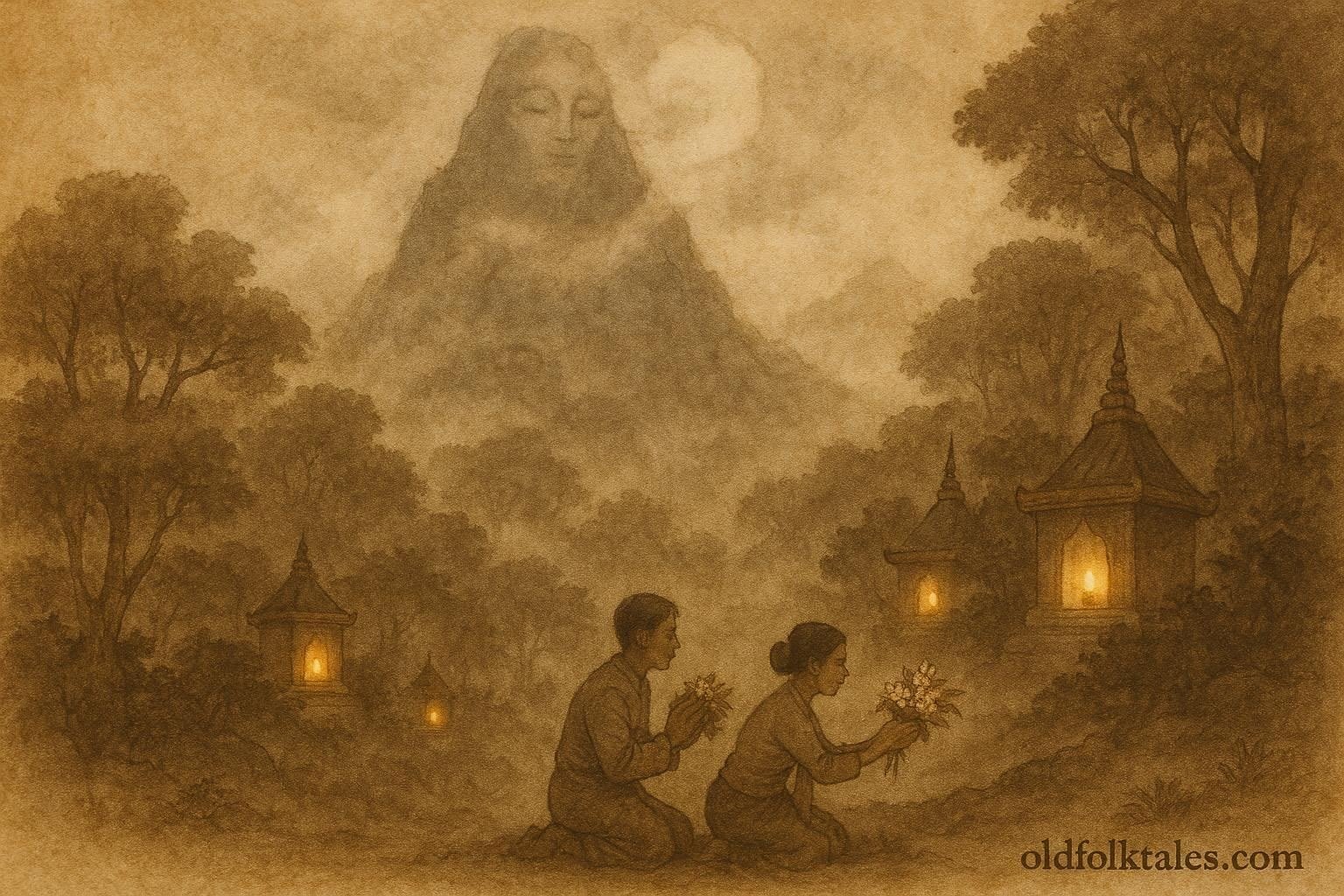
Mist often clings to Mount Popa at dawn, drifting slowly between ancient trees and volcanic stone. Villagers living at the foot of the mountain speak in hushed voices when they look upward, for they believe the mountain is alive with unseen presence. Travelers who pass through the region notice small shrines tucked among roots and rocks, each bearing offerings of flowers, rice, and oil lamps. These offerings are not made lightly. They are meant for the powerful nat spirit who dwells upon Mount Popa, watching every step taken on its sacred slopes.
Long ago, before the mountain paths were worn smooth by pilgrims, Mount Popa was feared as much as it was revered. Hunters who entered its forests without prayer often returned ill or disoriented, claiming the mountain itself had turned against them. Farmers who mocked the old beliefs found their crops failing without explanation. Yet those who approached with humility and respect spoke of strange blessings, sudden clarity of mind, or unexpected protection from danger. Over time, stories spread of the Nat of Mount Popa, a spirit both just and fierce, who rewarded devotion and punished arrogance.
One season, a prolonged drought gripped the villages surrounding the mountain. Streams ran shallow, fields cracked under the sun, and livestock weakened. Elders gathered beneath a banyan tree to discuss the cause. They concluded that the people had grown careless. Fewer offerings had been made. Fewer prayers spoken. The mountain had been treated as mere land rather than sacred ground. To restore balance, they decided to send a delegation to Mount Popa to renew their vows of reverence.
Explore timeless legends from China, Japan, and Korea in our East Asian Folktales collection.
Among those chosen was a young man named Min Htet, known for his steady character and quiet respect for tradition. He had learned from his grandmother to greet trees before passing them and to whisper thanks when taking water from a stream. Alongside him traveled a wealthy merchant named U Kyaw, who scoffed at such customs. U Kyaw agreed to join only to prove that the mountain held no power over him.
As they climbed higher, the forest grew still. Birds ceased their calls, and even the wind seemed to pause. Min Htet stopped frequently to bow and place small offerings along the path. U Kyaw laughed and walked ahead, boasting that fear was the only spirit haunting the mountain. Suddenly, the ground beneath him shifted. He slipped, tumbling down a steep slope, stopping only when tangled roots caught his fall. Though alive, he was shaken and bruised, his pride deeply wounded.
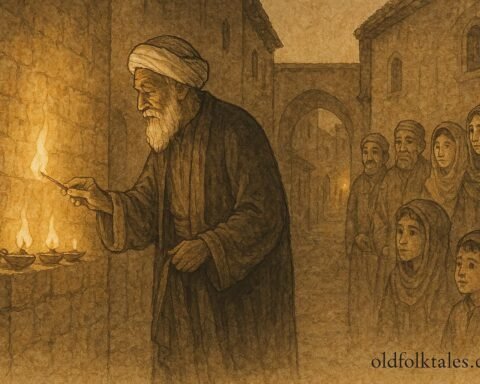
Min Htet descended carefully and helped the merchant rise. Together they continued, this time in silence. As night fell, they reached a clearing where an ancient shrine stood, carved from blackened stone. Lamps flickered though no flame touched them. The air felt heavy, as though unseen eyes watched from every direction. Min Htet knelt and offered rice, flowers, and sincere prayer, asking forgiveness for the community and guidance for their future.
The ground trembled softly. From the shadows emerged a towering presence, neither fully human nor beast, radiant yet terrifying. The Nat of Mount Popa revealed itself, its voice echoing like thunder through the trees. It spoke not in anger but in judgment. It reminded them that sacred places demand humility, that arrogance blinds the heart, and that respect maintains harmony between worlds.
The nat turned its gaze upon U Kyaw, who fell to his knees, overcome with fear and remorse. He confessed his mockery and begged forgiveness, promising to honor the mountain and its spirit henceforth. The nat listened, then vanished as quietly as it had appeared. At dawn, rain fell for the first time in months, soaking the earth and reviving the fields below.
When the delegation returned, the villages celebrated not only the rain but the lesson learned. U Kyaw donated his wealth to restore shrines and support the poor. Min Htet became a guardian of tradition, teaching children the importance of respect for sacred spaces. From that day forward, Mount Popa was approached with renewed reverence, its nat honored as both protector and moral guardian.
Travelers still climb the mountain today, leaving offerings and walking softly along its paths. Some say the mist thickens when arrogance approaches and clears when sincerity reigns. The Nat of Mount Popa remains unseen, yet its presence is felt in every whispering leaf and steady heartbeat of the land.
Moral Lesson:
True power lies not in pride or wealth but in humility, respect, and recognition of sacred balance. Those who honor the unseen forces of nature and spirit live in harmony, while arrogance invites downfall.
Knowledge Check:
- Who watches over Mount Popa?
Answer: A powerful nat spirit. - Why did the villagers suffer drought?
Answer: They neglected reverence for the sacred mountain. - What mistake did U Kyaw make?
Answer: He mocked spiritual traditions and showed arrogance. - How did Min Htet show respect?
Answer: By offering prayers and gifts along the mountain path. - What happened after the nat appeared?
Answer: Rain returned and balance was restored. - What lesson did the villagers learn?
Answer: Sacred spaces require humility and respect.
Source:
Adapted from Southeast Asian Studies Program Myanmar Nat Documentation, 2013.
Cultural Origin:
Central Burmese nat belief tradition.