The city slept lightly on the nights when the air grew strangely still. Lantern flames did not flicker, dogs did not bark, and even the insects seemed to fall silent. Elders knew these signs well and barred their doors before darkness settled completely. They whispered warnings to children and travelers alike, reminding them that some nights belonged not to humans but to the unseen world. These were the nights of the Night Parade of One Hundred Demons.
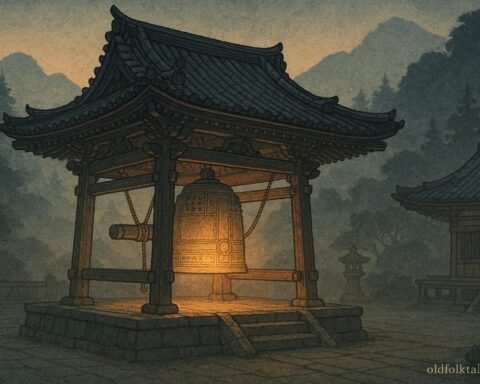
In the capital during the Heian period, narrow streets wound between wooden houses, temples, and noble estates. By day they were filled with poetry recitations, court gossip, and the clatter of ox drawn carts. By night they became corridors of shadow. It was said that when the moon hid behind clouds and the stars dimmed, the boundary between worlds weakened. On such evenings, yokai gathered beyond the edges of sight, waiting for the moment when the human world grew careless.
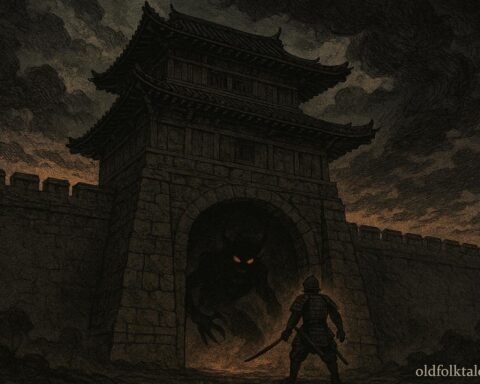
The parade did not announce itself with sound. It arrived as a feeling, a tightening of the chest and a sense that something was approaching from every direction at once. Those who were awake felt their lantern light dull as if swallowed by darkness. From the far end of a street, shapes began to move. They did not march in orderly lines but flowed like water, filling alleys and spilling across crossroads.
Explore ancient tales from Thailand, Cambodia, and the Philippines in Southeast Asian Folktales.
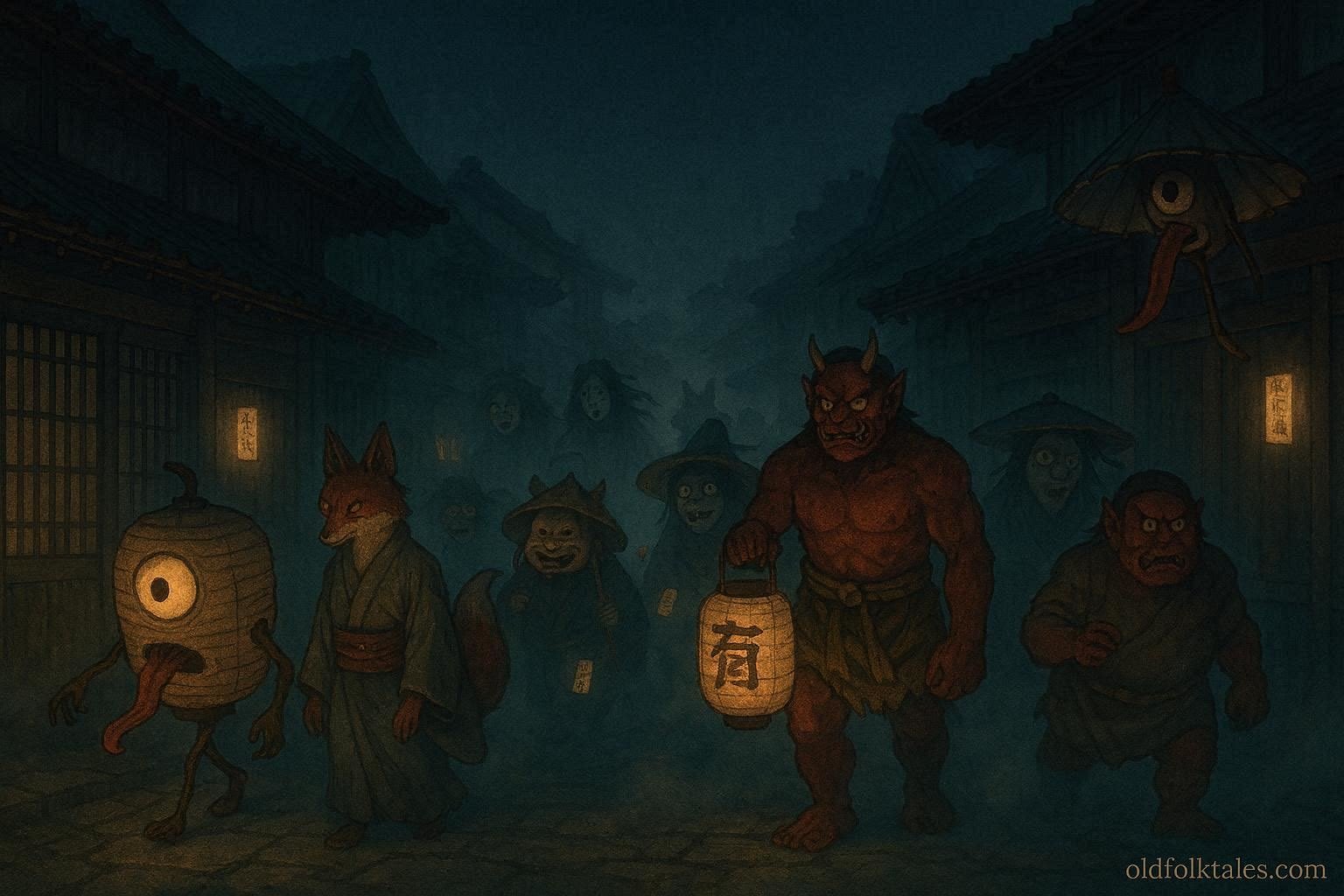
There were oni with horns curved like crescent moons, their skin red or blue and their eyes burning with restless hunger. There were umbrellas that hopped on a single leg, lanterns with faces that grinned too widely, and long necked women whose heads floated above their bodies like drifting balloons. Fox spirits padded along the rooftops, while tanuki beat invisible drums against their bellies. Some yokai laughed softly, others muttered, and a few stared silently at the houses they passed, as if counting the living inside.
Among the humans of the city lived a young court clerk named Fujiwara no Akimitsu. He was diligent and clever but also curious, and curiosity often led him into trouble. Akimitsu had heard the stories of the Night Parade since childhood, yet part of him believed they were warnings exaggerated to frighten the careless. One evening, after working late copying official records, he found himself walking home long after sunset. The streets were empty, and the air felt heavy, as though the city itself was holding its breath.
At a crossroads near his home, Akimitsu noticed something odd. His shadow stretched in several directions at once, cast by no visible light. A chill ran through him, and he remembered the old teachings. Never look directly at the parade. Never speak its name aloud at night. Never step into the street when the air falls silent.
As if summoned by his thoughts, movement stirred at the far end of the road. Shapes emerged slowly, growing clearer with each heartbeat. Akimitsu felt his legs weaken. He wanted to run, but his body refused to move. The parade was coming.
He remembered one final instruction given by his grandmother, a woman who had survived many strange nights. If caught outside, hide your face, cling to protective charms, and become invisible through stillness. With shaking hands, Akimitsu pulled a small paper talisman from his sleeve. It bore sacred characters written by a temple monk. He pressed it to his chest, knelt beside the road, and covered his head with his sleeves.
The parade passed close enough that he could hear it. Footsteps like rustling leaves, laughter like cracking wood, whispers that seemed to speak his name. Through the thin fabric of his sleeves, he glimpsed shadows sliding across the ground. A presence loomed beside him, so close that he felt breath against his ear. His heart thundered, but he did not move.
One yokai paused. Akimitsu sensed its attention and felt a pressure like a weight upon his shoulders. The creature sniffed the air, curious. Then, just as suddenly, it moved on. The parade flowed past him, filling the street and then draining away into the darkness beyond the city.
When sound returned to the world, it did so all at once. A dog barked. Wind stirred the lanterns. Akimitsu collapsed onto the ground, his strength gone. He waited until dawn before rising and making his way home.
The next morning, the city buzzed with quiet rumors. A merchant had fallen ill after wandering at night. A servant had been found wandering the streets, his mind broken and his speech reduced to nonsense. Others claimed to have heard laughter outside their windows or seen shadows pass beneath their doors.
Akimitsu said nothing of his own encounter. Instead, he visited the temple and offered thanks. From that day forward, he never dismissed old warnings as superstition. He taught his children and their children after them to respect the unseen, to know that not all paths are meant to be walked, and that some nights belong to spirits alone.
And so the people remembered. When the air grew still and the moon disappeared, doors were closed, charms were hung, and the living stayed inside. For the Night Parade still walks, unseen but never gone, reminding humanity that the world is wider and stranger than daylight allows.
Moral Lesson
The story teaches that humility and respect for unseen forces protect the living from harm. Human knowledge is limited, and not all dangers announce themselves clearly. By honoring traditions, listening to elders, and observing spiritual boundaries, people learn how to coexist with forces beyond their control. Curiosity without wisdom leads to suffering, but caution guided by respect allows harmony between the human world and the unseen realm.
Knowledge Check
- What signs warned people that the Night Parade was approaching?
Answer: Silence in nature, still air, dim lantern light, and an uneasy feeling. - Why did Akimitsu hesitate to believe the stories at first?
Answer: He thought the tales were exaggerated warnings meant to scare people. - What protective action saved Akimitsu during the parade?
Answer: He used a sacred talisman, hid his face, stayed still, and avoided looking. - What happened to people who encountered the parade without protection?
Answer: They suffered illness, madness, or spiritual harm. - Why is it important not to look directly at the parade?
Answer: Direct contact breaks spiritual boundaries and invites danger. - What lesson did Akimitsu pass on to future generations?
Answer: To respect spiritual warnings and understand that some realms are not meant for humans.
Source
Adapted from International Research Center for Japanese Studies Yokai Archive, 2013.
Cultural Origin
Heian period urban folklore.