Long ago in the northern mountains of Japan, where the forests were deep and the winters were long, there lived a humble woodsman named Sadao. He was known for his gentle spirit and his respectful attitude toward every living thing in the wilderness. Though he was poor and his hut was small, he believed that kindness to the land and its creatures brought harmony to one’s life.
One cold evening near the beginning of autumn, Sadao discovered an injured badger caught in a hunter’s abandoned trap. The old animal trembled with fear and pain as Sadao approached, but the woodsman knelt slowly, speaking softly so he would not alarm the creature. With careful hands he loosened the cruel metal jaws of the trap and freed the badger’s leg. The creature struggled to stand but collapsed again, exhausted and frightened.
Sadao lifted the animal with great care and carried it back to his hut. For several days he tended to the badger, giving it warm water, mashed chestnuts, and herbal salves to soothe its wounded leg. Slowly the creature regained its strength. Its eyes, once clouded with fear, began to shine again with life. One morning as the mist drifted through the pines, the badger rose to its feet and bowed its head toward Sadao. The woodsman smiled and opened the door of the hut. The animal walked out into the forest, taking a final look at the man before disappearing into the morning shadows.
Sadao never expected anything in return. To him, compassion was simply the correct way to live. He soon forgot the incident, for the long winter was approaching and there was much work to be done.
As the months passed, the weather grew harsh. The snowfall was heavier than anyone in the mountains could recall. Food became scarce and even firewood was difficult to gather beneath the deep drifts. Many families in the region struggled to survive, and Sadao’s little hut grew colder each night. He ate less and less, unwilling to take more than he needed from the forest that already suffered under the snow’s weight.
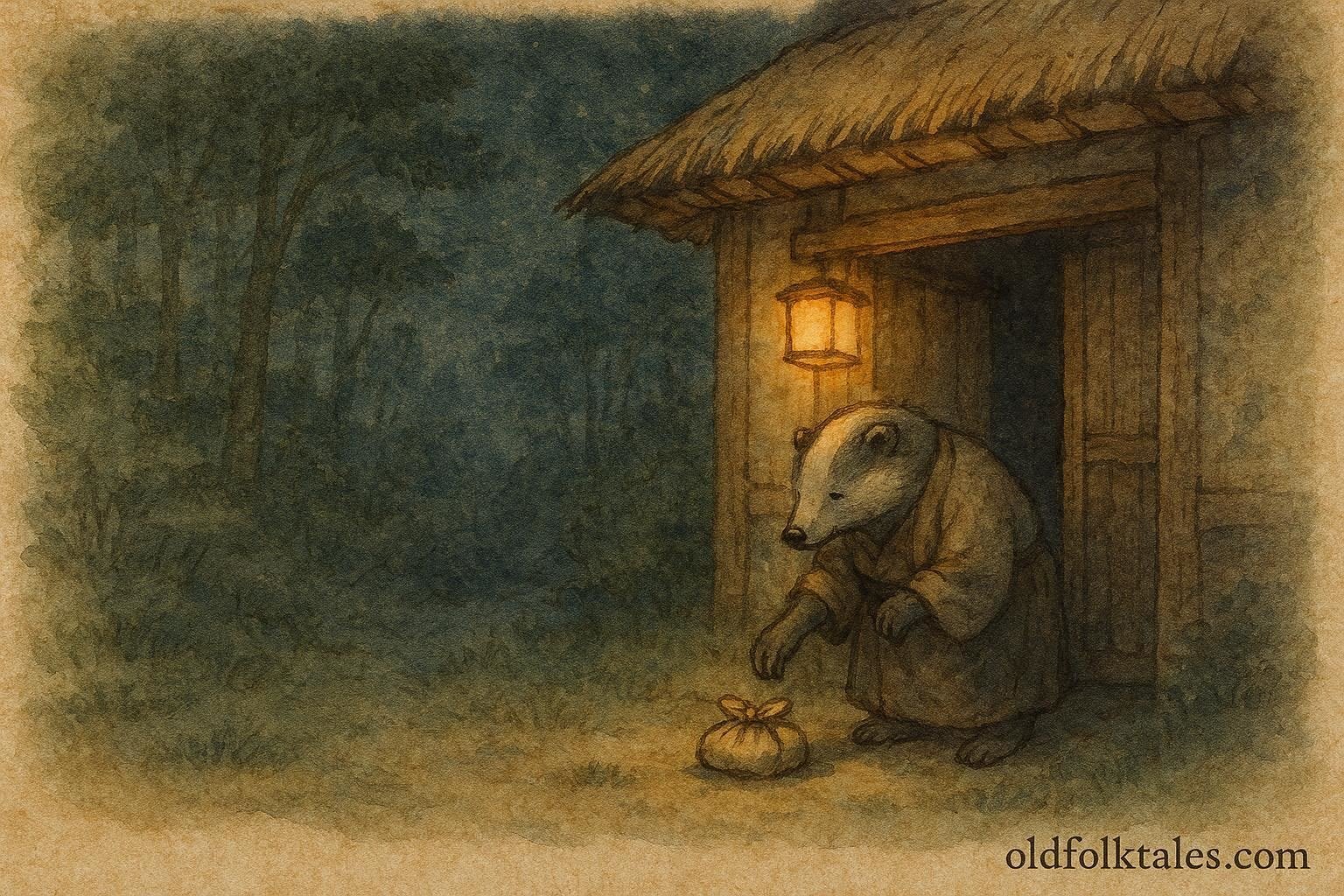
One night, when the wind howled like a living creature outside his hut, Sadao heard a soft rustling near his door. He opened it cautiously. There on the threshold lay a bundle of food wrapped in woven bark. Inside were dried persimmons, mountain herbs, and a handful of precious rice, items difficult for anyone to find during such a harsh season.
Sadao looked around but saw no one. He assumed a kindly neighbor had taken pity on him. The next night another bundle appeared, this time containing mushrooms and roasted chestnuts. Again there was no sign of a visitor. The offerings continued for many days. Each time Sadao called out into the night, thanking whoever might be listening, but no answer ever came. Whoever was helping him wished to remain unseen.
Near the end of winter, when the snow finally began to melt and the streams started flowing again, Sadao set out into the woods to collect fallen branches. The forest was quiet except for the dripping of melting icicles. As he approached a clearing, he noticed movement beneath a great cedar tree. There he found the old badger he had once rescued. The creature’s fur was thick and silvered with age, and its gaze was calm and wise.
The badger looked at him for a long moment, then dropped a final bundle of food at his feet before bowing its head. In that instant Sadao understood the truth. It had been the badger all along, gathering what little it could find each night to keep him alive through the winter. The animal seemed to smile before turning and slowly disappearing into the trees.
Deep emotion filled Sadao’s heart. He returned to his hut carrying the bundle and whispered a quiet prayer for the creature’s safety. When the spring sun warmed the mountains and the people of the region returned to their fields, Sadao often left small offerings beneath the cedar tree where he had last seen the badger. He felt that expressing gratitude in return was the best way to honor the friendship they had shared.
Years later the tale of the woodsman and the old badger spread through the surrounding villages. The people spoke of the quiet bond between human and animal, and they told their children that kindness never vanished into the forest. It always returned, sometimes in forms one might never expect. Parents shared this tale as a reminder that compassion creates ripples that reach far beyond the moment of the act.
Even today, elders in the northern mountains claim that when the winter is at its harshest and the snow lies thick upon the earth, one might hear a soft rustling outside a lonely hut. It is the spirit of the old badger, they say, still keeping its promise and still roaming the forests in search of those who show kindness. Whether this is truth or simply the warm story of generations past, all who hear it understand its message. Goodness endures, and gratitude lives long after the snow has melted.
Discover more East Asian Folktales from the lands of dragons, cherry blossoms, and mountain spirits.
Moral Lesson
Every act of kindness creates a lasting bond, and true gratitude returns quietly yet powerfully in times of need.
Knowledge Check
- Why did Sadao bring the injured badger home in the first place?
Answer: He wished to help the suffering creature and believed compassion was his duty. - What difficulty did Sadao face during the winter?
Answer: Food became scarce and survival became difficult during the harsh snowfall. - Who delivered the mysterious bundles of food to Sadao’s hut?
Answer: The old badger he had rescued earlier. - Why did the badger choose to remain unseen while helping Sadao?
Answer: It wished to show quiet gratitude without seeking recognition. - What did Sadao do in return once he learned the truth about the badger?
Answer: He left offerings beneath the cedar tree as a gesture of thanks. - What lasting message does the story give about kindness?
Answer: That compassion returns in unexpected ways and forms bonds beyond words.
Source
Adapted from Hirosaki University Folklore Collection, 2019.
Cultural Origin
Northern Japanese mountain folklore.