
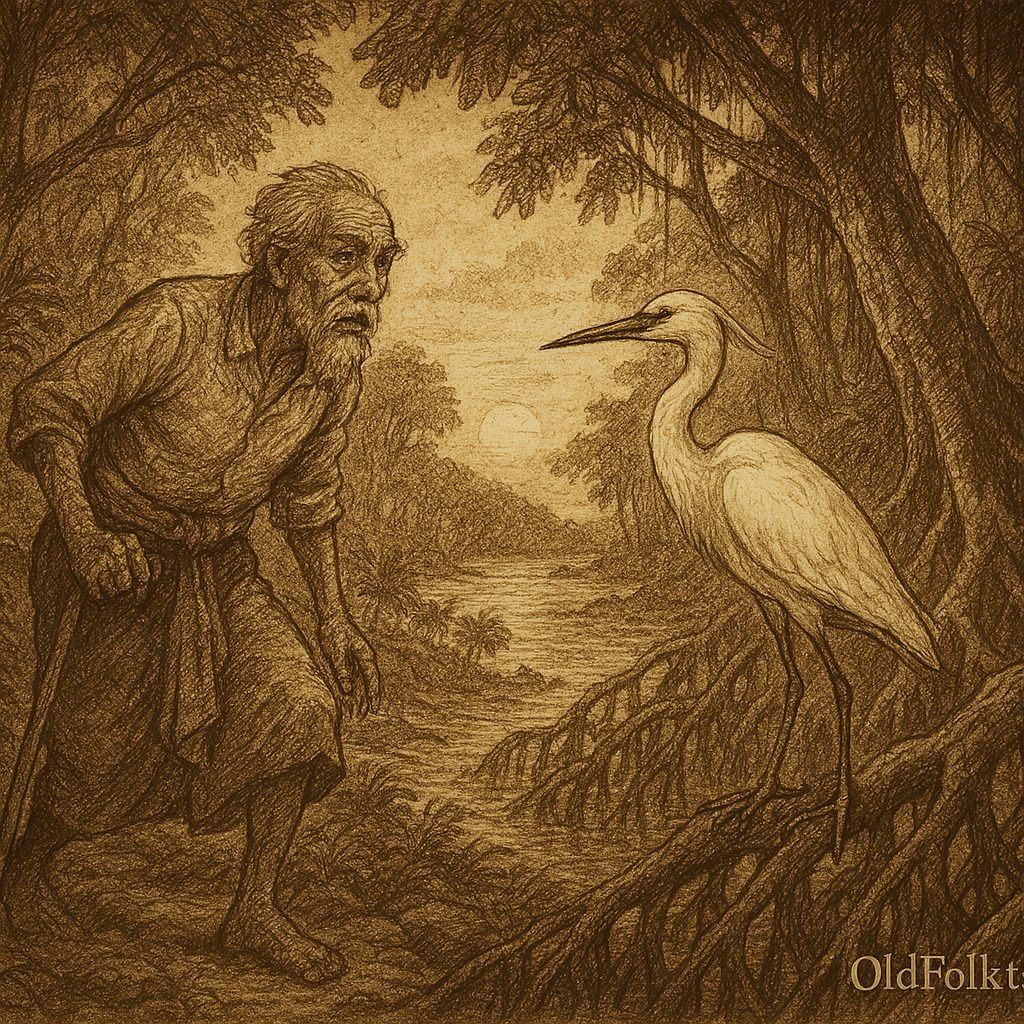
In the Lumut region of Brunei, where the coastal forest meets the whispering tides and mangrove roots twist like ancient fingers into brackish waters, there exists a story that elders still tell with reverent voices. It is a tale woven into the very fabric of the community, passed down through generations like a precious heirloom the legend of the Old Man of Lumut Leter, a mysterious guardian who walks between two worlds.
The coastal forest of Lumut is a place of shadows and secrets. Towering dipterocarp trees create a canopy so thick that even at midday, the forest floor remains dim and cool. Below, the tangle of mangroves spreads outward toward the sea, their roots creating a labyrinth where water and land blur into one another. It is easy to lose one’s way in such a place, where every tree looks like its neighbor and the paths seem to shift with the changing tides. The locals know this forest well and treat it with respect, for it is a realm where the natural and supernatural exist side by side.
Click to read all East Asian Folktales — including beloved stories from China, Japan, Korea, and Mongolia.
The Old Man himself is a figure shrouded in mystery. No one knows his true name or where he came from, though some elders claim he has walked these forests for longer than living memory. He appears as an elderly man with weathered skin the color of aged teak, his face etched with countless lines that tell of years spent beneath sun and rain. His eyes hold a peculiar depth, dark as monsoon clouds yet gentle as morning mist. He wears simple clothes of faded cloth, and he moves through the forest with the quiet grace of someone who belongs to it completely.
But the Old Man of Lumut Leter is no ordinary wanderer. As dusk descends and the sky bleeds orange and purple over the South China Sea, a transformation occurs. The old man’s form begins to shimmer and shift, and where he once stood, a magnificent white sea bird takes flight. Some say it is a white heron, others claim it is a rare egret, while still others insist it is a creature that exists nowhere else in the world a spirit bird clothed in feathers of purest white that seem to glow in the fading light.
It is in this form that the Old Man fulfills his sacred purpose: guiding lost children back to safety.
Over the years, many children have wandered too far from their villages, drawn by curiosity into the deep forest or lured by the mystery of the mangroves. As the sun sinks low and shadows lengthen, panic sets in. The familiar paths disappear, and every direction looks the same. Tears flow, and small voices call out for parents who cannot hear them. It is then that the white sea bird appears.
The children see it perched on a low branch or standing at the edge of a tidal pool, its white plumage luminous in the gathering darkness. The bird calls out a sound both melodious and urgent and begins to move, hopping from root to root, flying short distances and then waiting. The lost children, sensing something miraculous and kind in this creature, follow. The white bird leads them through the maze of trees and water, never hurrying so fast that small legs cannot keep pace, never straying from the safest paths. And always, without fail, the children emerge from the forest near their villages, where frantic parents wait with torches and prayers on their lips.
But the protection of the Old Man of Lumut Leter does not extend equally to all who encounter him. Adults who become lost in the forest and spot the white sea bird often make a fatal mistake. Believing they can follow the bird as children do, they pursue it with confidence born of pride. They do not realize that the forest demands something from grown souls that children give freely: humility.
Those adults who chase after the white bird without reverence find themselves drawn deeper into the mangroves, where the distinction between solid ground and sucking mud vanishes. The bird always stays just ahead, just visible, leading them in circles until the darkness is complete and the tide begins to rise. Some are found days later, shaken and unable to speak of what they experienced. Others vanish entirely, their fate becoming another whispered mystery of Lumut forest.
But there is a way for adults to receive the Old Man’s guidance. The elders teach that when a grown person encounters the white sea bird and needs its help, they must stop all movement. They must lower their eyes in respect, acknowledge their vulnerability, and recite the traditional protective chant that has been preserved in the Lumut region for generations. The words of this chant vary slightly among families, but all versions share the same essence: a humble request for guidance, an acknowledgment of the forest’s power, and a promise to honor the sacred bond between human and spirit.
Only when this chant is spoken with true sincerity and humility will the white bird acknowledge the adult petitioner. The transformation occurs in reverse the bird shimmers and becomes the old man once more, standing before the lost soul with kind but knowing eyes. He nods slowly, then turns and walks, his pace measured and deliberate. The adult who has shown proper respect may follow at a respectful distance, and they will be led safely to the forest’s edge.
The people of Lumut have learned to teach their children about the Old Man from an early age. They tell them that if they are ever lost, they should not fear the white sea bird but follow where it leads with trust in their hearts. They teach their young ones that the forest is not their enemy but a place deserving of respect. And most importantly, they pass down the protective chant, ensuring that each generation knows how to humble itself before the mysteries that dwell in the coastal shadows.
On certain evenings, when the sun sets over the mangroves and the first stars appear, villagers claim they can still see the white bird moving through the trees, vigilant and eternal. Some say the Old Man of Lumut Leter was once a guardian of these forests in life and chose to continue his protection in death. Others believe he is a nature spirit that has taken pity on human fragility. But all agree on one truth: he remains there still, walking between worlds, ready to guide those who are lost if they possess the wisdom to follow with innocent trust or the humility to ask with respectful hearts.
Click to read all Southeast Asian Folktales — featuring legends from Thailand, Indonesia, Vietnam, and the Philippines.
The Moral Lesson
The legend of the Old Man of Lumut Leter teaches that protection and guidance are offered freely to the innocent and humble, but pride and arrogance blind us to the help that surrounds us. Children receive the guardian’s aid because they approach the unknown with natural trust and without pretense, while adults must consciously choose humility and respect to receive the same blessing. This tale reminds us that some paths to safety require us to surrender our ego, acknowledge our limitations, and honor the sacred wisdom that exists in both nature and tradition. True strength lies not in self-sufficiency but in knowing when to humble ourselves and accept guidance from forces greater than ourselves.
Knowledge Check
Q1: Who is the Old Man of Lumut Leter in Bruneian folklore and what is his primary role?
A1: The Old Man of Lumut Leter is a mysterious guardian figure from the coastal forests of Brunei who transforms into a white sea bird at dusk. His primary role is protecting lost children by guiding them safely back to their villages through the dangerous mangrove forests. He represents the benevolent spirit guardians found throughout Southeast Asian folklore who watch over vulnerable members of the community.
Q2: What happens to the Old Man at dusk and why is this transformation significant in Bruneian legend?
A2: At dusk, the Old Man transforms into a magnificent white sea bird described variously as a heron, egret, or unique spirit bird. This transformation is significant because it allows him to fulfill his guardian role by becoming a visible, approachable guide for lost children. The white bird form symbolizes purity, visibility in darkness, and the liminal nature of a being that exists between human and spirit realms, perfectly suited for navigating the threshold time of twilight.
Q3: Why can children follow the white sea bird safely while adults often cannot in this Lumut forest tale?
A3: Children can follow the white sea bird safely because they approach it with natural innocence, trust, and humility qualities that the guardian spirit recognizes and honors. Adults, however, often pursue the bird with pride and self-assurance, lacking the respect and reverence the forest demands. This difference in approach reflects a deeper truth: children’s unspoiled hearts allow them to perceive and accept spiritual guidance that adults’ egos often reject or misunderstand.
Q4: What is the traditional protective chant mentioned in the story and what purpose does it serve?
A4: The traditional protective chant is a ritual prayer preserved in the Lumut region that adults must recite when encountering the white sea bird and seeking its guidance. The chant typically includes humble requests for help, acknowledgment of the forest’s power, and promises to honor the sacred relationship between humans and nature spirits. It serves as a test of humility and sincerity only when spoken with genuine respect will the guardian transform back and offer his guidance to adults.
Q5: What do the mangroves of Lumut represent symbolically in this Bruneian legend?
A5: The mangroves of Lumut represent the liminal space between known and unknown, safety and danger, physical and spiritual realms. Their maze-like root systems and the blurring of land and water create a natural metaphor for confusion and being lost both literally and spiritually. In the story, they serve as the testing ground where human character is revealed: the humble find passage to safety, while the proud become hopelessly entangled.
Q6: What broader cultural lesson about respect and tradition does this Lumut forest legend teach?
A6: This legend teaches that respecting traditional wisdom and maintaining humility are essential for navigating life’s dangers. The protective chant passed down through generations represents cultural knowledge that connects communities to their environment and spiritual heritage. By requiring adults to recite traditional words with sincerity, the story emphasizes that modern maturity should not breed arrogance that dismisses ancestral wisdom; rather, true wisdom lies in honoring and preserving the protective traditions that have guided communities through generations.
Source: Adapted from oral tradition legends documented in the Brunei Museums Journal, Oral Tradition Series
Cultural Origin: Lumut region, Brunei Darussalam








