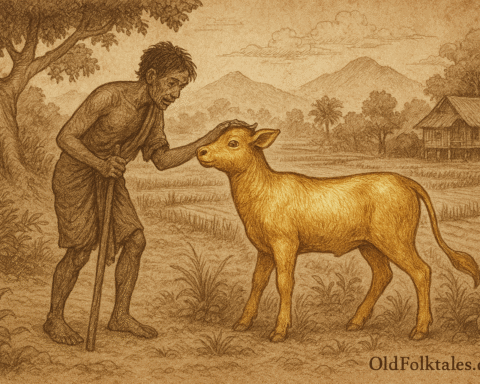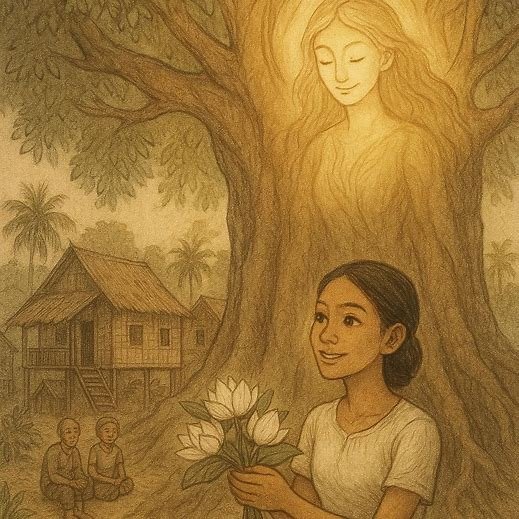
In the heart of a peaceful Cambodian village surrounded by green rice paddies and gentle hills stood an ancient fig tree. Its roots were thick and twisted like old serpents, and its branches stretched wide enough to shade the entire shrine beneath it. The villagers called it the spirit tree, for they believed that a powerful devatā, a celestial being, dwelt within its hollow trunk.
Every full moon, the villagers would bring offerings of jasmine garlands, coconuts, and bowls of sweet rice to honor the spirit. Among them was a young girl named Soriya. She was pure of heart, gentle in voice, and full of devotion. While others came to ask for blessings, Soriya came simply to give thanks. She swept the base of the tree, poured cool water on its roots, and whispered prayers of gratitude for the shade and fruit it offered.
Explore desert legends and palace tales in our Western Asian Folktales archive
One night, when the moon shone brightest, the devatā appeared to her in a dream. He was radiant like sunlight through leaves, dressed in silken robes that shimmered with gold. “Child of the earth,” he said softly, “you have tended this tree with a love purer than the rivers. Long ago, you and I were husband and wife, parted by death. I have waited through lifetimes to see your spirit again.”
Soriya woke with her heart trembling between fear and wonder. She told no one of the dream, but when she returned to the shrine the next morning, she found fresh lotus blossoms placed upon the altar, though none in the village had brought them.
Over the following nights, the devatā continued to visit her dreams. He told her of his life as a tree spirit and his longing to be reunited with her. Finally, he went to seek permission from Preah En, the god Indra, who ruled over the heavens. “Great Lord,” said the devatā, bowing deeply, “in my human life, I wronged my beloved. When death came, I prayed to be reborn where I could protect her. Now I dwell in the sacred fig tree of her village. May I take her as my wife once more, in purity and devotion?”
Indra, seeing the sincerity of the spirit’s heart, granted his wish but warned, “Your love must not bring harm to others. Let your union be an example of compassion, not envy.”
So it came to pass that Soriya and the devatā were united in a sacred marriage between heaven and earth. The devatā revealed himself at dusk, surrounded by golden light, and took human form. The villagers, astonished but reverent, blessed the union. Soon after, Soriya’s family found their fields growing greener than ever, their harvests rich and bountiful. The spirit of the fig tree watched over them, sending blessings of peace and prosperity.
But as with many tales of fortune, envy soon followed.
A wealthy neighbor, seeing Soriya’s good fortune, began to whisper to his wife, “Why should the devatā not bless us as well? Let us offer him finer gifts, silk, gold, even a cow, and he will surely reward us.” So the couple built a grand altar beside the tree, overshadowing the humble shrine Soriya had tended. They demanded blessings in exchange for their offerings and spoke to the devatā not with reverence but with greed.
That night, a storm rolled in. The wind howled through the fig leaves, and lightning struck nearby. The next morning, the grand altar lay in ruins, while the original shrine Soriya had tended stood untouched. The wealthy man’s crops withered, his cattle fell ill, and his home grew silent with misfortune.
Terrified, he sought Soriya’s forgiveness. She went to the tree and prayed, “Great spirit, forgive those who do not understand. Teach us to love without envy and to serve without demand.” The leaves of the fig tree rustled softly as if answering her prayer, and peace returned to the village.
In time, Soriya and the devatā’s story became a blessing told to every child. It reminded the people that love between spirit and human can only thrive in purity and truth, that gratitude invites blessings, and that greed always leads to ruin. To this day, villagers in Cambodia still make offerings beneath fig trees, honoring the spirit of Soriya and the devatā who loved her across lifetimes.
Explore ancient tales from Thailand, Cambodia, and the Philippines in Southeast Asian Folktales.
Moral Lesson
The story teaches that true love is selfless and spiritual, rooted in gratitude and virtue rather than desire or greed. It reminds us that blessings flow from sincerity, while envy and pride bring destruction.
Knowledge Check
-
Who lived within the sacred fig tree in Soriya’s village?
A powerful tree spirit, or devatā. -
How did Soriya show her devotion to the tree?
She cared for it daily, offering thanks and tending to it with love. -
What did the devatā reveal about his past life?
That he and Soriya had once been husband and wife in a previous life. -
What warning did Indra give the devatā?
That his love must be pure and not cause harm or envy among humans. -
What happened to the greedy neighbor who imitated Soriya’s offerings?
His altar was destroyed, and misfortune fell upon his household. -
What is the central message of the tale?
Love and gratitude bring divine blessings, while greed and imitation lead to suffering.
Source
Adapted from The Origin of the Sirenia (“Ryoen Toen Kamnoet Satv Phsot”) collected from the Khmer storyteller Koung Chandana, Prey Chhor District, Kompong Cham, as translated in Kambodschanische Volksmärchen (1987).
Cultural Origin
Cambodia (Khmer oral folklore tradition)