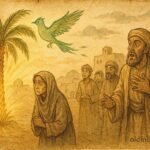
Long before the snows settled over the Himalayas and the rivers carved their silver paths across the land, Tibet was a vast wilderness of mountains and forests. No human voice echoed across its valleys, and only spirits, animals, and gods walked upon its sacred peaks. It was a place of beauty and danger, waiting for harmony to be born.
From his heavenly abode, Avalokiteśvara, the Bodhisattva of Compassion, gazed down upon the silent land. He saw that the valleys were rich, the mountains pure, and the winds carried blessings, yet the earth lacked the one creation that could bridge heaven and nature: humankind. At that time, a powerful ogress roamed Mount Gongpori, wild and untamed, filled with loneliness and desire. If left unchecked, her rage would summon demons and fill the land with darkness. Moved by pity, Avalokiteśvara resolved to transform her fury into love and bring forth a people guided by compassion.
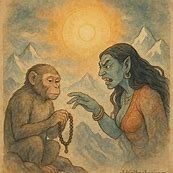
He called upon one of his gentle disciples, a holy monkey who had attained wisdom through years of meditation. “Descend to the earth,” the Bodhisattva said, “and dwell among the forests of Tibet. There you will plant the seed of kindness.” The monkey obeyed and made his home on the green slopes of Mount Gongpori. Each day he prayed, lived in peace, and shared his quiet spirit with the land.
Journey through enchanted forests and islands in our Southeast Asian Folktales collection.
One day, the ogress appeared before him, fierce and beautiful, her eyes blazing like twin embers. “Holy one,” she said, “take me as your mate, or I will unite with demons and fill this land with monsters.” The monkey bowed respectfully but answered, “I am a servant of compassion. I have taken vows of purity and cannot marry.”
The ogress trembled with anger and grief. “If you refuse,” she cried, “I will curse the mountains, and your kindness will be lost forever!” Troubled by her despair, the monkey turned his thoughts to prayer. That night, Avalokiteśvara appeared in a vision of golden light and spoke: “My son, do not fear. This is no sin, but destiny. Join with her, for from your union will arise a people who carry both your patience and her strength. They will be the children of Tibet.”
Obeying his master’s words, the monkey accepted the ogress as his companion. Their union was unlike any other: one of calm wisdom and untamed passion, heaven and earth meeting in harmony. Soon, the ogress gave birth to six children, each with different virtues. One was wise, another brave, another clever, another patient, another kind, and another strong-willed. As time passed, their descendants multiplied and spread across the land, building homes in the valleys and herding yaks upon the hills. Thus, the first Tibetans were born.
Seeing their hunger, Avalokiteśvara blessed the mountains with wild barley, millet, and fruits so they would never starve. The monkey taught them how to gather and share food, to live in peace, and to honor the spirits of the mountains. The ogress taught them songs, dances, and the ways of survival. Together, they nurtured a people who embodied both compassion and courage.
Generations passed, and the land flourished. The Tibetans grew strong, learned to speak, to build, and to pray. They offered thanks to their heavenly ancestor, Avalokiteśvara, and honored the memory of the monkey and ogress who had given them life. Mount Gongpori became sacred ground, a symbol of balance between the spiritual and the earthly, the gentle and the fierce.
In every version of the legend, the moral remains the same. The monkey represents wisdom, patience, and compassion, the spiritual qualities that guide humanity toward peace. The ogress embodies strength, passion, and the wild force of nature without which no life can thrive. Only when these two come together does harmony exist.
In the evenings, as the sun sets over the high plateau, Tibetan elders tell this story to their children. They remind them that the blood of both the monkey and the ogress flows through their veins. The gentle heart and the brave soul live side by side within every person. That is why the Tibetan people are known for their deep faith and resilience, for their songs of compassion and their courage to endure the hardships of the mountains.
Some say that when the mists rise from Mount Gongpori, it is the spirit of Avalokiteśvara watching over his children. The gentle rustle of the wind through the pines is the whisper of the monkey’s prayer, and the echoing thunder that rolls across the peaks is the ogress’s laughter, proud and fierce. Together, they still guard the land they helped create.
The legend of the monkey and the ogress is more than a tale of origin. It is a spiritual truth woven into Tibetan identity that all beings carry within them both the divine and the primal, the compassionate and the strong. Harmony, not perfection, is the highest virtue. It is said that when Tibetans pray for peace, they invoke the spirit of Avalokiteśvara, but when they face hardship, they draw strength from the ogress, their ancient mother.
To this day, monks, storytellers, and scholars continue to pass down this myth, preserving its sacred meaning. It remains a cornerstone of Tibetan belief, symbolizing how love, even between opposites, can create life, culture, and destiny.
Discover more East Asian Folktales from the lands of dragons, cherry blossoms, and mountain spirits.
Moral Lesson
The legend of the origin of the Tibetan people teaches that harmony and creation are born from the union of compassion and strength. It reminds us that wisdom without courage is fragile, and courage without kindness is blind. True peace is achieved when the gentle and the fierce live together in balance.
Knowledge Check
-
Who sent the monkey to earth, and for what purpose?
Avalokiteśvara sent the monkey to tame the wild ogress and bring life and harmony to Tibet. -
Why did the ogress approach the monkey?
She was lonely and sought companionship, threatening to bring chaos if rejected. -
What made the monkey change his decision?
Avalokiteśvara instructed him that their union was part of destiny and would create the Tibetan people. -
What qualities did the Tibetans inherit from their parents?
From the monkey they inherited compassion and wisdom; from the ogress they inherited strength and courage. -
What is the sacred significance of Mount Gongpori?
It is the mountain where the first ancestors united, symbolizing the balance of heaven and earth. -
What is the key moral of this story?
Harmony between opposites compassion and strength sustains creation and defines the human spirit.
Source
Adapted from the Tibetan creation myth “The Monkey and the Ogress” in The Tibetan Book of Origins: Myths of the World’s Roof, collected and translated by Samten G. Karmay (1998), Oxford: Oxford University Press.
Cultural Origin: Tibet (Bön and Buddhist creation folklore)