
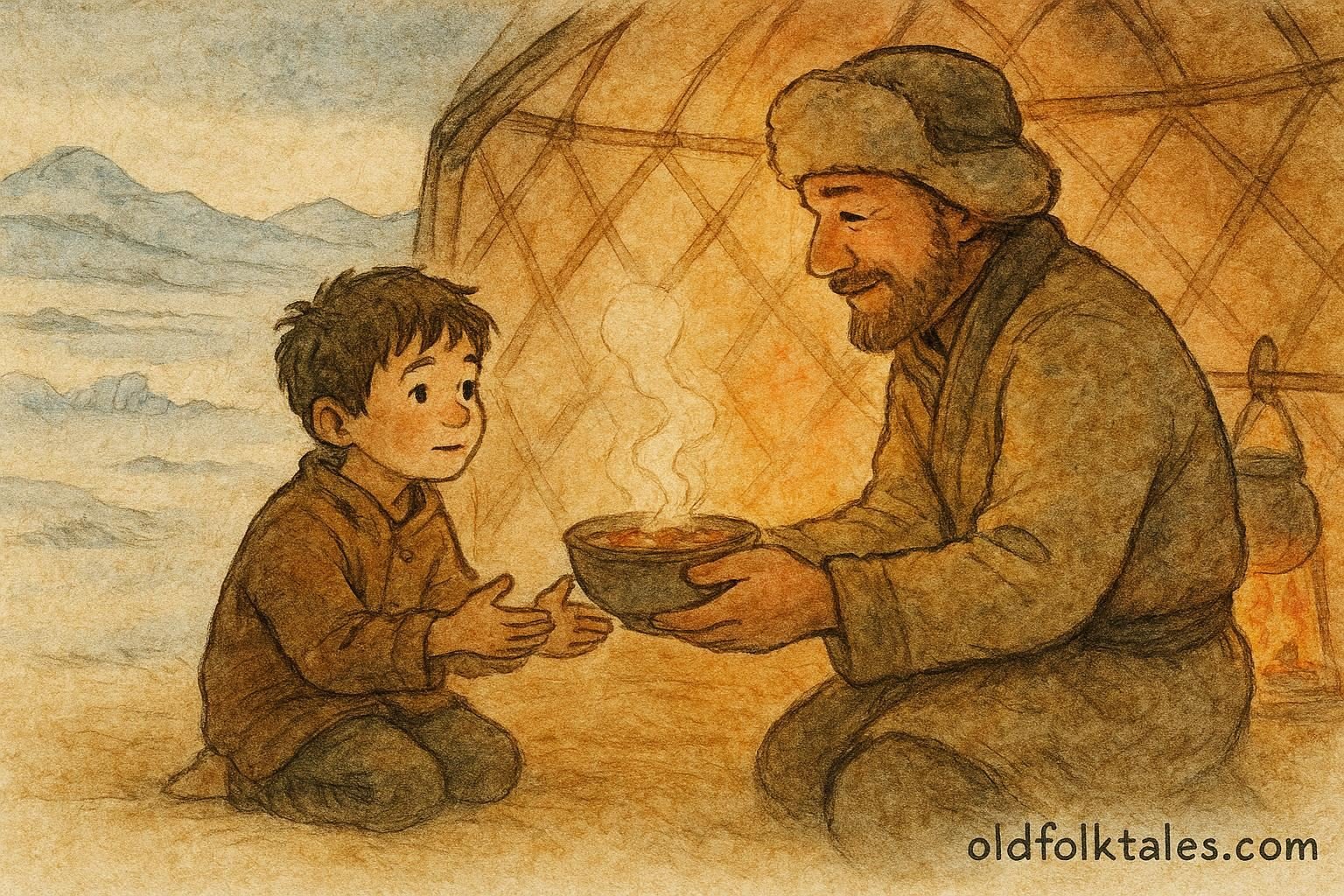
On the vast, windswept steppes of Kazakhstan, where the tall grasses rippled like waves beneath the endless sky, there lived a young orphan named Arman. His parents had died when he was very small, leaving him to wander from village to village, surviving on scraps and the kindness of strangers. Though he bore his hardships quietly, his heart remained gentle, and his spirit resilient.
One cold evening, as the sun sank behind the distant mountains, Arman trudged along a narrow dirt track, his stomach empty and his feet sore. He had slept under the open sky the night before, and the wind had stolen the warmth from his thin coat. Just as the shadows lengthened, he spotted a small yurt tucked among the hills. A warm glow escaped from its doorway, promising shelter.
Discover more East Asian Folktales from the lands of dragons, cherry blossoms, and mountain spirits.
Hesitant but desperate, Arman approached. A kindly stranger opened the door, a tall, soft-spoken man with silver-streaked hair and eyes that seemed to shine with understanding. “Come in, child,” he said gently. “No one should wander the steppes hungry and cold.”
Inside the yurt, the air was rich with the aroma of fresh bread and simmering stew. The stranger offered Arman a bowl of warm food and a place beside the hearth. “Rest,” he said. “Tomorrow, the world will be kinder with strength and care.”
As Arman ate, he noticed a small, intricately carved box on a shelf. Curiosity sparked, and he asked about it. The stranger smiled mysteriously. “It is a gift for those who act with courage and kindness. Use it wisely when the time comes.”
That night, Arman slept soundly for the first time in many months. He dreamed of endless fields, of friendly faces, and of a life filled with hope. When morning arrived, the stranger handed him the carved box. “This is yours now,” he said. “Remember, generosity is never wasted, and every act of kindness creates its own path.”
Arman continued his journey, the box tucked safely under his arm. He encountered travelers in need, animals caught in snares, and villagers struggling through harsh weather. Each time, he remembered the stranger’s words. He shared his food, freed trapped animals, and helped the weary along the path. With every good deed, Arman felt the weight of loneliness lift from his shoulders, replaced by a growing confidence.
One day, a wealthy merchant traveling through the steppes noticed the boy’s courage and compassion. Arman had rescued a foal stuck in mud near a river, and the merchant had witnessed it from a distance. Impressed, he offered Arman a place in his caravan, protection, and a chance to learn a trade. The boy accepted, grateful and humble.
Months passed, and Arman’s reputation for kindness and diligence spread across the region. The carved box, which he had once treated with awe, now revealed its true magic: inside was a small token of blessing, a reminder that generosity begets opportunity. Through the guidance of the stranger’s wisdom and his own acts of compassion, Arman’s life transformed from one of despair into a story of hope, resilience, and belonging.
By the time Arman grew into a young man, he had found a new family among the merchant’s people, earned their respect, and even helped other orphans along the way. Though he never forgot the stranger who had offered him shelter that fateful evening, Arman learned that kindness was a chain reaction, and that even the smallest gesture could ripple across the steppes, changing lives in ways no one could foresee.
Journey through enchanted forests and islands in our Southeast Asian Folktales collection.
Moral Lesson
Acts of kindness and hospitality are powerful; they not only aid those in need but also open doors to a better life. Compassion is both a virtue and a guide.
Knowledge Check
1. Who is the main character of the story?
Arman, a young orphan boy wandering the Kazakh steppes.
2. Who helps Arman, and how?
A kindly stranger provides food, shelter, and a magical token, teaching the value of generosity and courage.
3. What cultural values does this story highlight?
Hospitality, altruism, courage, and compassion—core traits in Kazakh folk-moral tradition.
4. What role does the carved box play in the story?
It symbolizes blessing, guidance, and the rewards of kindness and good deeds.
5. How does Arman’s life change through the story?
His acts of kindness lead him to safety, community, and purpose, ultimately improving his social status and wellbeing.
6. Why is this story significant in Kazakh folklore?
It emphasizes the importance of hospitality, moral integrity, and the transformative power of altruism in a nomadic culture.
Source: Adapted from SOAS short folk stories collection.
Cultural Origin: Kazakhstan (Kazakh folk-moral tradition)








