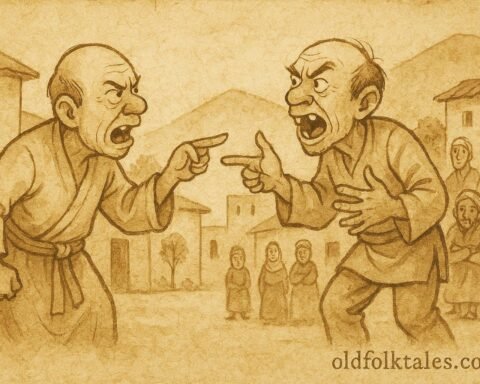
In a prosperous kingdom of ancient Nepal, there lived a young Prince who had a peculiar fondness for his royal barber. Every morning, as the barber’s sharp blade glided across the Prince’s face, the talkative servant would entertain his master with an endless stream of stories, gossips, and tales from the town. The Prince found these morning sessions delightful, hanging on every word that flowed from the barber’s lips as easily as water from a mountain spring.
But beneath the barber’s cheerful demeanor lurked a seed of bitter jealousy. While everyone in the kingdom respected and admired the court Pundit, a learned priest known for his wisdom, virtue, and spiritual guidance, the barber harbored a deep resentment toward him. Perhaps it was envy of the Pundit’s elevated position, or perhaps some imagined slight had poisoned the barber’s heart. Whatever the reason, he plotted day and night to destroy the holy man’s reputation and position.
Click to read all Southeast Asian Folktales — featuring legends from Thailand, Indonesia, Vietnam, and the Philippines.
One fateful morning, the barber arrived at the Prince’s chambers with an unusual solemnity clouding his features. His hands moved mechanically over the razor, his tongue silent, his eyes distant and troubled. The Prince, accustomed to his barber’s constant chatter, immediately sensed something amiss.
“What’s wrong with you today?” the Prince asked with concern. “Why don’t you talk as you usually do?”
The barber continued his work in heavy silence, sighing deeply from time to time. Finally, after much prodding from the Prince, he spoke in a voice thick with manufactured sorrow.
“Sire,” he began, his eyes downcast, “last night I had the most extraordinary dream. I found myself transported to paradise itself, walking among celestial gardens more beautiful than anything on earth. And there, in that divine realm, I encountered your noble father and your loving mother.”
The Prince sat upright, his interest immediately captured. “My parents? You saw them in paradise? Tell me, were they well? Were they happy?”
The cunning barber paused dramatically, allowing worry to crease his brow. He shook his head slowly, painting a picture of deep concern across his face.
“That is precisely what troubles me, Sire,” he replied. “While they reside in the blessed realm, they face a great difficulty. They are in desperate need of a priest, someone learned in the sacred texts and rituals to look after their spiritual needs in the afterlife. Your father and mother specifically asked me to convey this urgent message to you. They wondered if you might send the court Pundit to paradise to help them solve this pressing problem.”
The Prince’s face showed both confusion and concern. “But how could I possibly do that? How does one send a living person to paradise?”
The barber had prepared for this question. With an air of casual certainty, he replied, “That should not be too difficult, Sire. The process is quite simple, really. The Pundit need only be placed in a coffin and lowered into a grave. Once the earth covers him, he will soon awaken in paradise, ready to serve your honored parents in their time of need.”
The Prince, trusting his favorite servant completely, nodded slowly. “Oh, I see. If that is what my parents require, then I must fulfill their wish. I will arrange it immediately.”
Word of this bizarre plan spread through the palace like wildfire, and soon reached the ears of the court Pundit himself. When the holy man learned that he was to be buried alive under the pretense of being sent to paradise, his blood ran cold. But the Pundit had not earned his reputation for wisdom through book learning alone he possessed a sharp, practical intelligence that would now be tested as never before.
Appearing before the Prince with utmost humility and respect, the Pundit bowed low and said, “Your Highness, I am deeply honored that your noble parents have requested my services in the celestial realm. However, such a momentous journey requires proper preparation. I humbly request one month to settle my earthly affairs, perform the necessary rituals, and prepare my soul for this sacred transition.”
The Prince, being a fair and reasonable man, readily granted this request. “Of course, venerable Pundit. Take all the time you need to prepare yourself properly.”
The Pundit returned to his home and immediately set his plan in motion. He selected a suitable spot in his garden where his grave would be dug, then secretly employed a dozen trusted and faithful men. These workers labored night and day, digging not just a grave, but an elaborate underground tunnel that stretched from the burial site all the way to the cellar beneath his house. They worked in absolute secrecy, removing the earth in covered baskets and disposing of it far from prying eyes.
When the tunnel was complete, the Pundit carefully covered the opening at the grave site with sturdy wooden planks, then layered grass, weeds, and earth over them so skillfully that no one could detect the hidden passage below. He tested the mechanism repeatedly, ensuring that once the coffin was lowered, he could open it from within using a secret device he had designed.
The day of the burial arrived with great ceremony. The entire court gathered to witness the Pundit’s departure to paradise. The holy man lay peacefully in his coffin, dressed in white garments, his hands folded across his chest, looking for all the world like a man resigned to his fate. Prayers were chanted, incense was burned, and the coffin was slowly lowered into the grave.
As the first shovelfuls of earth began to fall upon the coffin, the Pundit remained calm and still. Once the sounds of the burial party faded and silence descended, he activated the secret mechanism. The bottom of the coffin opened smoothly, and he dropped down into the tunnel below. Moving carefully through the darkness, he made his way along the underground passage until he emerged safely in the cellar of his own house.
There, in the quiet solitude of his home, the Pundit began a remarkable transformation. He allowed his hair to grow long and wild, his beard to become thick and unkempt, and his nails to extend like the talons of a bird. For three long years, he remained hidden, living in isolation, planning his dramatic return. The kingdom believed him dead and serving the Prince’s parents in paradise.
Finally, when the time was right, the Pundit emerged from his seclusion. His appearance was shocking: hair flowing past his shoulders in matted tangles, his beard reaching his chest, his nails curved and yellowed like ancient ivory. He looked like a wild hermit who had lived for decades in a mountain cave.
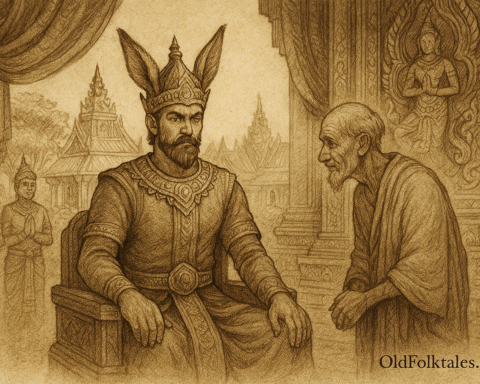
He walked straight to the palace and presented himself before the Prince’s court. The moment he entered the throne room, gasps of astonishment rippled through the assembled courtiers. Some screamed, others fainted, and the Prince himself jumped from his throne in utter shock and amazement.
“Pundit!” the Prince exclaimed, his voice trembling. “When did you return from paradise? And why… why do you look so untidy, so wild, with such unkempt hair and such very long nails?”
The Pundit bowed deeply, then fixed his gaze on the barber, who had gone pale as death and was trying to shrink into the shadows.
“That is exactly why I am here today, Your Highness,” the Pundit replied in a grave voice. “For who would willingly leave the pleasures and peace of paradise to return to this miserable, troubled earth, if it were not for a special and urgent reason? You see, until about a year ago, I was contentedly serving your noble parents in the celestial realm, attending to their every spiritual need. But then something terrible happened.”
He paused, letting the tension build in the silent throne room.
“Until about a year ago, your respected father had an excellent barber who attended to him faithfully in paradise. He was skilled with the razor and kept your father’s appearance immaculate every single day.”
The Prince leaned forward with interest, while the royal barber began to sense where this story was heading. A cold sweat broke out across his forehead.
“But for some reason,” the Pundit continued gravely, “this barber was sent away from paradise some months ago. Since then, your honorable father has been unable to find anyone to replace him. His daily grooming has become a terrible ordeal, and he grows more frustrated with each passing day.”
The Pundit paused, then delivered his crushing blow: “Finding nobody suitable to meet his daily toilet requirements, your noble father ordered me to return to earth with a specific request. He asks that you send your own barber—the very one standing before us now to paradise immediately to serve him. Your father speaks of this man often and believes he would be perfect for the position.”
The throne room fell into stunned silence. Every eye turned toward the barber, who had gone deathly pale. His mouth opened and closed like a fish gasping for air, but no words came out. The trap he had so carefully set for the Pundit now closed around him with iron certainty.
“This is excellent news!” exclaimed the Prince, clapping his hands together. “My father needs you, faithful barber! You must proceed to paradise right then and there to serve him. Guards! Prepare everything immediately!”
The barber finally found his voice, stammering desperately, “But… but Your Highness… I… the dream… it was only…”
“Only what?” the Prince asked sharply, his eyes narrowing with sudden suspicion. “Are you suggesting that you lied about meeting my parents in paradise? That you invented the entire story?”
The barber realized with horror that any protest would expose his murderous scheme. If he admitted the dream was false, he would face execution for attempting to murder the Pundit. If he maintained the dream was real, he would be buried alive. Either path led to his doom.
The soldiers wasted no time. Within moments, they began digging a grave in the very spot the Pundit had indicated, though this time, there was no secret tunnel waiting below. A coffin was brought forth, simple but sturdy, and the barber was led toward it on trembling legs.
“Please, Your Highness!” the barber cried out, falling to his knees. “I beg you… there must be some mistake… I cannot…”
But his protests fell on deaf ears. The Prince, still believing he was honoring his father’s request, showed no mercy. The Pundit stood silently nearby, his face calm and impassive, watching justice unfold through the barber’s own twisted design.
The poor barber, though perhaps he deserved little pity, was laid into the coffin, his eyes wide with terror, his body shaking uncontrollably. He tried to speak, to confess, to beg for forgiveness, but fear had stolen his voice. The lid was closed over him, shutting out the light of day forever.
The coffin was lowered into the grave with ropes, inch by terrible inch, until it settled at the bottom with a soft thud. Then the soldiers began to shovel earth upon it: heavy, final, unforgiving earth that sealed the barber’s fate as completely as he had tried to seal the Pundit’s.
And so the wicked barber, who had dug a grave for an innocent man, found himself lying in that very grave. His jealousy, his lies, and his murderous scheme had all returned to him, as such things always do. The Pundit, through wisdom, patience, and clever planning, had not only saved his own life but had allowed justice to work itself through the barber’s own words and actions.
Journey through enchanted forests and islands in our Southeast Asian Folktales collection.
The Moral Lesson
This timeless tale teaches us that evil schemes, no matter how cleverly devised, will ultimately fail when confronted by wisdom and patience. The story illustrates how jealousy and malice can lead people to commit terrible acts, but also shows that intelligence and careful planning can overcome even the most dangerous plots. Most importantly, it reminds us that those who dig graves for others may find themselves falling into those very same graves, for deception has a way of returning to its source.
Knowledge Check
Q1: Who are the main characters in this Nepali folk tale and what are their roles?
A: The main characters are the Prince (the ruler who trusts his barber too much), the court Pundit (a wise priest who serves the royal family), and the jealous barber (who plots against the Pundit). The Prince represents innocent trust, the Pundit symbolizes wisdom and patience, and the barber embodies jealousy and deceit.
Q2: What was the barber’s evil scheme in this story from Nepal?
A: The barber fabricated a dream in which he claimed to have visited paradise and met the Prince’s deceased parents. He told the Prince that his parents desperately needed a priest in the afterlife and convinced the Prince to bury the court Pundit alive, supposedly to “send” him to paradise. This was actually a murder plot disguised as a divine request.
Q3: How did the wise Pundit escape death in this Nepali folktale?
A: The Pundit requested a month to prepare for his “journey to paradise.” During this time, he secretly had workers dig an underground tunnel from his grave site to his house cellar. When he was buried, he used a secret device to open the coffin from inside and escaped through the tunnel, hiding in his house for three years.
Q4: What is the significance of the Pundit’s appearance when he returned?
A: The Pundit allowed his hair, beard, and nails to grow wild for three years to make his return appear authentic and dramatic. His unkempt, hermit-like appearance served as “proof” that he had actually been to paradise, making his story about meeting the Prince’s parents credible and helping him expose the barber’s treachery.
Q5: How did the Pundit get revenge on the barber?
A: Rather than seeking violent revenge, the Pundit used clever wit. He returned claiming he had been in paradise serving the Prince’s parents, but that they needed a barber because their previous one had been sent away. He told the Prince that his father specifically requested that the royal barber be sent to paradise immediately, thus turning the barber’s own deadly scheme against him.
Q6: What cultural and religious elements from Nepal are present in this folk tale?
A: The story features several Nepali cultural elements including the role of the court Pundit (Brahmin priest) as a spiritual advisor, the concept of paradise in Hindu belief, the importance of spiritual rituals and preparations, the traditional relationship between royalty and religious advisors, and the moral framework emphasizing karma (that evil deeds return to their source) and dharma (righteous duty).
Source: Nepali folktale, Nepal