In a grand palace perched atop the rolling hills of a Palestinian valley, there lived a princess known far and wide for her beauty, grace, and gentle heart. The corridors of the palace echoed with her laughter, and the gardens bloomed with life wherever she wandered. Yet behind her radiant smile, the princess carried a secret, a love that could never be spoken aloud. She had fallen for a humble palace guard, a young man whose hands were calloused from tending the gardens and training the palace gates, whose heart, however, shone with courage, wisdom, and honesty.
The princess’s love was tender but forbidden. Royal custom dictated that only men of noble birth could aspire to her hand. The young guard knew this, yet his devotion to her was steadfast. He watched her from afar, performing his duties with diligence, hoping one day his valor and loyalty might earn her father’s favor.
The king, wise and proud, eventually discovered the budding romance. He summoned the young man to the throne room, his gaze stern and unyielding. “If you wish to marry my daughter,” the king declared, “you must prove yourself worthy through three impossible tasks. Fail, and you shall never see her again.”
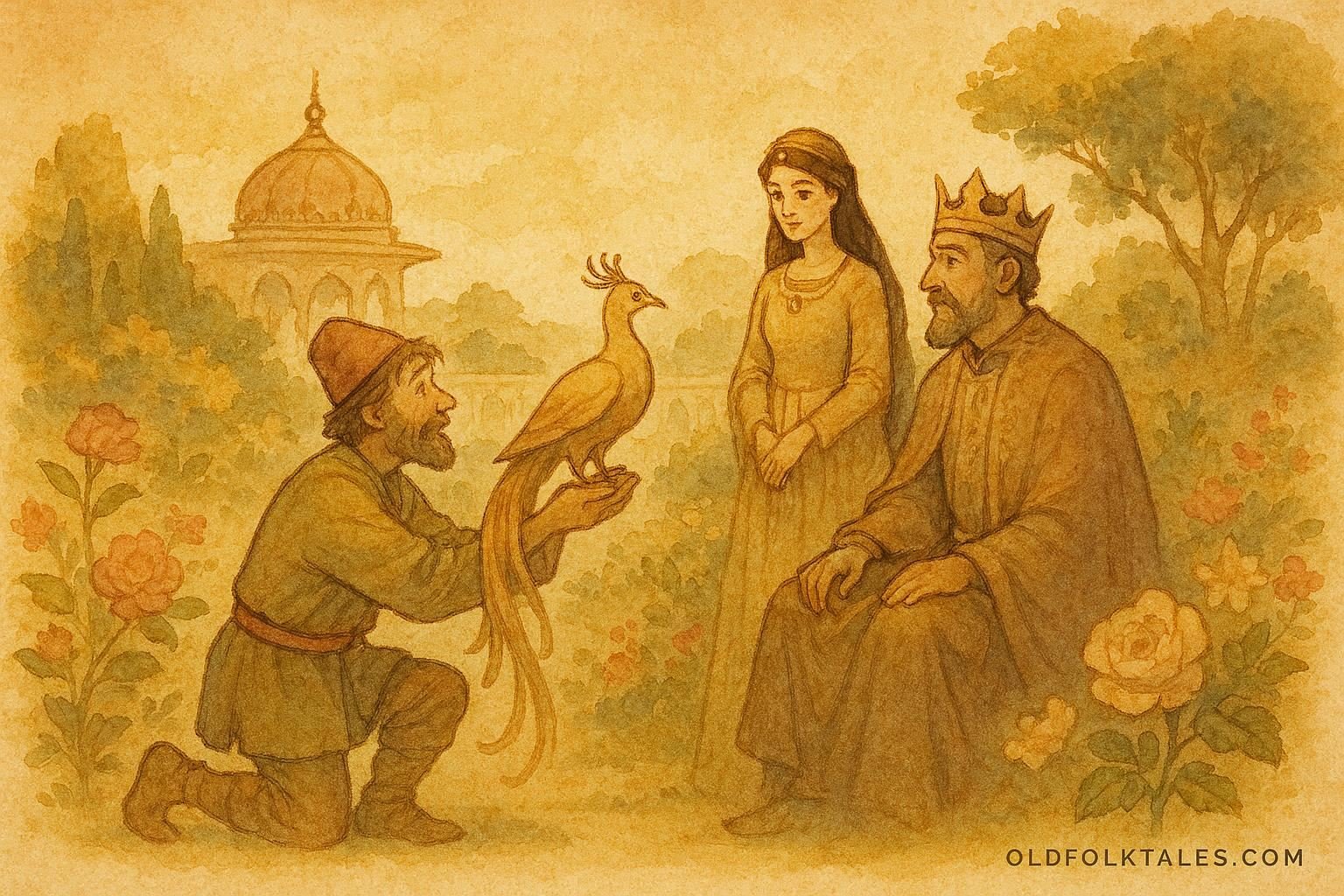
The first task was to retrieve a mythical bird said to bring luck and wisdom to the one who could hold it. The bird lived atop a mountain that scraped the clouds and nested near waterfalls whose spray blinded the eyes. The young guard set off, knowing the journey was perilous. The princess, however, could not bear the thought of his danger and secretly provided him with a magical feather from her personal collection, enchanted to guide the bearer safely. With it, he found the bird, earning it with care and bringing it back unharmed, to the astonishment of the court.
The second task was even greater: to build a small palace overnight, a structure strong enough to endure the weather, beautiful enough to delight the king, and adorned with gardens that rivaled the palace itself. The young guard labored from dusk until the first light of dawn, but the enormity of the work threatened to defeat him. As the night deepened, the princess whispered advice, pointing out clever techniques and directing the placement of stones and timber. By morning, the palace stood complete, a testament to their unity and ingenuity.
The final challenge was a test of wit: three riddles so intricate that no one in the king’s court could solve them. The first asked for the name of a flower that blooms in moonlight only; the second demanded the sound a mountain makes when it dreams; the third required the young man to reveal the greatest treasure of the heart. The young guard pondered, unsure how to answer. From behind a carved screen, the princess murmured her guidance, reminding him to look not only with his eyes but with his heart. He answered each riddle correctly, leaving the king astounded.
Through these trials, the king realized something profound. Though the young guard lacked noble birth, he possessed qualities that wealth and titles could not grant: courage, intelligence, loyalty, and above all, a heart capable of true love. The princess and the guard were married in a ceremony that united not just two people, but the lesson that character outweighs lineage. From that day forward, the palace and gardens thrived under their shared care, a symbol of love, wisdom, and the power of perseverance.
The tale of the princess and her humble guard spread throughout the valley. Mothers told it to daughters as a story of hope; fathers whispered it to sons as a lesson in courage. It reminded all who heard it that nobility is not a matter of birth, but of heart and deeds.
Moral Lesson
This Palestinian folktale teaches that true nobility comes from character, intelligence, courage, and love, rather than birth or wealth. Perseverance, cleverness, and devotion can overcome even the strictest social hierarchies.
Knowledge Check
1. Who is the heroine of the story?
The princess, known for her beauty, intelligence, and secret love for the palace guard.
2. What is the young guard asked to prove?
He must complete three impossible tasks to demonstrate his worthiness for the princess’s hand.
3. How does the princess help the guard?
She provides magical items, advice, and guidance, secretly assisting him in completing the tasks.
4. What qualities does the guard display through the story?
Courage, cleverness, devotion, perseverance, and intelligence.
5. What is the cultural lesson of this Palestinian folktale?
It emphasizes that true nobility and love are defined by character and deeds, not social rank.
6. How does the story conclude?
The guard successfully completes all tasks, marries the princess, and their union becomes a celebrated symbol of virtue and love.
Source
Adapted from the Palestinian folktale “The Princess and the Guard,” Palestinian rural oral tradition, collected in On Palestinian Journeys (Folktale Archive).