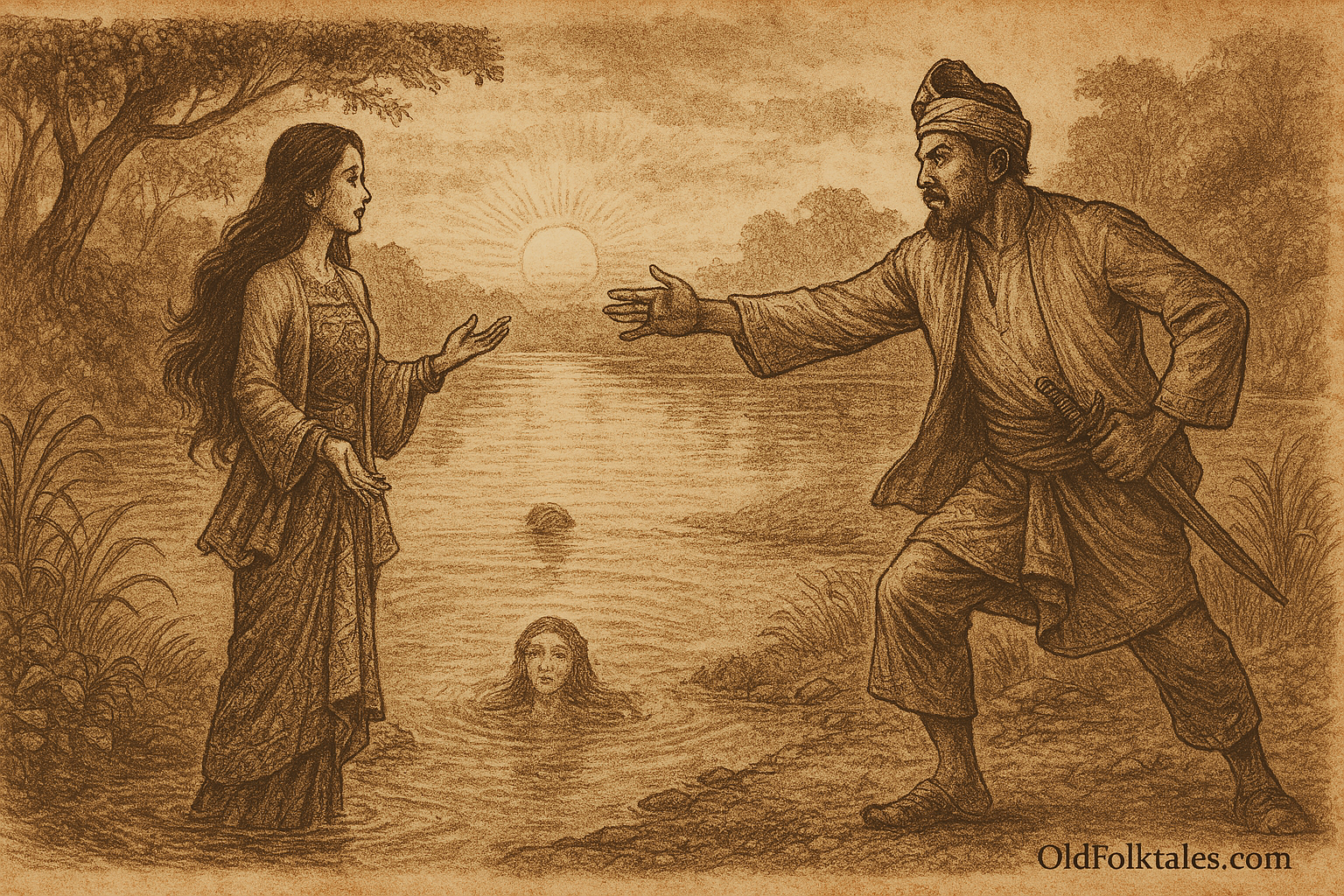
In the northern state of Kedah, where the Sungai Petani River winds through verdant rice fields and ancient rainforests, there once lived a petty chieftain named Dato’ Mahmud. He was not a great ruler, nor was he particularly wise or beloved by his people. What distinguished him from other men was not nobility of character but an insatiable greed and an obsessive desire to possess beautiful things: fine silks, carved kris daggers, precious gems, and above all, a wife whose beauty would be the envy of every man in the region.
Dato’ Mahmud had been married twice before, but both wives had left him, unable to bear his demanding nature and cruel tongue. He treated women not as companions but as ornaments, valuables to be displayed and controlled. His heart held no capacity for genuine affection, only for acquisition and pride.
Click to read all East Asian Folktales — including beloved stories from China, Japan, Korea, and Mongolia.
One day, while traveling through a remote village to collect taxes, Dato’ Mahmud encountered an elderly peddler selling curiosities at the market: ancient coins, weathered manuscripts, brass oil lamps, and assorted objects of questionable origin. Among the clutter, one item caught the chieftain’s eye, a hand mirror framed in tarnished silver, its surface clouded and dark despite the bright morning sun.
“What is this worthless thing?” Dato’ Mahmud asked dismissively, picking up the mirror. “The glass is so dirty I cannot even see my reflection.”
The peddler, a wizened man with eyes that seemed to see too much, smiled knowingly. “That is no ordinary mirror, Tuan. It does not show what is, but what could be. It reveals future brides to those who seek them. But I warn you, not everything the mirror shows can or should be grasped.”
Dato’ Mahmud laughed at the old man’s cryptic words. Superstitious nonsense, he thought. But the mirror intrigued him nonetheless, and he purchased it for a handful of coins, far less than the peddler had asked.
That evening, alone in his chambers, Dato’ Mahmud examined his purchase more closely. The mirror’s surface remained dark and impenetrable, showing nothing at all. Frustrated, he was about to cast it aside when he remembered the peddler’s words: “It reveals future brides to those who seek them.”
“Show me,” he commanded the mirror. “Show me the most beautiful woman in Kedah, the one who will become my bride.”
The mirror’s surface began to shimmer and swirl like water disturbed by wind. Slowly, an image formed: a woman of such breathtaking beauty that Dato’ Mahmud gasped aloud. Her skin was like polished teak, her hair flowed like black silk past her waist, and her eyes held a depth and mystery that seemed to pull at his very soul. She wore traditional Malay dress of the finest batik, and around her neck hung ornaments that glittered like morning dew.
But it was not just her beauty that captivated him. There was something ethereal about her, something not quite of this world. She stood at the edge of a river, the early morning light painting the sky behind her in shades of gold and rose. The water at her feet reflected her image perfectly, creating a mirror within the mirror.
“Where is she?” Dato’ Mahmud demanded of the mirror. “Tell me where to find this woman!”
As if in answer, the scene in the mirror shifted to show the surroundings more clearly: the distinctive bend of the Sungai Petani River, the old fig tree that grew near the northern bank, the stone markers that fishermen used to navigate. Dato’ Mahmud recognized the location instantly. It was less than half a day’s journey from his own estate.
Dawn had barely broken the next morning when Dato’ Mahmud sent his most trusted messenger, a man named Kassim, to the river bend with instructions: find the beautiful woman who appears at sunrise, discover who she is and where she lives, and deliver the chieftain’s proposal of marriage. Dato’ Mahmud was confident she would accept. After all, what woman would refuse the proposal of a wealthy chieftain?
Kassim arrived at the designated spot just as the first light of dawn touched the water. And there she was, exactly as the mirror had shown: a woman of extraordinary beauty standing at the river’s edge, gazing across the water as if waiting for something or someone.
“Puan,” Kassim called respectfully, approaching her. “I bear a message from Dato’ Mahmud, who wishes to make you his bride. He offers you wealth, status, and a life of comfort. Will you accept his proposal?”
The woman turned to look at him, and Kassim felt his breath catch. Her beauty was even more remarkable up close, but there was something strange about her: she seemed almost translucent in the early morning light, and when she moved, she left no footprints in the soft mud of the riverbank.
“I cannot be his bride,” she said, her voice like music carried on water. “I belong to the dawn and the river. Tell your master that some things are not meant to be possessed.”
But before Kassim could respond, she simply vanished, fading into the morning mist as if she had never been there at all. Kassim stood frozen in shock, staring at the empty space where she had stood. Had she been real, or had he imagined her?
When Kassim returned and reported what had happened, Dato’ Mahmud grew angry. “You fool! You let her escape! She is playing hard to get, testing my worthiness. I will go myself and claim her.”
The next morning, Dato’ Mahmud arrived at the river bend before dawn, determined to meet this mysterious woman himself. As the sun rose and golden light spread across the water, she appeared again, as beautiful and ethereal as before.
“I have come to make you my wife,” Dato’ Mahmud announced without preamble, his voice filled with the arrogance of someone accustomed to getting his way. “Accept my proposal, and you will want for nothing.”
The woman regarded him with eyes that held infinite sadness. “You see me but do not understand what I am. I am not a woman who can be wed. I am the spirit of this river, bound to appear each dawn, existing in the moment between darkness and light. You cannot possess me any more than you can possess the sunrise itself.”
But Dato’ Mahmud was not listening. All he could see was the most beautiful creature he had ever encountered, and his desire to possess her overwhelmed any sense of reason or respect. He lunged forward, reaching out to grasp her arm.
The moment his fingers touched her, everything changed. The spirit woman’s form began to shimmer and flow like water. Her expression transformed from sadness to something ancient and terrible. Dato’ Mahmud felt himself being pulled forward, his feet sinking into ground that had suddenly become as soft as quicksand. The river seemed to reach up for him, wrapping around his legs like liquid chains.
“You were warned,” the spirit said, her voice now echoing with the power of the river itself. “Those who try to grasp what should only be admired, those who seek to possess what is meant to remain free, will find themselves claimed instead.”
Dato’ Mahmud screamed as he was pulled inexorably toward the water. He tried to resist, to break free, but the river was far stronger than any mortal man. Within moments, he vanished beneath the surface, the water closing over him without a ripple, as if he had never existed at all.
The spirit woman stood alone once more at the river’s edge as the sun completed its rise into the sky. Then, as she did every morning, she faded away with the last of the dawn light, returning to whatever realm she inhabited between the worlds.
Word of Dato’ Mahmud’s disappearance spread quickly through the region. His servants found his horse tied near the river bend, and they found the mysterious silver mirror lying in the mud at the water’s edge, its surface now completely black and lifeless. But of the chieftain himself, there was no trace.
Some said he had drowned. Others whispered that the river spirits had claimed him as punishment for his greed and disrespect. His estate was divided among distant relatives, and within a generation, his name was barely remembered except as a cautionary tale.
But the legend of the Princess of Sungai Petani lived on. Fishermen and farmers who worked near that bend in the river reported seeing her still, appearing at dawn just as she always had: a beautiful woman in traditional dress, standing at the water’s edge, gazing across the river with an expression of eternal longing and sadness.
And the mirror? It was kept by one of the village shamans, who understood its true nature. On certain mornings, when the light was just right, the mirror would briefly come to life again, its surface clearing to show the image of the spirit princess standing by the river at sunrise. But the shaman never allowed anyone to keep the mirror long, knowing the danger it represented to those whose hearts were filled with greed rather than wisdom.
“She is a reminder,” the shaman would explain to those who asked about the legend. “A reminder that not everything beautiful is meant to be possessed. Some things exist to be admired from a respectful distance, to teach us about beauty and mystery and the limits of human desire. The spirit princess appears each dawn to show us what we can see but never hold, what we can appreciate but never own.”
To this day, some locals claim that if you go to that particular bend in the Sungai Petani River at dawn and if your heart is pure and your intentions respectful, you might catch a glimpse of her: the Princess of Sungai Petani, eternally beautiful, eternally free, eternally beyond the grasp of those who would seek to possess rather than honor what is sacred.
And somewhere, perhaps in an old wooden chest in a village shrine, the silver mirror waits, its surface dark and quiet, holding within it the image of a woman who taught a greedy chieftain the hardest lesson of all: that true beauty cannot be owned, only witnessed and revered.
Click to read all Southeast Asian Folktales — featuring legends from Thailand, Indonesia, Vietnam, and the Philippines.
The Moral Lesson
This legend teaches that not everything beautiful is meant to be possessed. Dato’ Mahmud’s fate demonstrates that treating people as objects to be acquired rather than honored as individuals with their own sovereignty leads to destruction. The spirit princess represents the sacred and the sublime, things that exist to be appreciated but never owned. Her eternal appearance at dawn reminds us that some mysteries should remain mysteries, that respect for boundaries is wisdom, and that attempting to grasp what should remain free will result in losing everything, including ourselves.
Knowledge Check
Q1: Who was Dato’ Mahmud in the Malaysian legend? A: Dato’ Mahmud was a petty chieftain in Kedah known for his greed and desire to possess beautiful things. He treated women as ornaments rather than people, having driven away two previous wives. His character flaw was seeing people as objects to be acquired and controlled rather than respected as individuals.
Q2: What was special about the magical mirror in the legend? A: The silver mirror did not show present reflections but revealed future brides to those who sought them. When Dato’ Mahmud commanded it to show him the most beautiful woman in Kedah, it revealed the spirit princess at Sungai Petani River. The peddler warned that “not everything the mirror shows can or should be grasped,” foreshadowing the danger.
Q3: Who was the Princess of Sungai Petani? A: The Princess was not a mortal woman but a river spirit bound to appear each dawn at the bend of Sungai Petani River. She described herself as existing “in the moment between darkness and light,” belonging to the dawn and the river. She was ethereal, translucent, and left no footprints, warning that she could not be possessed like the sunrise itself.
Q4: What happened to Dato’ Mahmud when he tried to grasp the spirit princess? A: When Dato’ Mahmud ignored her warnings and tried to physically grasp her, the ground beneath him became like quicksand and the river reached up like liquid chains. The spirit’s form transformed, becoming terrible and powerful, and she pulled him into the water where he vanished without a trace, claimed by the river as punishment for his disrespect and greed.
Q5: What happened to the magical mirror after Dato’ Mahmud’s disappearance? A: The mirror was found in the mud at the river’s edge, its surface completely black and lifeless after claiming its owner. It was later kept by a village shaman who understood its dangerous nature. On certain mornings with the right light, the mirror would briefly show the spirit princess at sunrise, but the shaman never allowed anyone to keep it long.
Q6: What does the spirit princess symbolize in Malaysian Kedah folklore? A: The spirit princess symbolizes the sacred, the sublime, and the untouchable aspects of beauty and nature that must be respected rather than possessed. She represents boundaries between the mortal and spirit worlds, the wisdom of appreciation without ownership, and the danger of treating sacred or sovereign beings as objects to be acquired. Her eternal dawn appearances remind people to honor what is free and mysterious.
Cultural Origin: Sungai Petani, Kedah State, Malaysia (Malay folklore tradition)