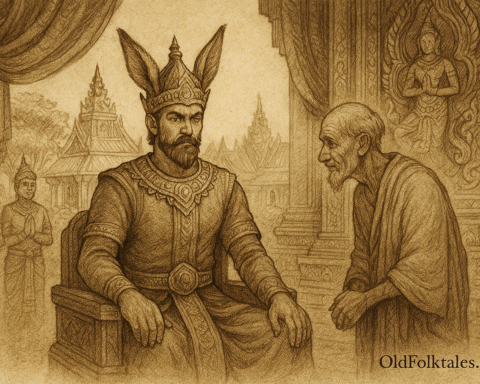
In a prosperous kingdom, there lived a Raja who had but one son, a young prince who loved nothing more than the thrill of the hunt. Each day he would ride out with his bow and arrows, exploring the wild lands that surrounded his father’s palace. His mother, the Rani, had given him freedom to hunt in three directions, but she strictly forbade him from venturing toward the fourth side. She knew a dangerous secret, if her son went that way, he would hear tales of the radiant Princess Labam, and once he knew of her existence, he would leave everything behind to seek her.
For many months, the obedient prince respected his mother’s wishes. But curiosity is a persistent companion, and one day while hunting, the forbidden direction called to him irresistibly. “Why should I not see what lies beyond?” he wondered. Against his mother’s warning, he turned his horse toward the fourth side.
Click to read all South & Central Asian Folktales — home to stories from India, Nepal, Afghanistan, and Sri Lanka.
The prince soon found himself in a strange jungle, eerily quiet except for the rustling of wings. The trees were filled with parrots, hundreds of them, their green feathers brilliant against the sunlight filtering through the canopy. The prince raised his gun and fired. Instantly, the entire flock erupted into the sky in a cacophony of shrieks and beating wings. All fled except one magnificent bird who remained perched on a high branch, Hiraman, the Raja of all parrots.
Hiraman called out angrily to his deserting subjects, “Come back! Don’t abandon me when danger strikes! If you leave me alone, I shall tell Princess Labam of your cowardice!”
At these words, the flock wheeled back, chattering anxiously. The prince stood transfixed. “These birds speak!” he exclaimed. Then, hardly daring to breathe, he asked, “Who is Princess Labam? Where does she live?”
But the parrots would reveal nothing more. “You can never reach Princess Labam’s country,” they said mysteriously, and refused to speak further.
The prince’s heart grew heavy with an inexplicable longing. He threw down his gun and returned home in a daze. For four days he lay on his bed, refusing food and speaking to no one. His worried parents finally coaxed the truth from him—their son had learned of Princess Labam, and now nothing else mattered.
“We don’t know where her country lies,” his father said desperately. “You must not leave us. You are our only child!”
But the prince’s determination was unshakeable. “I must find her,” he said quietly. “Perhaps God will guide my path. If I succeed, I will return to you. If I perish, at least I will have tried.”
Seeing they could not dissuade him, his grieving parents prepared him for the journey. His father gave him fine clothes, a strong horse, weapons, and bags of rupees. His mother wrapped sweetmeats in her handkerchief with trembling hands. “When you grow hungry, my child, eat these,” she said through her tears.
The prince rode for many days until he reached a jungle with a peaceful tank surrounded by shady trees. After bathing his horse and himself, he sat down to rest and opened his mother’s handkerchief. To his surprise, every single sweetmeat contained an ant. Rather than cast them aside in frustration, the kindhearted prince laid them all on the ground. “Never mind,” he said gently. “I won’t eat them, the ants shall have them.”
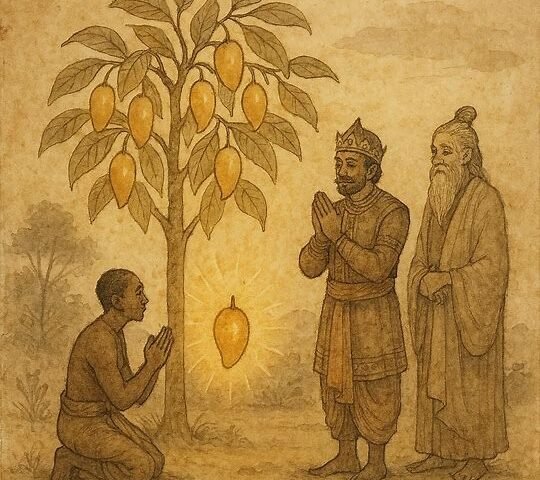
Suddenly, the Ant-Raja himself appeared before the astonished prince. “You have shown kindness to my people,” the tiny king said. “If ever you face trouble, think of me, and we shall come to your aid.” Then he vanished.
The prince continued his journey and soon entered another jungle, where terrible roaring split the air. He discovered a massive tiger writhing in pain. “Why do you roar so?” the prince asked.
“I have suffered with a thorn in my foot for twelve years,” the tiger groaned. “The pain is unbearable!”
“I will help you,” the prince said, though he wondered aloud, “But will you eat me once you are healed?”
“Never!” the tiger promised. “Please, make me well.”
Using his small knife, the prince carefully extracted the deeply embedded thorn. The tiger’s roar of pain was so tremendous that his wife came bounding from the neighboring jungle, ready to attack. The tiger quickly hid the prince, then explained what had happened. Moved by the prince’s compassion, both tigers became his devoted friends. They fed him and sheltered him for three days. When the prince finally prepared to leave, the tiger said solemnly, “If you ever need us, think of me, and we will come.”
The prince’s next encounter was perhaps the strangest. In a third jungle, he found four fakirs quarreling bitterly over their deceased master’s possessions: a magical bed that flew wherever its rider wished, a bag that produced whatever one desired, a bowl that provided endless water, and a stick with rope that would defeat any army.
The clever prince devised a solution. “I will shoot four arrows in different directions. Whoever retrieves each arrow first shall have the corresponding treasure.” The fakirs agreed eagerly. But while they raced after the fourth arrow, the prince sat upon the magical bed with the other three treasures and commanded, “Take me to Princess Labam’s country!”
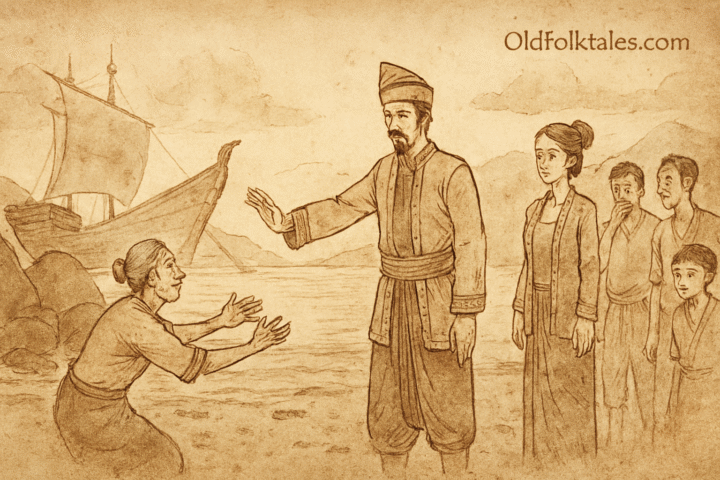
The bed rose into the air and flew until it reached a distant land. The prince found shelter with an old woman, despite her fears that the king’s law forbade housing foreigners. The prince’s magical bag provided sumptuous dinners, and his bowl supplied fresh water. The old woman was amazed.
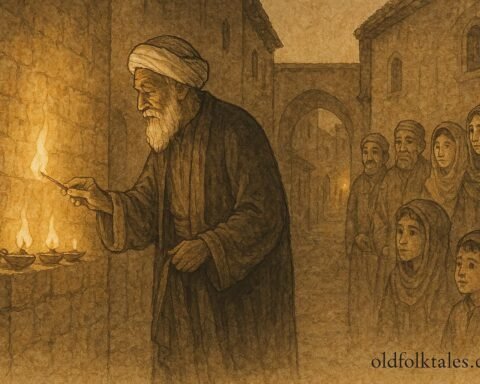
As night fell, she explained why no lamps were lit. “The king has forbidden lights because his daughter, Princess Labam, illuminates the entire kingdom when she sits upon her roof at night. She shines brighter than the moon itself.”
When darkness came, the prince witnessed a sight that stole his breath. The princess emerged dressed in magnificent silks and jewels, with a band of diamonds and pearls across her hair. She glowed with such radiant beauty that night became day throughout the kingdom. The prince’s heart was lost completely.
That night, while the princess slept, the prince flew to her chamber on his magical bed and left gifts from his bag—first betel leaves, then a beautiful shawl, and finally, a glorious ring. When he tried to place the ring on her finger, she awoke and cried out in fear.
“Don’t be afraid,” the prince said quickly. “I am a Raja’s son. Hiraman parrot told me of you, and I have traveled far to find you.”
The princess, seeing his noble bearing and gentle manner, agreed to marry him, but first, he must satisfy her father’s impossible demands.
The king presented the prince with eighty pounds of mustard seed to crush into oil in a single day. Remembering his promise, the prince thought of the Ant-Raja, who appeared with his entire colony. While the prince slept, thousands of ants extracted every drop of oil.
Next, the king commanded him to fight two fearsome demons the king had imprisoned. The prince thought of his tiger friends, who came wearing golden and silver coats studded with pearls and diamonds. They battled the demons until both monsters lay dead.
Still the king was not satisfied. “Beat my kettle-drum in the sky,” he ordered. The magical bed carried the prince upward, and he struck the drum so all could hear.
For the final test, the king presented a thick tree trunk and a hatchet made of wax. “Cut this in two by morning, or die,” he commanded.
That night, the princess revealed the solution. She pulled a hair from her head and gave it to the prince. “Tell the trunk, ‘Princess Labam commands you to split,’ and stretch my hair along the hatchet’s blade.”
When the prince did so the next morning, the hair touched the trunk and it split perfectly in two.
The king finally consented to the marriage. After a grand wedding attended by rulers from across the land, the prince and Princess Labam returned to his parents’ kingdom, where they lived in joy and prosperity, always keeping the magical treasures that had made their union possible.
The Moral Lesson
This tale teaches that true success comes not from strength alone, but from kindness and compassion. The prince’s gentle treatment of the ants and tiger, creatures others might have ignored or harmed, earned him loyal friends whose help proved essential. His journey shows that goodness planted like seeds will grow into blessings when we need them most. Additionally, the story reminds us that patience, cleverness, and determination, combined with help from those we’ve treated well, can overcome any obstacle, no matter how impossible it may seem.
Knowledge Check
Q1: Why did the Rani forbid her son from hunting on the fourth side?
A: The Rani knew that if her son hunted on the fourth side, he would hear about Princess Labam from the parrots who lived there. She feared that once he learned of the princess’s existence and beauty, he would become obsessed and leave his family to search for her, which is exactly what happened.
Q2: What magical objects did the prince acquire from the four fakirs, and how did he obtain them?
A: The prince cleverly obtained four magical treasures: a flying bed that carried riders anywhere they wished, a bag that provided whatever its owner desired, a bowl that supplied unlimited water, and a stick with rope that could defeat armies. He tricked the quarreling fakirs by promising to shoot four arrows and let whoever retrieved each arrow keep the corresponding treasure, but while they searched for the fourth arrow, he took the bed and the other items and flew away.
Q3: What does Princess Labam’s nightly radiance symbolize in the story?
A: Princess Labam’s ability to shine so brightly that she illuminates the entire kingdom symbolizes inner beauty, virtue, and worth that cannot be hidden. It represents how true nobility and goodness naturally light up the world around them, making her a treasure worth any quest. Her radiance also explains why she was so protected and why the prince’s journey was so difficult, something so precious requires extraordinary effort to win.
Q4: How does the prince’s kindness to animals help him complete the king’s impossible tasks?
A: The prince’s compassion toward the ants and the injured tiger created loyal friendships that later saved his life. The Ant-Raja and his colony crushed eighty pounds of mustard seed into oil overnight, an impossible task for one person. The tiger and his wife, dressed in magnificent, jeweled coats, fought and killed the king’s two demons that had terrorized the kingdom. This demonstrates the tale’s central message that kindness returns to help us in unexpected ways.
Q5: What is the significance of the four impossible tasks the king assigns to the prince?
A: The four tasks, extracting oil from mustard seeds, defeating demons, beating a drum in the sky, and cutting a tree trunk with a wax hatchet, represent tests of character rather than mere physical challenges. They were designed to be impossible, ensuring no suitor could marry the princess. However, they also tested the prince’s resourcefulness, his ability to maintain friendships (with the ants and tigers), his cleverness with magical objects, and his trust in the princess herself. Together, they prove he deserves his bride through merit, not just royal status.
Q6: What is the cultural origin and significance of this folktale?
A: This is a traditional Indian folktale that reflects common themes in South Asian storytelling: the hero’s quest, the intervention of magical helpers, tests of character and worthiness, and the triumph of virtue. The story includes distinctly Indian elements like Rajas, Ranis, fakirs, betel leaves, rupees, and tanks (water reservoirs). Such tales were traditionally used to teach moral lessons about kindness, perseverance, and the importance of treating all creatures, no matter how small with respect and compassion.
Source: Indian folktale, India