In a fertile valley of southern China, a wide river nourished villages along its banks for generations. The villagers depended on its waters to irrigate rice paddies, fill wells, and sustain livestock. The river was not only a source of life but also a living symbol of the ancestors’ guidance and protection. Stories passed down for centuries emphasized the sacred bond between the community and the river, warning that disrespect or neglect of ancestral rites could bring calamity.
One year, during a particularly dry season, the river suddenly ceased to flow. Streams that once gushed with crystal water became stagnant pools. Irrigation channels ran dry, and fish floated lifeless on the surface. Farmers could not water their fields, and wells yielded only muddy water. Villagers were bewildered and frightened. Elders recalled the ancestral teachings: the river’s flow depended on the villagers upholding vows of honesty, communal cooperation, and ritual offerings.
Rumors spread quickly. Some said the river had become offended by secret quarrels, thefts, and failures to honor the ancestors. Others believed that the river spirits themselves had withdrawn, disappointed by the villagers’ arrogance. In panic, the village council gathered. They consulted the oldest elders, who instructed the community to reflect on past behaviors and openly confess transgressions. Only sincere repentance could restore the river’s flow.
Journey through enchanted forests and islands in our Southeast Asian Folktales collection.
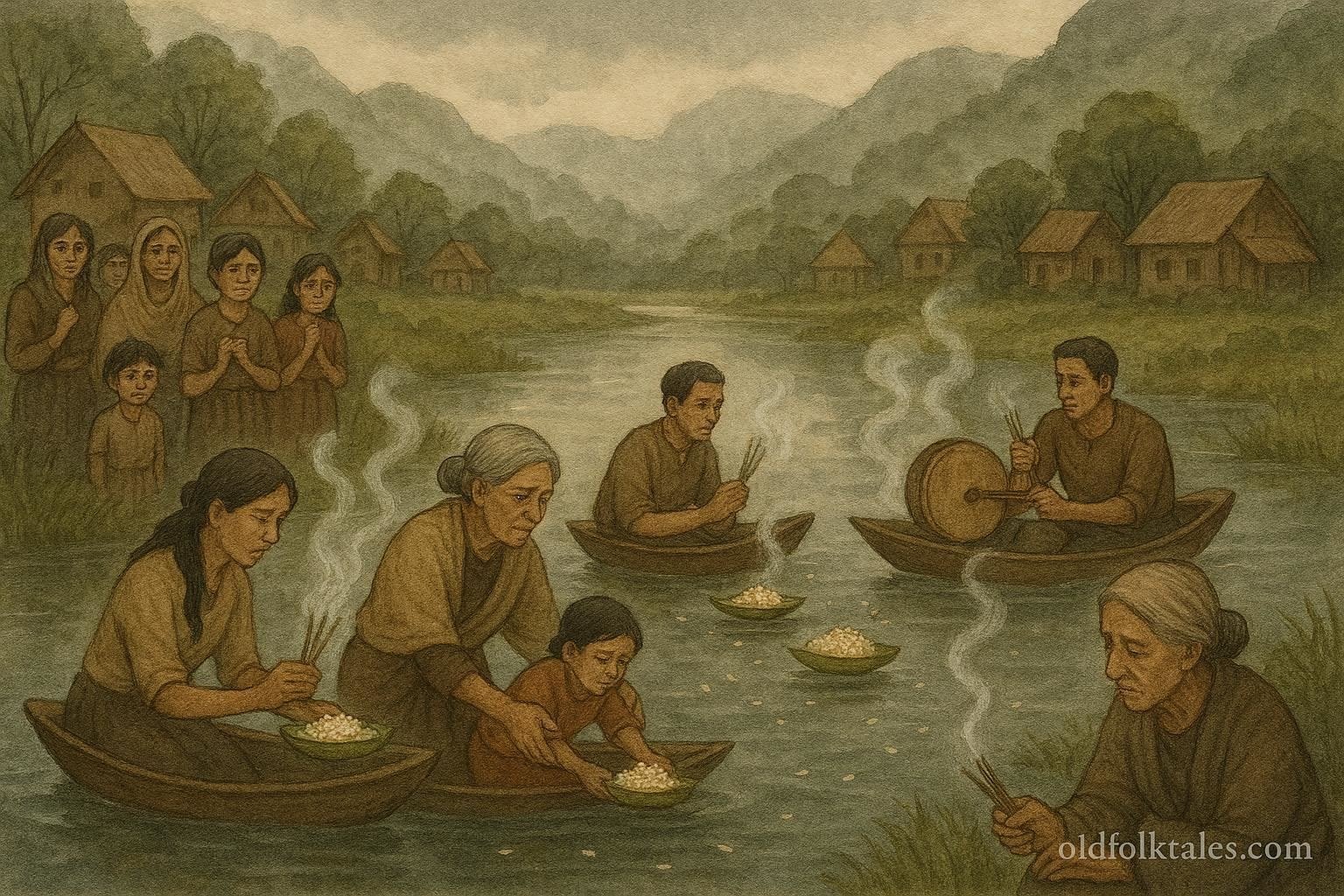
The villagers organized a series of public rituals. Each family came forward to recount any wrongdoings, including disputes over land, disputes among siblings, and broken promises. Children observed the elders’ examples, learning humility and the importance of truth. The community also prepared offerings of rice, tea, and incense, placing them in small boats to float along the riverbed. Drums were beaten in measured rhythm, and the villagers chanted prayers, calling upon the river spirits and their ancestors to forgive human shortcomings.
Days passed, and the river remained stubbornly still. Some villagers became impatient, suggesting that the water had vanished forever. However, the elders reminded them that the river was not merely water; it was a manifestation of ancestral will and moral law. Only genuine repentance could awaken its flow. Families continued to gather, apologizing openly and promising to uphold communal values in the future.
One morning, after a night of particularly heartfelt prayers and offerings, faint ripples appeared on the river’s surface. Villagers watched in awe as the water began to flow slowly at first, then with increasing strength. Fish returned to the moving water, and irrigation channels filled once again. Farmers wept with relief, realizing that the river’s temporary silence had been a test of collective responsibility. The elders declared that the river’s lesson was clear: the community’s prosperity depended on moral integrity, respect for tradition, and careful attention to ancestral guidance.
The story of the river that refused to flow spread far beyond the valley. Neighboring villages sent emissaries to learn the rituals and the importance of upholding ancestral vows. Over time, festivals developed to commemorate the event. Each year, villagers performed collective rituals along the riverbanks, honoring ancestors and renewing vows to respect one another, avoid deceit, and care for the land. These ceremonies reinforced communal bonds, teaching successive generations the value of ethical living.
In later years, the river flowed abundantly, but the story remained a constant reminder. Children were taught that their actions, even small ones, had consequences not only for themselves but for the community and for the sacred natural world. Elders emphasized that moral conduct, honesty, and communal cooperation were as vital as skillful farming or trade. By restoring the river’s flow, the villagers learned that collective responsibility was intertwined with spiritual and ecological harmony.
Scholars who later documented the tale noted that it exemplifies moral ecology: the idea that the environment responds to human ethical behavior. The river’s refusal to flow functioned both as punishment and as a teaching tool, reinforcing values that ensured the community’s long-term survival. By acknowledging transgressions and recommitting to communal norms, the villagers experienced a renewal of both water and moral clarity. The river’s lesson endured, reminding future generations that natural abundance is inseparable from human virtue.
Explore timeless legends from China, Japan, and Korea in our East Asian Folktales collection.
Moral Lesson
The river teaches that collective well-being depends on respect, honesty, and adherence to moral and spiritual obligations. Disregarding ancestral guidance or ethical principles can disrupt communal harmony and the environment itself. By practicing repentance, accountability, and cooperation, communities can restore balance and ensure the continuity of both natural and social prosperity.
Knowledge Check
- Why did the river stop flowing in the village?
The river ceased to flow because villagers had neglected ancestral vows and failed to maintain honesty and communal cooperation. - What actions did the villagers take to restore the river?
They confessed wrongdoings publicly, offered rice, tea, and incense, and performed collective rituals honoring ancestors. - What lesson did the elders emphasize to the community?
The elders emphasized that prosperity depended on moral integrity, respect for tradition, and collective responsibility. - How did neighboring villages respond to the river’s lesson?
They sent emissaries to observe and learn the rituals, adopting similar practices to uphold ethical and spiritual values. - What broader principle does this story illustrate about human interaction with nature?
It illustrates moral ecology: the environment reflects human ethical behavior, and sustainable living requires virtue and responsibility. - What lasting impact did the river’s refusal have on village culture?
It established annual rituals, reinforced communal cooperation, and taught successive generations the importance of ethical behavior for social and ecological balance.
Source
Adapted from Institute of Ethnology Chinese Oral Traditions Archive, 2016.
Cultural Origin
Southern Chinese ritual folklore.