On the eastern coast of the Malay Peninsula, where turquoise waters lap against white sandy shores and coconut palms sway in the constant sea breeze, there once stood a village that had not yet earned its name. The settlement was home to fisherfolk and farmers who lived in harmony with the land and sea, their lives following the ancient rhythms of monsoon seasons, fishing cycles, and rice harvests.
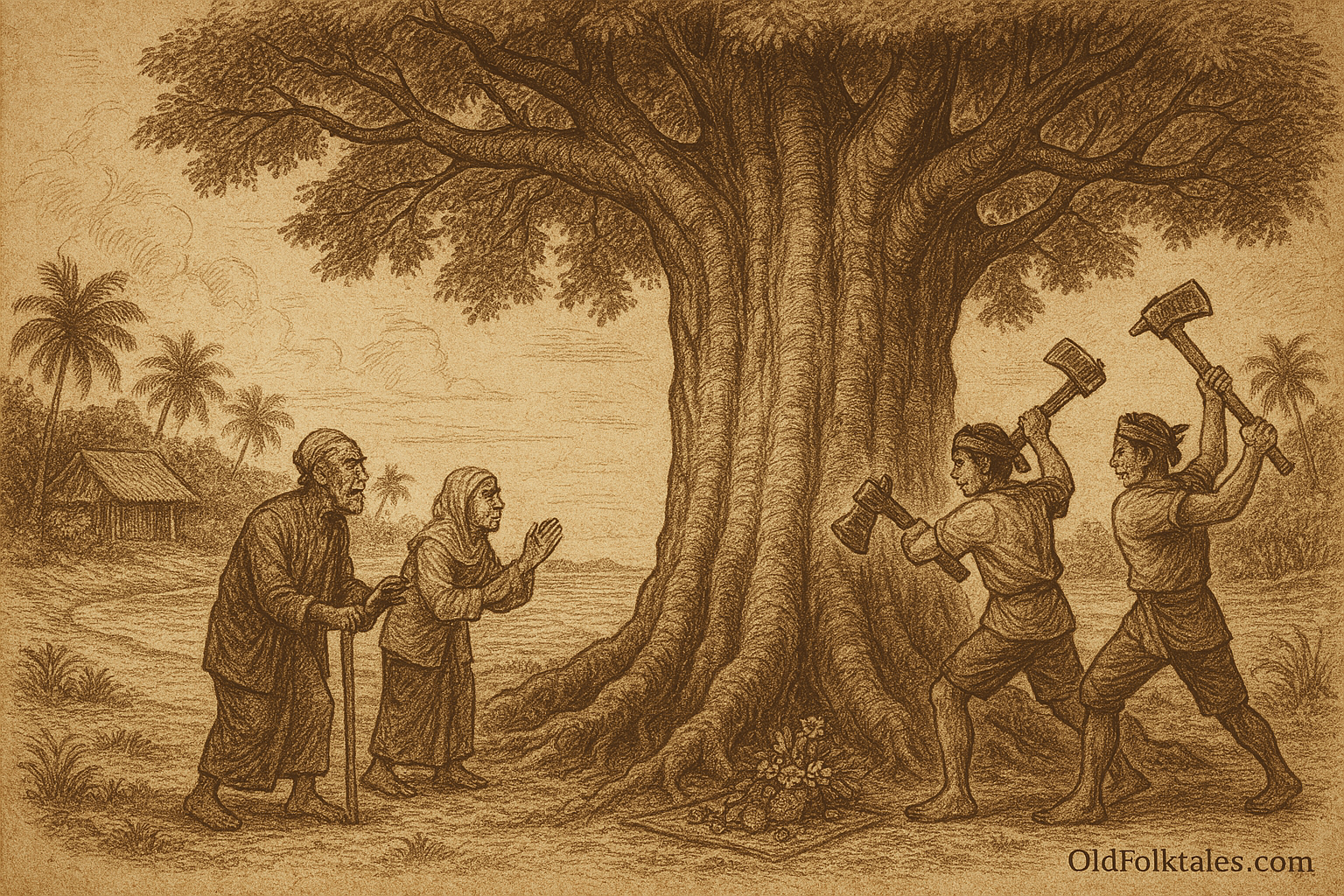
At the very heart of this nameless village stood an extraordinary tree. The Merang tree rose like a living monument, its massive trunk so wide that ten men with arms outstretched could barely encircle it. Its branches spread in all directions, creating a canopy so vast and dense that the tree’s shadow could shelter the entire village during the scorching midday sun. The roots ran deep and wide, anchoring themselves into the earth like the fingers of a giant, stabilizing the soil and protecting the settlement from erosion during heavy rains.
Click to read all East Asian Folktales — including beloved stories from China, Japan, Korea, and Mongolia.
The tree was ancient beyond memory. The eldest grandmother in the village had heard from her own grandmother that the Merang tree had stood there since before the first houses were built, since before the first fishing boats touched these shores. Its bark was thick and gnarled, marked with the passage of countless seasons. Birds nested in its upper branches, creating a constant symphony of chirping and song. Monkeys played among its limbs, and during fruit season, the tree provided sustenance for countless creatures.
But the Merang tree was far more than just an impressive specimen of nature. The village elders spoke of it with reverence, their voices hushed and respectful. They taught the younger generations that the tree was a spiritual guardian, a protector placed by forces beyond human understanding to watch over the village and its people. Offerings of flowers, rice, and fruit were regularly placed at its base, accompanied by prayers of gratitude and requests for continued protection.
“The tree is sacred,” the elders would remind everyone during village gatherings. “It shelters us from storms, its roots prevent floods, its presence brings good fortune to our catches and harvests. We must never harm it, never take from it without asking permission, never forget the debt we owe to its protection.”
For generations, the villagers honored these teachings. They cared for the tree, kept the area around it clean and respectful, and celebrated festivals beneath its spreading branches. In return, the village prospered. Fishermen returned with nets bursting with fish, farmers enjoyed bountiful harvests, and the settlement was spared from the worst disasters that sometimes struck neighboring communities.
But as time passed and new generations were born, some began to forget the old ways. Young people, influenced by traders from distant lands who spoke of progress and profit, started to see the great Merang tree differently. Instead of a sacred protector, they began viewing it as merely a tree and more specifically, as an enormous source of valuable timber.
“Think of what we could build with that wood,” some young men began to whisper among themselves. “The trunk alone could construct several houses. The branches could be fashioned into boats. We could sell the timber and become wealthy. Why should we let such valuable resources sit unused, just because of old stories and superstitions?”
These dangerous ideas spread like wildfire through the younger generation. They began to openly question the elders’ warnings, dismissing the spiritual significance of the tree as primitive thinking that had no place in their ambitious plans for the village’s future. The more the elders cautioned them, the more rebellious and determined they became.
One fateful morning, a group of young men gathered with axes and saws, their faces set with determination and defiance. They had made their decision: they would cut down the Merang tree, regardless of the elders’ protests. The old ways, they declared loudly, were holding the village back from prosperity.
The elders rushed to stop them, pleading desperately. “You must not do this! The tree is our protector. We do not know what consequences will follow if we harm it without proper rituals, without seeking permission from the spirits it houses. Please, wait! Consult with the village bomoh, perform the necessary ceremonies”
But the young men refused to listen. They pushed past the elders, dismissing their warnings as the fearful ravings of a generation too superstitious to embrace progress. They approached the mighty Merang tree, raised their axes high, and struck the first blow against its ancient bark.
The sound of metal biting into wood echoed across the village like a terrible omen. The tree seemed to shudder, its leaves rustling despite the absence of wind. Birds erupted from the branches in a panicked cloud, their cries filling the air. But the young men only laughed at what they saw as coincidence, swinging their axes with renewed vigor.
They worked throughout the day, taking turns to rest while others continued the assault on the massive trunk. The elders watched in horror, many weeping openly, praying to whatever forces might still intervene. By evening, a deep gash had been cut into the tree’s side, exposing the pale wood beneath the dark bark. The young men, exhausted but triumphant, promised to return the next day to finish their work.
That night, the first disaster struck.
A sudden storm rolled in from the sea with terrifying speed, far more violent than any monsoon the village had experienced in living memory. Wind howled like wounded beasts, tearing roofs from houses and sending fishing boats crashing against the shore. Rain fell in torrents, flooding homes and washing away precious stores of rice and dried fish. Lightning split the sky continuously, and thunder shook the earth itself.
The villagers huddled in their damaged homes, terrified and praying for dawn. Many noticed that the area directly beneath the Merang tree’s canopy remained strangely calm, as if the wounded tree was still trying to protect them despite the harm they had caused it.
When morning finally came, the storm had passed, leaving behind devastation. But worse was to follow. In the days after the attempted felling, nothing went right in the village. Fishermen cast their nets and pulled up nothing but seaweed and debris. The rice paddies, despite being recently planted, began to wither and die from a mysterious blight. Children fell ill with fevers that no traditional remedies could cure. Snakes appeared in unprecedented numbers, slithering into homes and frightening the inhabitants.
The young men who had led the assault on the tree suffered the most. One broke his leg in a simple fall. Another developed a painful skin condition that resisted all treatment. A third had nightmares so terrible he refused to sleep, his eyes growing hollow and haunted. The axes and saws they had used against the tree mysteriously vanished, later found deep in the forest as if something had carried them far from the village.
As misfortune piled upon misfortune, even the most skeptical villagers began to understand the truth. The tree had not been merely a tree, it had been their guardian, their protector, and they had attacked it with axes and arrogance. The disasters were not random bad luck but consequences of their disrespect for the sacred.
The elders called an emergency village meeting beneath what remained of the Merang tree’s shadow. The gash in its trunk had begun to ooze sap, like blood from a wound, but the tree still stood, still lived, still offered its shelter despite the harm inflicted upon it.
“We have been fools,” the village chief declared, his voice heavy with remorse. “We allowed greed and arrogance to blind us to the wisdom our ancestors passed down. We must make amends before we lose everything.”
The village bomoh, the spiritual healer and intermediary with the unseen world, was summoned to perform elaborate ceremonies of apology and healing. For seven days and seven nights, offerings were made at the base of the wounded tree flowers, fruits, rice, incense, and prayers spoken with genuine remorse and humility. The entire village participated, including the young men who had wielded the axes, their faces now marked with shame and fear.
On the eighth day, the bomoh emerged from his trance and delivered the spirits’ message: “The tree forgives, for that is its nature. But you must never forget this lesson. You must tend to its wound with respect and care. And you must carry the name of what you nearly destroyed as a reminder to all future generations of the consequences of forgetting sacred duties.”
The villagers agreed immediately. They carefully treated the tree’s wound with traditional medicines and wrapped it with special cloth. They performed monthly rituals of gratitude and protection. And most importantly, they named their settlement Kampung Merang, Merang Village after the great tree that stood at its heart, ensuring that no future generation could forget the lesson their arrogance had taught them.
Slowly, the disasters ceased. The fish returned to the nets, the crops grew healthy again, the children’s fevers broke, and the snakes retreated to the forest. The village prospered once more, but with a new understanding of the delicate balance between human needs and spiritual respect.
The Merang tree still stands in the village center to this day, its ancient wound now healed over with time but still visible as a scar a permanent reminder. The villagers continue to honor it with offerings and prayers, and the story of how Kampung Merang received its name is told to every child as soon as they are old enough to understand.
And the young people who once dismissed the elders’ warnings grew into elders themselves, ensuring that future generations would never repeat their mistake. They taught their children and grandchildren that some things are sacred not because of superstition but because they embody protections and connections that existed long before we were born and will continue long after we are gone if we have the wisdom to preserve them.
Click to read all Southeast Asian Folktales — featuring legends from Thailand, Indonesia, Vietnam, and the Philippines.
The Moral Lesson
This tale teaches us that what our ancestors designate as sacred often serves purposes deeper than we immediately understand. The Merang tree was not revered out of ignorance but because it represented a living connection between the physical and spiritual worlds, a guardian whose presence brought tangible protection and prosperity. The story warns against dismissing traditional wisdom as mere superstition, especially when driven by greed or the arrogance of believing modern thinking makes us superior to ancestral knowledge. True progress does not require abandoning respect for the sacred; rather, it demands we understand why certain things were protected and honor that wisdom while moving forward.
Knowledge Check
Q1: What is the significance of the Merang tree in the story?
A: The Merang tree was an ancient, massive tree that served as the spiritual guardian and protector of the village. Its physical presence provided shelter and prevented erosion, while its spiritual significance brought prosperity to fishing and farming. It represented the connection between the natural and supernatural worlds in Malaysian belief.
Q2: Why did the young men want to cut down the tree?
A: The young men saw the enormous tree as valuable timber that could be used to build houses and boats or sold for profit. Influenced by outside ideas about progress and dismissive of traditional beliefs, they viewed the tree’s sacred status as mere superstition that prevented the village from achieving material prosperity.
Q3: What disasters occurred after the tree was attacked?
A: Multiple calamities struck the village: a violent storm caused extensive damage, fishing nets came up empty, rice crops withered from blight, children fell ill with incurable fevers, and snakes invaded homes. The young men who cut the tree suffered personal misfortunes including injuries, illness, and terrifying nightmares.
Q4: How did the villagers make amends for harming the tree?
A: The village bomoh performed elaborate seven-day ceremonies involving offerings of flowers, fruits, rice, and incense, accompanied by prayers of genuine remorse. The entire community participated, treated the tree’s wound with traditional medicines, and committed to monthly rituals of gratitude. They also renamed their settlement Kampung Merang to honor the tree.
Q5: What does the name “Kampung Merang” commemorate?
A: The name “Kampung Merang” (Merang Village) serves as a permanent reminder of the lesson learned when the villagers nearly destroyed their sacred protector. It ensures that future generations will never forget the consequences of disrespecting spiritual guardians and dismissing ancestral wisdom in favor of short-term material gain.
Q6: What cultural values does this Malaysian folktale preserve?
A: The story emphasizes core Malaysian and Southeast Asian values: respect for sacred natural sites, honoring ancestral wisdom and traditional knowledge, maintaining balance between material needs and spiritual responsibilities, recognizing that nature can be both provider and guardian, and understanding that some protections exi6sted long before us and require preservation rather than exploitation.
Cultural Origin: Malaysian folklore, Terengganu, Malay Peninsula, Southeast Asia